

A Comparison of Air-to-Water Heat Pumps vs. Ground Source Heat Pumps for Commercial Use
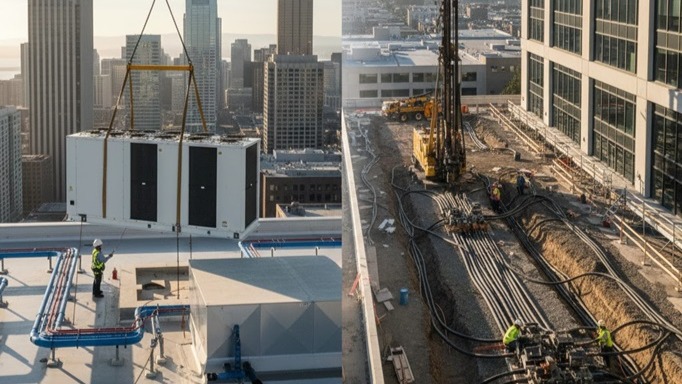
Commercial building owners and facility managers seeking sustainable heating solutions face fundamental technology choices between air source and ground source heat pump systems. Both technologies extract renewable heat from natural sources, delivering substantial efficiency improvements over conventional heating, yet differ significantly in installation costs, operating characteristics, and application suitability. This comprehensive comparison examines air source heat pump and ground source heat pump technologies, analysing technical performance, economic factors, and practical considerations that inform optimal selection for diverse commercial applications.
Understanding Heat Pump Technology Fundamentals
Both air source and ground source systems operate on identical thermodynamic principles, using refrigeration cycles to extract low-grade environmental heat and elevate it to useful temperatures for space heating and domestic hot water. Vapour compression cycles circulating refrigerant through evaporator, compressor, condenser, and expansion valve components achieve remarkable energy efficiency, delivering 3-4 units of heat for every unit of electricity consumed - efficiency impossible with any combustion-based heating technology.
The fundamental distinction lies in heat source characteristics. Air source heat pump systems extract heat from ambient outdoor air, a readily accessible but variable heat source fluctuating with weather conditions. Ground source heat pump systems extract heat from earth or groundwater maintaining relatively stable temperatures year-round, providing consistent performance independent of weather variations. This core difference cascades through installation requirements, performance characteristics, costs, and application suitability.
Renewable heat classification applies to both technologies under UK regulations, supporting decarbonisation objectives and qualifying for various incentive schemes. Heat extraction from environmental sources - whether air or ground - requires no fossil fuel combustion, eliminating direct carbon emissions at point of use. Operational emissions depend on electricity grid carbon intensity, progressively reducing as renewable generation expands. Both technologies align with net-zero commitments requiring heating sector decarbonisation.
Installation Costs and Project Budgets
Capital cost differences between air source and ground source installations significantly influence technology selection. Air source systems typically cost £800-£1,200 per kilowatt installed capacity including equipment, electrical infrastructure, and installation labour. A 100kW air source installation might cost £80,000-£120,000 depending on complexity, site conditions, and distribution system requirements.
Ground source installations incur substantially higher capital costs, typically £1,200-£2,000 per kilowatt capacity due to expensive ground works. Borehole drilling represents the largest cost component - commercial systems commonly require multiple boreholes 80-150 metres deep. Drilling costs vary with ground conditions, accessibility, and regional competition, averaging £40-60 per metre drilled. A 100kW ground source system requiring 10 boreholes at 120 metres each incurs drilling costs approaching £60,000 before equipment or other installation costs.
Horizontal ground loop arrays offer lower excavation costs than vertical boreholes but require substantial land area. Commercial-scale horizontal arrays need approximately 200-300 square metres per 10kW heating capacity. Few urban commercial sites possess adequate available land whilst maintaining 5-10 metre borehole separation from buildings, utilities, and boundaries. Consequently, commercial ground source installations predominantly use vertical boreholes despite higher costs.
Total project costs for equivalent heating capacity typically show ground source installations costing 50-80% more than air source alternatives. However, this capital cost premium must be evaluated against potential operating cost savings and longer equipment lifespans. Government incentive schemes historically offered higher payments for ground source installations reflecting higher capital costs, improving overall project economics. Current and future support mechanisms should be evaluated when comparing technologies.
Operating Efficiency and Performance
Operating efficiency directly impacts annual energy costs and carbon emissions throughout system life. Lowara commercial pumps supporting both types of systems must be properly specified to avoid excessive circulation energy consumption. Ground source systems generally achieve higher annual efficiency than air source due to stable ground temperatures optimising refrigeration cycle performance year-round.
Seasonal Coefficient of Performance (SCOP) provides realistic efficiency indicators accounting for varying operating conditions. Quality commercial air source systems achieve SCOP values 3.0-3.8 in UK climate conditions. Ground source systems typically achieve SCOP values 3.5-4.5, representing approximately 20-25% efficiency advantage. This efficiency premium translates directly into reduced electricity consumption - a ground source system consuming 25,000 kWh annually versus air source consuming 30,000 kWh for identical heating load.
Cold weather performance separates technologies most distinctly. Air source efficiency degrades significantly when outdoor temperatures drop below freezing, with capacity and COP reducing progressively as temperatures fall. Ground source systems maintain consistent efficiency regardless of outdoor temperature, drawing heat from ground maintaining 8-12°C year-round below 2 metre depth. This stability provides predictable performance and eliminates need for supplementary backup heating during extreme cold events affecting air source systems.
Part-load efficiency characteristics favour both technologies over conventional boilers. Inverter-driven compressors modulate capacity continuously, operating at reduced speeds during mild conditions whilst maintaining efficiency. This contrasts with fixed-speed boilers cycling on-off wastefully. Air source systems achieve excellent part-load performance during mild weather when operating conditions are optimal, whilst ground source maintains consistent efficiency across all load levels.
Space Requirements and Site Constraints
Air source outdoor units require accessible locations with adequate airflow clearances - typically 500mm fan discharge side, 300mm other sides. Commercial systems often comprise multiple smaller units distributed across sites rather than single large units. Rooftop placement often proves optimal, removing equipment from valuable ground-level space whilst reducing noise impact on building occupants. Structural capacity must accommodate equipment weight and vibration, occasionally necessitating reinforcement.
Acoustic considerations influence air source placement significantly. While modern equipment operates relatively quietly (sound power levels 55-70 dBA), extended operating hours typical in commercial applications affect neighbouring properties. Strategic positioning, acoustic barriers, and low-noise operating modes mitigate concerns whilst maintaining adequate performance. Planning permission sometimes imposes noise restrictions requiring careful design attention.
Ground source borehole installations require drilling access for specialised rigs - typically truck-mounted equipment needing firm ground conditions and overhead clearance exceeding 10 metres. Drilling locations must avoid underground services (drainage, utilities, foundations) whilst maintaining regulatory separations from water supplies and property boundaries. Permanent ground access remains unaffected post-installation - car parks, landscaping, and buildings can overlie ground loops once installed.
Plant room space requirements for ground source exceed air source due to manifolds distributing flow across multiple boreholes. Each borehole connects through dedicated pipework converging at manifolds before connecting to heat pump equipment. Manifold rooms must accommodate numerous pipes, valves, flow meters, and pressure gauges. Mikrofill pressurisation systems maintain proper pressure throughout extended ground loop circuits. Design adequate plant room space early in planning processes to avoid costly modifications later.
Maintenance Requirements and Reliability
Air source maintenance centres on preserving airflow efficiency and refrigerant system integrity. Quarterly filter cleaning or replacement prevents restriction and capacity loss. Annual coil cleaning removes accumulated dirt impairing heat transfer. F-Gas regulations mandate annual leak testing for commercial refrigerant quantities exceeding specified thresholds. Defrost systems require periodic verification ensuring proper operation during humid, freezing conditions. Fan bearings and motors typically last 10-15 years before replacement.
Ground source systems eliminate outdoor exposure reducing weather-related maintenance. Ground loops, once installed and pressure tested, operate maintenance-free for decades - expected lifespan exceeds 50 years with proper installation using quality materials. Heat pump equipment and circulation pumps require similar maintenance to air source though without outdoor filter cleaning. Antifreeze concentration testing every 2-3 years ensures adequate freeze protection and corrosion inhibition in ground loops.
Equipment reliability generally favours ground source due to stable operating conditions and reduced weather exposure. Air source compressors experience wider temperature swings and more frequent cycling stressing components. However, modern inverter-driven equipment in both technologies demonstrates excellent reliability with proper maintenance. Expected heat pump equipment lifespans approach 15-20 years for air source and 20-25 years for ground source, with ground loops surviving multiple heat pump replacements over their extended service life.
Service availability influences long-term reliability. Air source installations benefit from larger installer base and parts availability due to greater market adoption. Ground source specialists remain less numerous, though growing as market expands. Emergency service response may prove slower for ground source in some regions. Consider service provider proximity and capability when evaluating technologies, particularly for critical facilities requiring rapid response.
Environmental Considerations
Operational carbon emissions for both technologies depend primarily on electricity grid carbon intensity. Current UK grid electricity carbon intensity approximately 250 grams CO2 per kWh means heat pumps already reduce emissions substantially compared to gas heating despite electricity's higher carbon intensity than gas. As renewable generation expands, grid electricity progressively decarbonises, automatically improving heat pump carbon credentials without equipment modifications.
Ground source marginally reduces operational carbon through higher efficiency - approximately 15-20% fewer emissions than air source for equivalent heating. However, embodied carbon from manufacturing and installation differs significantly. Ground source drilling consumes substantial energy whilst borehole materials (HDPE pipework, grout) carry manufacturing carbon footprints. Comprehensive lifecycle carbon analysis should account for embodied carbon amortised over system life, not merely operational emissions.
Land use and ecological considerations favour air source requiring minimal site disturbance beyond equipment foundations. Ground source drilling temporarily disrupts areas during installation though sites restore quickly post-installation. Thermal impact on surrounding ground remains negligible for properly designed systems maintaining thermal balance - heat extracted during winter roughly equals heat rejected during summer cooling operation or naturally replenishes between heating seasons.
Refrigerant environmental impact deserves attention regardless of technology choice. Both systems use hydrofluorocarbon (HFC) refrigerants with global warming potential thousands of times greater than CO2. Proper system design minimising refrigerant charge, rigorous leak prevention, and responsible end-of-life recovery reduce impact. Lower-GWP refrigerant development promises improved environmental profiles for future systems. DAB circulation pumps efficiently move heat transfer fluids with minimal energy consumption and environmental impact.
Application-Specific Suitability
Office buildings benefit from either technology though factors influence optimal choice. Air source suits refurbishment projects where ground works prove disruptive or prohibitively expensive. Distributed outdoor units serving different floors or zones provide redundancy and simplified control. Ground source suits new-build offices where ground works integrate with construction activities. High efficiency reduces operating costs over decades-long building operation whilst stable performance improves occupant comfort.
Industrial facilities with substantial heating loads and available land suit ground source where operating cost reduction justifies higher capital investment. Robust industrial environments require rugged equipment - outdoor air source units withstand harsh conditions whilst ground source concentrates equipment indoors protected from elements. Process heat recovery opportunities may favour air source with heat recovery capabilities, simultaneously providing cooling where needed whilst capturing rejected heat for space heating or domestic hot water.
Retail applications typically prioritise customer experience over operating cost minimisation. Air source quick installation minimises business disruption during refurbishment. Aesthetic integration proves easier with compact outdoor units versus extensive ground works. Noise sensitivity in premium retail environments may favour ground source elimination of outdoor equipment, though modern air source operates quietly enough for most applications with proper acoustic design.
Educational facilities operate seasonal occupancy patterns with extended summer closures allowing ground thermal regeneration. Long planning horizons typical of educational institutions justify ground source capital premiums through decades of operating cost savings. Teaching opportunities from renewable heating installations provide educational value. However, constrained budgets often prioritise air source lower capital cost despite higher operating expenses.
Hybrid and Combined Systems
Some installations benefit from combining technologies, using ground source for base load with air source supplementing peak demand. This hybrid approach reduces ground loop size and drilling costs whilst maintaining efficiency for majority of annual heating hours. Air source handles coldest periods when efficiency drops acceptably given infrequent operation. Control strategies prioritise ground source operation, only enabling air source when ground source capacity proves insufficient.
Borehole thermal energy storage (BTES) offers exciting possibilities for large developments. Summer heat rejection into boreholes stores thermal energy extracted during winter heating. Balanced annual extraction and rejection maintains ground temperatures whilst providing seasonal heat storage improving overall system efficiency. BTES applications suit district heating schemes serving multiple buildings with diverse heating and cooling loads enabling thermal energy sharing.
Decision-Making Framework
Systematic technology evaluation weights multiple criteria according to organisational priorities. Capital budget constraints strongly influence selection - air source suits limited budgets whilst ground source requires substantial upfront investment justified by long-term savings and performance. Site characteristics including available land, ground conditions, and planning restrictions affect viability, particularly for ground source requiring suitable geology and drilling access.
Operating cost sensitivity depends on energy price expectations, building operating hours, and organisational financial time horizons. Facilities anticipating high heating demand over extended periods favour ground source efficiency advantages despite capital premiums. Buildings with lower heating loads or shorter operational planning find air source capital savings outweigh modest operating cost penalties.
Risk tolerance affects technology preference. Air source represents lower technical risk with proven performance, established installer base, and straightforward replacement if issues arise. Ground source involves geological uncertainties, specialist installation requirements, and higher stakes if performance disappoints. Conservative organisations may favour air source proven track record whilst innovative organisations embrace ground source performance potential.
Commercial heating technology selection demands careful analysis balancing capital costs, operating efficiency, site constraints, and organisational priorities. Air source heat pump systems offer lower capital investment, simpler installation, and widespread installer availability, suiting budget-conscious applications, constrained sites, and shorter investment horizons. Ground source heat pump systems deliver superior efficiency, stable performance, and excellent long-term economics despite higher upfront costs, favouring applications with suitable sites, long operational planning horizons, and emphasis on maximising efficiency and minimising operating costs. Professional assessment considering specific facility requirements, site characteristics, and financial parameters ensures optimal technology selection. National Pumps and Boilers provides expert consultation on both air source and ground source heat pump solutions, helping organisations evaluate options and select optimal technologies for their unique circumstances. For guidance on heat pump technology selection and system design, contact us to discuss your commercial heating requirements with experienced specialists.