

Boiler System Checks Before Replacement Parts Are Ordered
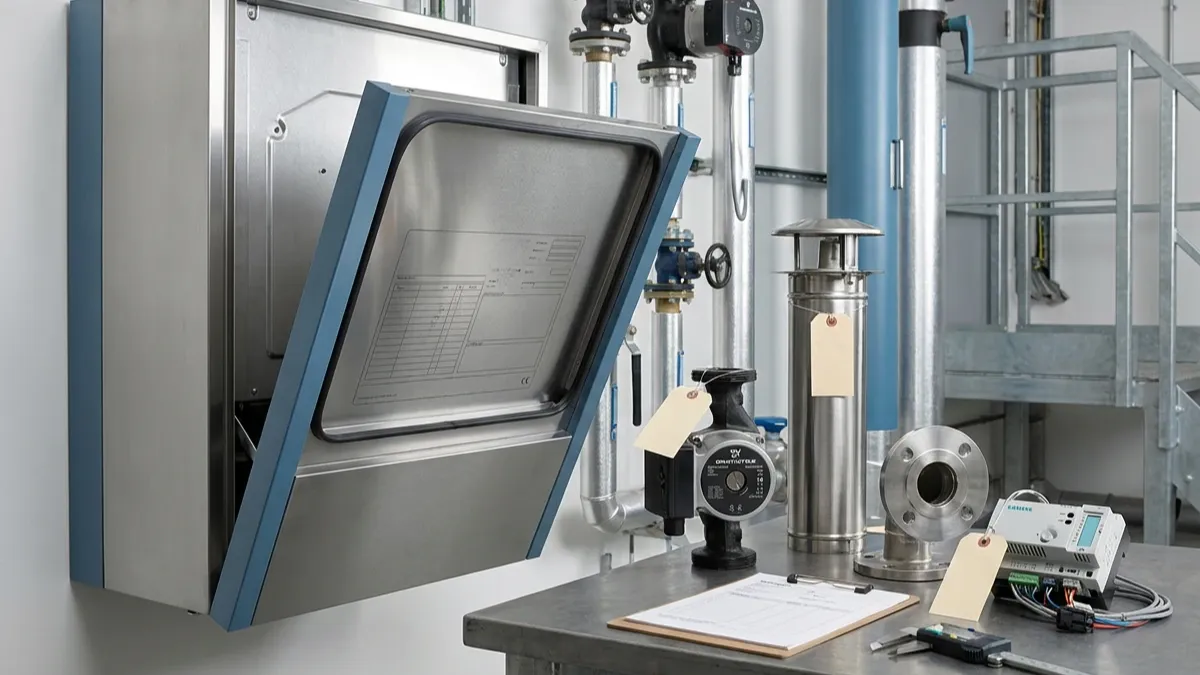
Boiler parts identification starts on the appliance, not in the basket. The boiler serial number, model and output on the data plate decide whether a flue kit, pump kit, header or control accessory can be ordered against that plant. A part name that looks right on a listing still belongs to a family, output band or flue size you have not proved yet.
The check is easy to skip when plant is down. Someone reads a function on a screen, matches it to a photograph of pipework, and builds the basket. The box that arrives can still be the wrong diameter, the wrong output band, or the wrong family. That is not a packing error. The identity was never on the ticket.
Write the identity first. Then name the part. If those two steps swap, the order becomes a guess and the first box comes back. A lockout, a noisy pump or a missing flame can explain why the search started. None of those is a part number.
Keep the buying question narrow. Is this published item listed against this boiler, this output, and this configuration? If that answer is not on the ticket, wait. Packing from a casing badge, a cascade schematic or last winter’s invoice is how the same wrong accessory gets ordered twice.
Start With the Boiler, Not the Basket
The boiler is the procurement reference. Horizontal flue kit, shunt pump, low-loss header and cascade frame are functions. They are not enough to pick stock. Two commercial boilers can share a marketing name and still split the accessory by output, flue diameter, control pack or cascade position.
Copy the manufacturer, model and rating from the inner plate. Copy the existing accessory reference from the component, the label, or the last packed ticket that already used that plate. Do not rebuild the identity from a plantroom whiteboard, a faded casing badge, or a memory of last winter’s job. Those notes help a site file. They do not pick a part.
A previous invoice is useful only when its characters still match the plate in front of you. If the invoice says one output and the plate says another, pack from the plate. The invoice already described a different appliance, a swapped body, or a copied ticket.
Photographs earn their place when they show characters, not atmosphere. One square frame of the data plate. One of the existing component label. One of the connection layout, plug type or bracket if that is what splits the accessory. A wide plantroom shot is not a plate shot. We will not zoom a corridor picture into a part number.
If a panel has to come off to see the plate, the photograph is still the plate, not the panel. A brand stripe on a door is casing print. Casing print does not go on the order.
Serial Number Beats a Shared Model Name
The boiler serial number is its own field. It is not a second copy of the model. Putting serial in the model box collapses two appliances into one wrong accessory. Putting the model in the serial box hides both.
On cascaded plant this matters more, not less. One asset tag on the room can cover a lead boiler, a lag boiler and a spare body that was never the same output. That is true on an industrial boiler cascade as well as a smaller commercial pair. The serial on the heat exchanger door, the underside, or the inner flap is the one that belongs on the ticket. A laminated schematic on the wall is a map. It is not the plate.
If two boilers in the same cascade share a family name, write both serials and say which body the part is for. Lead, lag and spare are notes after the identity, not a substitute for it. We pack against the body you photographed, not against the cascade story.
Older plantrooms collect leftover labels. A reseller sticker, a replaced casing, or a service tag over the model line will send the order into the wrong family. Lift enough of the tag to read the plate. Photograph that. Put the tag back if you must. Ordering from the sticker is casing-print behaviour.
If the plate is painted, dirty or punched metal with glare, tilt until the characters are readable. A white rectangle with no digits is not evidence. Write illegible for the field you cannot read and still copy the ones you can. A partial plate is a thinner ticket. It is not a licence to use the badge.
When a body has been swapped and the plate is blank, write blank after swap. Use whatever inner stamp remains, plus serial if a second sticker survived. Do not revive last year’s model from memory until the serial still matches.
Flue Kits Are Range-Bound
Flue accessories make the identity trap obvious. A horizontal kit, extension, bend or terminal is bounded by diameter and boiler range. The product name describes the route. The compatibility sits in the model and output band.
A listing that only says horizontal flue kit is a function. It does not tell you whether that kit is listed against a 55, 65, 90, 115 or 160 body, or against a different family. Some listings publish that band in the product name. Check the listed horizontal kit against the rating on the plate. If the plate sits outside that band, it is not a near-fit. There is no near-fit on flue parts. Wrong diameter or wrong family is a return.
Write flue type, diameter and terminal route after the identity block, not instead of it. Concentric, twin-pipe, horizontal, vertical, and roof terminal are notes. They cannot replace model and output. If you only know it is a horizontal kit because that is what came off, photograph the existing kit label and the boiler plate together. Read the diameter from the collar stamp or printed kit reference, not from the hole in the wall. A wall opening can be larger than the listed kit. We match plate plus kit label. We do not invent a kit from brickwork.
Extensions and bends follow the same rule. A bend that fits one diameter will not become the right bend because the plantroom is tight. Tight plantrooms still need the listed diameter. If the existing run uses mixed leftover pieces, say so on the ticket. Mixed leftover pieces are not a published kit.
Do not ask us to confirm that a flue arrangement is acceptable on site. That is a competent-person decision on the job. The commercial question is whether this published kit matches this boiler family and output. Keep the enquiry inside that line.
Accessories Follow the Same Identity Rule
The same split sits on pump kits, headers, cascade frames, sensors and interface modules. Stay in the make printed on the plate. If that make matches the family on the kit listing you just checked, the rest of that family's accessories still divide by output and function. A shunt pump kit for one rating is not a shunt pump kit for every body in the room. Open the accessory list only after the plate make is copied, then check the listing against that rating before the part name is treated as enough.
If the plate is a different make, close the list you had open for the last job. Similar pipework is not a part number. A door badge still needs the inner plate. If the door was swapped and the plate is another make, pack the plate, not the door.
Controls add a second split. Interface modules, outdoor sensors, cascade controls and BMS-related connections depend on what is already fitted. Photograph the existing module label and the boiler plate. Write the control variant in a note after the identity. Do not order a cascade control because the schematic shows a cascade. The schematic can outlive the hardware.
Hydraulic extras follow output and layout. Low-loss headers, closely spaced tees and cascade frames are listed against boiler ranges. Replacing an expansion tank on a boiler is the same check: copy the vessel label and the boiler plate before the replacement is named. A lookalike expansion vessel from the last job is still the wrong pick if the plate and the label disagree. If the plant has been altered, the old accessory note may describe a layout that is no longer there. Say what is fitted now. An old parts list is support, not a pick, until it matches the plate and the hardware in the room.
We stock published accessories. We do not convert a symptom into a kit. Noise, lockout, no flow and high pressure are reasons someone started looking. They are not the accessory name.
Keep One Order Record
The useful ticket can be read by someone who has not stood in that plantroom. It should carry boiler parts identification in one block, with the boiler serial number in its own field:
- Manufacturer and model, copied from the inner plate.
- Output or rating, copied exactly as printed.
- Boiler serial number, copied carefully, with a square plate photograph.
- Existing part reference from the component, label, packaging or last packed ticket that used this plate.
- Required item, named as the published part or as a clear function plus the plate fields above.
- Configuration notes: flue type and diameter, control variant, cascade position, connection or plug detail that actually splits the accessory.
That is the whole commercial record. Fault stories, who last attended, and whether the boiler should go back into service sit off this block. They can live in a site notebook. They do not choose the part.
If the boiler has been altered, say what changed. Controls swapped, cascade restaged, flue rerouted, body replaced. An old packed ticket is gold when the serial still matches. It is junk when the serial moved and nobody rewrote the file.
Keep a short plate file per boiler: make, model, output, serial, last packed accessory, date. That file is merchant memory. It is not a service history and it is not a diagnosis.
Conclusion
Order the part against the plate you photographed, not against the story that started the search. Manufacturer, model, output and serial first. Existing accessory label next. Range-bound flue kits and family-bound accessories after that. If those characters are on the ticket, the basket can be built. If they are not, wait for the photograph.
When the identity block is complete and you need current availability, pricing or a published replacement against that exact reference, get in touch. Ask whether the listed item matches this family and output. Do not ask us to confirm a fault, pass a flue route, or put the boiler back into service. That work stays on site. We pack the part that matches the plate.