
 -
- Choosing Pumps for Commercial Chilled Water Systems
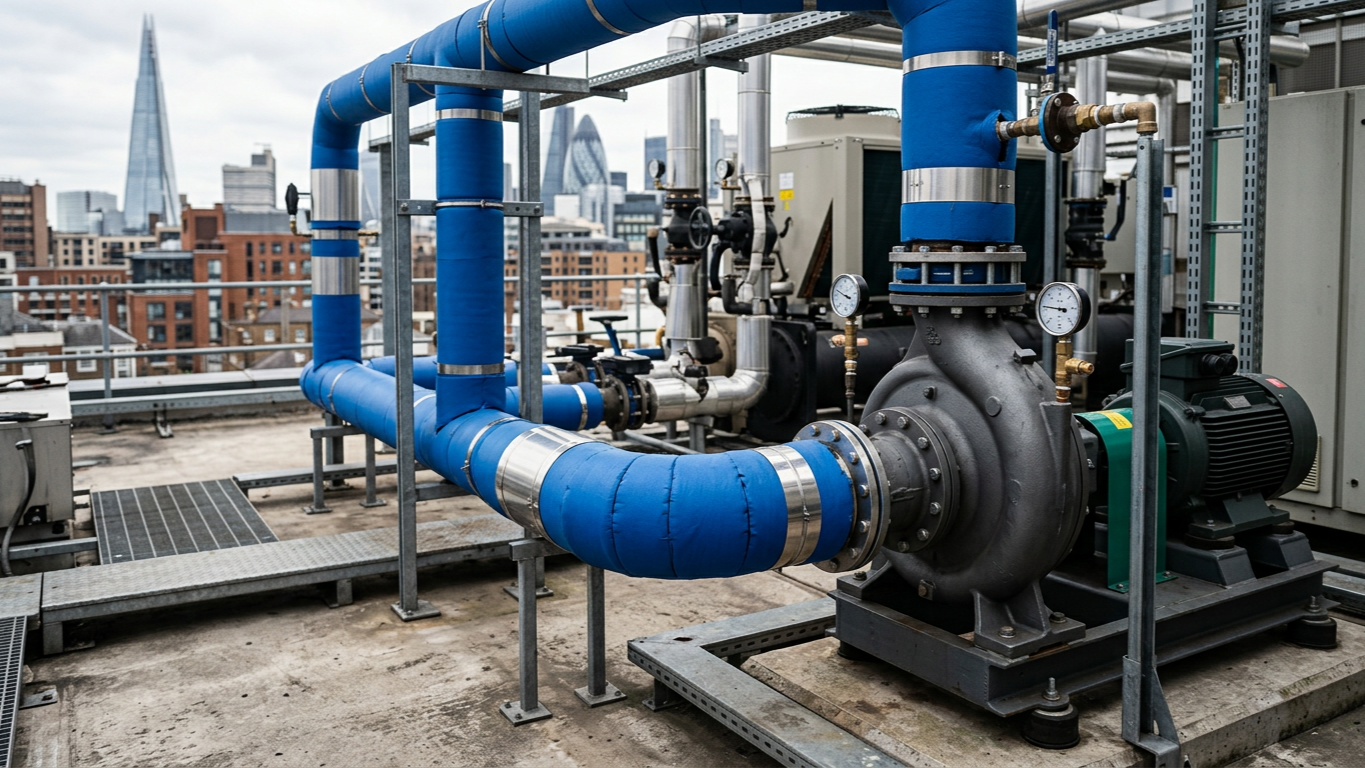
Commercial chilled water pumps demand consistent performance under demanding conditions. These systems cool everything from data centres to hospital operating theatres, where equipment failure creates genuine operational risk. The HVAC chiller pump selection process determines whether a building maintains stable temperatures or faces costly downtime and emergency repairs.
National Pumps and Boilers supplies commercial chilled water pumps across applications ranging from 50kW office installations to multi-megawatt industrial facilities. The technical requirements differ substantially from domestic heating systems - flow rates reach hundreds of cubic metres per hour, head pressures exceed 10 bar, and pumps operate continuously for months without shutdown.
Understanding Commercial Chilled Water System Requirements
Chilled water systems operate as closed-loop networks where pumps circulate water between chillers and terminal units. The water temperature typically ranges from 6°C to 12°C on the flow side, returning at 12°C to 18°C after absorbing heat from the building. This narrow temperature differential - usually 6°C - means commercial chilled water pumps must move substantial volumes to deliver the required cooling capacity.
System Flow and Head Calculations
A 500kW cooling load with a 6°C differential requires approximately 20 litres per second flow rate. The pump must overcome static head (vertical height), friction losses through pipework, and pressure drops across heat exchangers, control valves, and terminal units. Total system head commonly ranges from 15 to 40 metres for typical commercial installations, though complex buildings with multiple risers may demand 60 metres or more.
System volume affects pump selection indirectly through pipe sizing and velocity considerations. Engineers typically design for water velocities between 0.5 and 2.0 metres per second - slower flow reduces noise and erosion, whilst faster flow minimises pipe diameter and installation costs. The Grundfos pumps range includes models specifically rated for these commercial flow velocities.
Primary vs Secondary Pumping Configurations
Commercial installations commonly use either primary-only or primary-secondary pumping arrangements. Primary-only systems employ variable-speed pumps that modulate flow based on demand, with the chiller flow rate matching the system flow rate. This configuration suits smaller installations below 300kW where a single pump can handle the full range of operating conditions.
Primary-Secondary System Benefits
Primary-secondary systems separate chiller circulation (primary loop) from building distribution (secondary loop), connected via a low-loss header or common pipe. The primary pumps maintain constant flow through chillers, protecting them from low-flow conditions that cause freezing or inefficient operation. Secondary pumps respond to building demand independently, often using variable-speed drives to match actual cooling requirements.
The decoupling arrangement provides several advantages for larger systems. Multiple chillers can stage on and off without disrupting building flow. Pumps can be sized more accurately for their specific duties. Maintenance on one loop doesn't require shutting down the entire system. Primary-secondary configurations are typically recommended for installations above 500kW or buildings with significant load diversity.
Pump Types for Commercial Chilled Water Applications
Understanding pump types is crucial for effective HVAC chiller pump selection.
End-Suction Centrifugal Pumps
End-suction centrifugal pumps dominate smaller commercial applications up to approximately 30 litres per second. These pumps mount horizontally with suction and discharge flanges at 90 degrees, offering compact installation and straightforward maintenance. The Wilo pumps commercial range includes end-suction models with built-in variable-speed drives and pressure sensors for standalone operation.
In-Line Circulators
In-line circulators suit retrofit applications where space constraints prevent traditional pump installation. The motor and impeller mount directly in the pipework, with suction and discharge on the same centreline. This configuration simplifies installation in existing plant rooms, though it limits maximum power to approximately 15kW due to bearing and shaft design constraints.
Split-Case Pumps
Split-case pumps become economical for larger systems above 50 litres per second. The horizontally-split casing allows impeller access without disconnecting pipework - a significant advantage for high-availability applications. These pumps handle flows exceeding 200 litres per second with efficiencies reaching 85% at duty point. The Lowara pumps commercial range includes split-case models designed specifically for continuous-duty chilled water service.
Vertical Multistage Pumps
Vertical multistage pumps provide high head from a small footprint, making them suitable for high-rise buildings where static head dominates the system curve. Multiple impellers mounted on a common shaft generate head incrementally, with each stage contributing 10-20 metres. These pumps operate quietly and require minimal floor space, though motor access for maintenance demands adequate overhead clearance.
Motor Control and Variable-Speed Operation
Fixed-speed pumps operate at constant flow regardless of building demand, using control valves to throttle flow to individual zones. This approach wastes substantial energy - a valve closed to 50% position still requires the pump to generate full pressure, converting the excess energy to heat and noise. Fixed-speed operation only makes sense for constant-load applications or where electrical infrastructure cannot support variable-speed drives.
Variable-Speed Drive Benefits
Variable-speed drives (VSDs) adjust pump speed to match actual demand, reducing energy consumption by up to 70% in typical commercial buildings. Power consumption follows the cube law - reducing speed by 20% cuts energy use by approximately 50%. A 15kW pump running at 80% speed consumes roughly 7.5kW, delivering substantial operational savings over the system's 15-20 year service life.
Modern commercial chilled water pumps integrate VSDs directly into the pump assembly, eliminating separate control panels and simplifying installation. These pumps accept a 0-10V or 4-20mA control signal from the building management system, automatically adjusting speed to maintain setpoint pressure. Integrated drives also provide diagnostic data via BACnet or Modbus protocols, enabling predictive maintenance strategies.
Pressure Control Strategies
Pressure control strategy significantly affects system performance. Constant differential pressure control maintains fixed pressure regardless of flow, ensuring adequate pressure at the furthest terminal unit but wasting energy at partial load. Variable differential pressure control reduces the setpoint as flow decreases, following the natural system curve and maximising energy savings whilst maintaining adequate pressure for all zones.
Hydraulic Performance and Duty Point Selection
The pump duty point represents the intersection of the pump curve and system curve - the operating condition where pump head matches system resistance at the required flow rate. Selecting pumps that operate near their best efficiency point (BEP) at design conditions ensures reliable performance and minimises energy consumption, making this a critical aspect of HVAC chiller pump selection.
Operating Range Considerations
Operating significantly left or right of BEP creates problems. Running at low flow (left of BEP) increases radial thrust on bearings, raises internal recirculation, and generates heat that can damage seals and bearings. Operating at high flow (right of BEP) overloads the motor, increases vibration, and may cause cavitation if net positive suction head (NPSH) requirements aren't met.
Commercial installations rarely operate at design conditions - most buildings require full cooling capacity only a few hundred hours annually. This reality demands careful consideration of part-load performance. A pump selected for peak efficiency at 100% flow may operate inefficiently at the 40-60% flow rates that dominate actual operation. Reviewing pump curves across the full operating range, not just at design duty, ensures optimal HVAC chiller pump selection.
Avoiding Oversizing Errors
Oversizing pumps - a common specification error - compounds these problems. A pump rated for 30 litres per second installed in a system requiring 20 litres per second operates far right of BEP, wasting energy and reducing service life. Control valves throttle the excess capacity, converting the wasted energy to noise and heat. Accurate load calculations and proper pipe sizing prevent this costly mistake.
Material Selection and Corrosion Resistance
Chilled water systems operate as closed loops with minimal oxygen ingress, creating a relatively benign corrosive environment compared to open systems. Cast iron pump bodies with bronze or stainless steel impellers suit most applications, offering good corrosion resistance at reasonable cost. The NPB range includes cast iron pumps designed specifically for closed-loop commercial service.
Stainless Steel Construction
Stainless steel construction becomes necessary for systems using glycol antifreeze or operating in coastal environments with high chloride levels. Grade 316 stainless steel provides superior pitting resistance compared to 304, particularly in systems with extended shutdown periods that allow oxygen concentration. The additional cost - typically 40-60% above cast iron - proves worthwhile for critical applications where failure creates significant operational impact.
Shaft Seals and Bearings
Shaft seals prevent water leakage whilst allowing shaft rotation. Mechanical seals have replaced traditional gland packing in commercial applications, offering leak-free operation and eliminating the maintenance burden of regular adjustment. Carbon-ceramic seal faces suit standard chilled water applications, whilst silicon carbide faces provide extended service life in systems with poor water quality or abrasive particles.
Bearing selection affects reliability and maintenance requirements. Ball bearings suit smaller pumps up to approximately 15kW, offering long service life with minimal maintenance. Larger pumps use sleeve bearings lubricated by the pumped fluid, requiring no external lubrication but demanding clean water free from debris. External grease-lubricated bearings suit systems where water quality cannot be guaranteed.
System Protection and Monitoring
Commercial chilled water pumps require protection against operating conditions that cause damage. Motor overload protection prevents burnout from excessive current draw, whilst phase protection detects supply problems that would otherwise destroy three-phase motors. These protections should integrate with the building management system to provide early warning of developing problems.
Critical Protection Systems
Dry-run protection stops pumps when water flow ceases, preventing seal and bearing damage from inadequate cooling. This protection proves essential for systems with automatic makeup water, where leaks might drain the system overnight. Temperature sensors in the motor winding provide direct measurement of thermal stress, shutting down before damage occurs.
Performance Monitoring
Vibration monitoring detects bearing wear, impeller damage, and cavitation before catastrophic failure. Permanently-mounted sensors continuously measure vibration amplitude and frequency, comparing against baseline values to identify developing problems. This predictive maintenance approach prevents unexpected failures and allows planned repairs during scheduled shutdowns.
Pressure and flow monitoring verify system performance and identify efficiency degradation. Differential pressure across the pump confirms head generation, whilst flow meters measure actual delivery against design values. Declining performance indicates impeller wear, system fouling, or control problems that reduce efficiency and increase operating costs.
Energy Efficiency and ErP Compliance
The Energy-related Products (ErP) Directive establishes minimum efficiency standards for commercial pumps sold in the UK and EU. These regulations mandate minimum Energy Efficiency Index (EEI) values based on pump type and size, effectively eliminating the least efficient models from the market. Compliance verification requires manufacturers to test and publish performance data according to standardised procedures.
EEI Calculation and Benefits
The EEI calculation considers full-load and part-load efficiency across the pump's operating range, weighted toward the partial-load conditions that dominate actual operation. This methodology rewards pumps with flat efficiency curves that maintain performance across varying flow rates. Variable-speed pumps achieve substantially better EEI values than fixed-speed equivalents, reflecting their ability to reduce speed at partial load.
Beyond regulatory compliance, energy efficiency directly affects operational costs. A 10kW pump operating 8,000 hours annually consumes 80,000 kWh - approximately £16,000 at typical commercial electricity rates. Improving efficiency from 65% to 75% saves roughly £2,000 annually, recovering the premium cost of higher-efficiency equipment within 2-3 years. Over a 15-year service life, the cumulative savings exceed £30,000.
Seasonal Efficiency Considerations
Seasonal efficiency varies substantially from design-point efficiency. A pump achieving 80% efficiency at full load might average only 60% efficiency across actual operating conditions if poorly matched to the system. Reviewing manufacturer performance data across the full operating range - not just at duty point - reveals true operational efficiency and lifecycle costs, ensuring proper HVAC chiller pump selection.
Installation Considerations and Commissioning
Pump location affects performance and maintenance accessibility. Installing pumps on the chiller return (warm side) provides the highest available NPSH, reducing cavitation risk. This location also ensures the pump operates at the system's lowest pressure point, minimising seal stress and leakage risk. Adequate clearance around the pump - minimum 1 metre on the motor side - allows motor removal and impeller access without system modifications.
Pipework Configuration
Pipework configuration influences pump performance significantly. Straight pipe runs of 5-10 diameters upstream and 2-3 diameters downstream reduce turbulence and improve efficiency. Elbows immediately before the pump suction create uneven flow distribution across the impeller, increasing vibration and reducing performance. Flexible connectors isolate pump vibration from the pipework, preventing noise transmission throughout the building.
Isolation valves on suction and discharge allow pump removal without draining the entire system. These valves should be full-bore ball or gate valves that introduce minimal pressure drop when fully open. Check valves prevent reverse flow when multiple pumps operate in parallel, protecting against backflow through idle pumps. The pump valves range includes isolation and check valves rated for commercial chilled water service.
Commissioning Procedures
Commissioning verifies actual performance against design predictions. Flow measurement at various pump speeds confirms the pump curve matches manufacturer data. Pressure measurements throughout the system identify restrictions and verify control valve operation. Power consumption measurements validate efficiency claims and establish baseline values for future performance monitoring. Comprehensive commissioning data collection supports warranty claims and troubleshooting.
Redundancy and Reliability Strategies
Critical facilities require pump redundancy to maintain operation during equipment failure or maintenance. The N+1 configuration provides one standby pump for every N operating pumps - a three-pump system might operate with two duty pumps and one standby. This arrangement ensures full capacity during single-pump failure whilst allowing scheduled maintenance without system shutdown.
Duty-Standby Arrangements
Duty-standby arrangements suit smaller systems where a single pump handles the full load. Two identical pumps alternate weekly or monthly, equalising wear and maintaining both pumps in operational condition. When the duty pump fails, the standby pump starts automatically within seconds, preventing system disruption. This configuration costs less than N+1 but provides no additional capacity during peak demand.
Multiple Pump Systems
Multiple smaller pumps often prove more reliable than a single large pump, particularly for systems above 100 litres per second. Four 25-litre-per-second pumps provide better turndown capability than one 100-litre-per-second pump, maintain partial capacity during failures, and allow maintenance without a complete system shutdown. Variable-speed operation optimises efficiency by running the minimum number of pumps at higher speed rather than all pumps at reduced speed.
Lead-Lag Control
Lead-lag control rotates pump operation to equalise runtime and wear. The control system designates one pump as lead, starting it first and running it preferentially. When demand exceeds the lead pump capacity, the lag pump starts to provide additional flow. The control system periodically swaps lead and lag designations, preventing one pump from accumulating excessive runtime whilst the other deteriorates from disuse.
Lifecycle Costs and Maintenance Planning
Initial purchase price represents only 10-20% of total lifecycle costs for commercial pumps - energy consumption dominates operating expenses. A £5,000 pump consuming £3,000 of electricity annually costs £50,000 over 15 years, making efficiency improvements that reduce annual consumption by even 10% economically attractive. Lifecycle cost analysis should weigh energy costs heavily when comparing pump options.
Maintenance Requirements
Maintenance requirements affect both direct costs (labour and parts) and indirect costs (system downtime and lost productivity). Pumps with integrated VSDs reduce maintenance burden by eliminating separate control panels and associated wiring. Mechanical seals eliminate the regular adjustment required by gland packing. Permanently-lubricated bearings remove the need for periodic greasing and associated labour costs.
Spare Parts Availability
Spare parts availability becomes critical for systems requiring high availability. Pumps from established manufacturers like Grundfos, Wilo, and Lowara benefit from extensive parts networks and rapid delivery, minimising downtime during repairs. Proprietary designs or discontinued models may face weeks-long parts delays, creating unacceptable operational risk for critical facilities.
Planned Maintenance Strategy
Planned maintenance extends service life and prevents unexpected failures. Annual inspection identifies developing problems - bearing noise, seal weeping, coupling wear - before they cause catastrophic failure. Five-year overhauls replace wearing components (seals, bearings, couplings) at predetermined intervals, preventing age-related failures. This proactive approach costs substantially less than emergency repairs and eliminates the operational disruption of unexpected equipment failure.
Conclusion
Selecting commercial chilled water pumps requires balancing hydraulic performance, energy efficiency, reliability, and lifecycle costs. The pump must deliver the required flow and head whilst operating near the best efficiency point across the full range of operating conditions. Variable-speed drives reduce energy consumption substantially, recovering their additional cost within 2-3 years through operational savings.
Material selection, monitoring systems, and redundancy strategies affect long-term reliability and maintenance costs. Proper installation and commissioning verify performance and establish baseline data for future troubleshooting. National Pumps and Boilers supplies commercial chilled water pumps from leading manufacturers, including Grundfos, Wilo, and Lowara, backed by technical support and rapid parts availability.
Critical applications demand careful specification and professional installation to ensure reliable operation. For technical guidance on HVAC chiller pump selection, system design, or performance troubleshooting, contact us for expert advice tailored to specific commercial installations.