

Choosing Pumps for Saltwater and Coastal Environment Applications
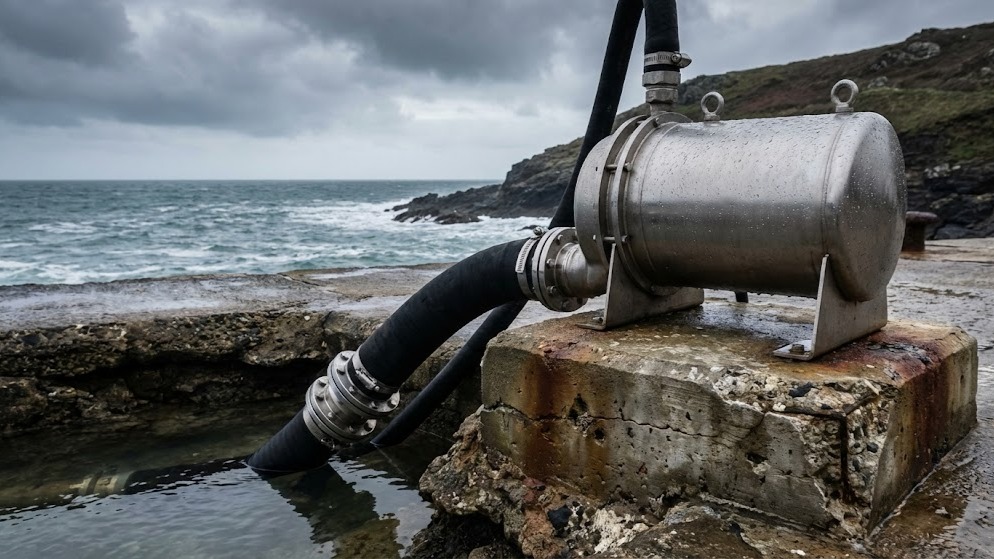
Saltwater destroys standard pumps in months, not years. Coastal installations face accelerated corrosion, seal degradation, and bearing failure that landlocked systems never encounter. The difference between a pump lasting 18 months and 15 years often comes down to material selection and sealing technology - decisions made at the specification stage, not after the first failure.
National Pumps and Boilers supplies corrosion-resistant pumping equipment specifically engineered for marine environments, where salt-laden air and brackish water demand materials and construction methods that exceed standard commercial specifications.
Understanding Saltwater Corrosion Mechanisms
Saltwater attacks pump components through multiple simultaneous mechanisms. Chloride ions penetrate protective oxide layers on metal surfaces, initiating pitting corrosion that spreads beneath seemingly intact surfaces. Galvanic corrosion accelerates when dissimilar metals contact in saltwater, creating electrochemical cells that rapidly consume anodic materials.
Coastal environments compound these challenges. Salt spray carries hundreds of metres inland, depositing corrosive residue on external pump housings, motor casings, and mounting hardware. Humidity levels above 70% prevent salt crystals from fully drying, maintaining continuous electrolyte films that sustain corrosion even between direct water exposures.
Standard cast iron pumps typically fail within 6-18 months in direct saltwater service. Bronze components last longer but still suffer dezincification - a selective corrosion process that leaves porous, weakened copper structures. Even stainless steel grades below 316 prove inadequate for continuous saltwater exposure, developing crevice corrosion around fasteners and gasket interfaces.
Material Selection for Marine Durability
Stainless Steel Options for Saltwater Pump Selection
Stainless Steel 316L provides baseline corrosion resistance for saltwater applications. The molybdenum content (2-3%) enhances resistance to chloride-induced pitting compared to 304 grades. The "L" designation indicates low carbon content, reducing carbide precipitation at weld zones that would otherwise create corrosion-susceptible areas.
For pump housings and impellers in continuous saltwater service, 316L stainless steel typically delivers 10-15 years service life when properly maintained. However, crevice corrosion remains a concern at gasket surfaces and threaded connections, requiring regular inspection intervals.
Super Duplex Stainless Steels (2507, Zeron 100) offer superior performance in aggressive marine conditions. These alloys combine austenitic and ferritic microstructures, achieving pitting resistance equivalent numbers (PREN) above 40 - compared to approximately 25 for 316L. This translates to measurably longer service life in warm saltwater and brackish conditions.
Grundfos pumps in super duplex construction serve desalination plants and offshore platforms where failure costs exceed equipment value by orders of magnitude. The material premium - typically 2-3x standard stainless steel - proves economical when lifecycle costs account for replacement labour and system downtime.
Bronze and Composite Materials
Bronze Alloys retain relevance for specific saltwater applications, particularly lower-pressure circulation systems. Aluminium bronze (C95400) and nickel-aluminium bronze (C95800) resist dezincification while maintaining excellent wear characteristics for impellers and wear rings. These alloys suit pump components experiencing sliding contact, where hardness and galling resistance matter alongside corrosion protection.
Composite and Polymer Materials eliminate metallic corrosion entirely. Glass-reinforced polypropylene, PVDF (polyvinylidene fluoride), and fibre-reinforced epoxy composites provide complete immunity to galvanic and pitting corrosion. Temperature limits (typically 60-80°C for thermoplastics) restrict applications, but for ambient-temperature saltwater circulation, composites often outlast metallic alternatives at lower installed cost.
Seal Technology for Saltwater Service
Mechanical seal failure causes 60-70% of pump breakdowns in marine environments. Standard elastomer seals swell, harden, or degrade rapidly in saltwater, losing sealing pressure and allowing abrasive salt crystals to enter bearing cavities.
Double Mechanical Seal Systems
Double Mechanical Seals with clean barrier fluid circulation protect seal faces from saltwater contact. The barrier fluid - typically glycol-water mixture or synthetic oil - operates at slightly higher pressure than the pumped medium, preventing saltwater ingress. This configuration extends seal life from months to years in continuous saltwater duty.
Seal face materials require careful matching. Silicon carbide versus silicon carbide provides excellent wear resistance and chemical compatibility with saltwater. Carbon versus ceramic combinations cost less but wear faster, particularly when suspended solids enter the seal chamber. For critical applications, tungsten carbide faces offer maximum durability, though at a significant cost premium.
Flushing and Cooling Requirements
Flushing and Cooling Systems remove heat and contaminants from mechanical seal chambers. API Plan 32 (flush from pump discharge) or Plan 11 (recirculation from seal chamber) prevent salt crystal accumulation on seal faces. In warm saltwater above 30°C, external cooling via Plan 23 (cooling jacket) or Plan 31 (cyclone separator with heat exchanger) maintains seal face temperatures within acceptable operating ranges.
Bearing Protection in Coastal Installations
Saltwater contamination destroys pump bearings through multiple pathways. Direct water ingress washes away lubricating grease, causing metal-to-metal contact and rapid wear. Salt residue acts as a grinding compound, accelerating bearing race degradation. Even salt-laden air moisture penetrates standard bearing seals, corroding bearing surfaces during idle periods.
Sealed Bearing Assemblies
Sealed Bearing Assemblies with multiple sealing stages prevent saltwater entry. Labyrinth seals create tortuous paths that centrifugal force and pressure differentials protect. Combined with spring-loaded lip seals using fluoroelastomer materials (Viton, Kalrez), these arrangements withstand direct spray exposure and occasional submersion.
Bearing materials themselves require an upgrade for marine service. Standard chrome steel bearings corrode rapidly in saltwater environments. Stainless steel bearings (440C, martensitic stainless) provide corrosion resistance, though with slightly reduced load capacity compared to chrome steel equivalents. For the most aggressive environments, ceramic hybrid bearings (ceramic balls, stainless steel races) eliminate bearing corrosion entirely while offering superior performance in contaminated lubricant conditions.
Lubrication Strategy
Lubrication Strategy matters as much as bearing specification. Calcium sulfonate complex greases resist water washout better than conventional lithium-based formulations. Synthetic PAO (polyalphaolefin) or PAG (polyalkylene glycol) base oils maintain viscosity and protective films in saltwater-contaminated conditions where mineral oils fail.
Electrical and Motor Considerations
Electric motors driving saltwater pumps face corrosion threats to external housings, terminal boxes, and shaft seals. Standard IP55-rated enclosures prove inadequate - salt creep penetrates cable glands and ventilation openings, corroding windings and electrical connections.
Marine-Duty Motor Requirements
Marine-Duty Motors with IP66 or IP68 ratings provide sealed construction that excludes salt spray and moisture. Stainless steel or epoxy-coated aluminium housings resist external corrosion. Cable entries use multiple O-ring seals with stainless steel compression glands. Terminal boxes incorporate moisture-resistant connections and conformal coatings on electrical components.
For submersible applications in saltwater, motor construction becomes more critical. Resin-encapsulated stator windings prevent water ingress to electrical components. Mechanical shaft seals require silicon carbide faces and fluoroelastomer O-rings. Cable entries must achieve permanent watertight integrity - the single most common failure point in submersible saltwater pumps.
Electrical Protection Systems
Electrical Protection systems monitor insulation resistance and detect water ingress before catastrophic failure. Thermistors embedded in motor windings provide overtemperature protection when cooling water flow reduces or blockages develop. Ground fault detection systems identify insulation degradation early, preventing complete motor burnout.
System Design Factors for Coastal Environments
Pump selection represents only part of the saltwater system's durability. Installation practices and system design determine whether equipment achieves design life or fails prematurely.
Mounting and Support Structures
Mounting and Support Structures require the same material consideration as pumps themselves. Mild steel baseplates corrode rapidly in salt spray, transferring loads unevenly and causing shaft misalignment. Stainless steel fabrications, hot-dip galvanized steel (minimum 85 microns coating thickness), or fibre-reinforced polymer structures provide long-term dimensional stability.
Grouting pump baseplates with epoxy-based non-shrink grout prevents crevice corrosion at the concrete interface. Standard cement-based grouts retain moisture and create corrosion cells at embedded steel components.
Pipework and System Components
Pipework Materials must match pump construction for corrosion resistance. Expansion vessels and system components in PVC-U, PVC-C, or HDPE eliminate metallic corrosion while maintaining structural integrity in brackish water and saltwater service. Flanged connections using stainless steel bolting and full-face EPDM or Viton gaskets prevent leakage and galvanic corrosion at joints.
Where metallic piping remains necessary, super duplex stainless steel or 6% molybdenum stainless alloys (254 SMO, AL-6XN) provide durability matching pump materials. Mixing metallurgies creates galvanic couples - a stainless steel pump connected to copper-nickel piping experiences accelerated corrosion at the dissimilar metal junction unless electrically isolated with dielectric unions.
Cathodic Protection Methods
Cathodic Protection extends equipment life in direct saltwater immersion. Sacrificial anodes (aluminium, magnesium, or zinc alloys) corrode preferentially, protecting pump housings and pipework. Impressed current systems provide more controlled protection for large installations, though requiring electrical power and periodic maintenance.
For coastal pump applications in salt spray zones rather than direct immersion, cathodic protection proves less effective than proper material selection and protective coatings.
Performance Characteristics in Saltwater
Saltwater's physical properties affect pump performance compared to freshwater operation. Density approximately 2.5% higher than freshwater increases power requirements proportionally - a pump requiring 10 kW in freshwater service needs 10.25 kW for equivalent flow and head in seawater.
Viscosity variations with temperature and salinity concentration affect pump efficiency and NPSH requirements. Warm saltwater (30°C) exhibits lower viscosity than cold freshwater (5°C), improving pump efficiency slightly but reducing available NPSH margin.
Suspended Solids and Wear
Suspended Solids in coastal and estuarine waters accelerate wear on impellers and wear rings. Sand, shell fragments, and biological matter act as abrasive grinding compounds. Pumps for these applications require increased clearances, hardened impeller materials, or semi-open impeller designs that pass solids without binding.
Lowara pumps with wear-resistant coatings and replaceable wear components serve coastal cooling water systems where suspended solids content reaches 50-100 mg/L. Maintenance intervals extend when impellers and wear rings use tungsten carbide or ceramic coatings, though initial cost increases substantially.
Maintenance Protocols for Marine Pumps
Saltwater pumps require more frequent inspection and maintenance than freshwater equivalents. Establishing preventive maintenance schedules prevents catastrophic failures and extends equipment life.
Weekly and Monthly Inspections
Weekly Inspections should verify seal integrity (no leakage), bearing temperature (within 40°C of ambient), vibration levels (below 4.5 mm/s RMS), and motor current draw (within nameplate specifications). Unusual noise, temperature rise, or vibration indicates developing problems requiring immediate investigation.
Monthly Maintenance includes visual inspection for external corrosion, testing seal flush systems, verifying cooling water flow, and checking mounting bolt torque. Salt deposits on external surfaces require removal with freshwater washing - allowing salt accumulation creates persistent moisture films that accelerate corrosion.
Quarterly and Annual Service
Quarterly Service involves mechanical seal inspection (if accessible), bearing lubrication (if grease-lubricated rather than oil bath), electrical connection tightness verification, and insulation resistance testing. Declining insulation resistance (below 2 megohms) indicates moisture ingress requiring immediate attention.
Annual Overhaul typically includes mechanical seal replacement, bearing inspection and replacement if wear is evident, impeller wear measurement, and internal component inspection for corrosion or erosion damage. Proactive component replacement before failure prevents secondary damage to expensive pump housings and shafts.
Specification Considerations for Coastal Projects
Specifying pumps for saltwater and coastal applications requires detailed environmental and operational information beyond standard pump selection parameters.
Water Chemistry and Environmental Data
Water Chemistry data should include salinity (parts per thousand), pH, temperature range, dissolved oxygen content, and biological fouling potential. Brackish water (5-30 ppt salinity) requires different material selections than full-strength seawater (35 ppt). Low pH conditions (below 7) accelerate corrosion even in corrosion-resistant alloys.
The Installation Environment classification determines the required protection levels. Direct immersion, splash zone, salt spray zone (within 500m of coast), or coastal atmosphere (500m-5km from coast) each demand different material and coating specifications. Wind-driven salt spray reaches further inland on exposed coastlines than sheltered locations.
Duty Cycle Considerations
Duty Cycle affects material selection economics. Continuous-duty pumps (8000+ hours annually) justify premium materials that intermittent-duty installations cannot economically support. A pump operating 2000 hours annually might achieve acceptable life in 316L stainless steel where continuous duty demands super duplex construction.
Contact us for application-specific guidance on saltwater pump selection, including material recommendations, seal configuration, and maintenance requirements for coastal and marine installations.
Conclusion
Saltwater pump selection demands materials engineering and sealing technology far exceeding standard commercial specifications. The difference between premature failure and design-life achievement lies in matching pump construction to specific environmental exposure levels and operating conditions.
Super duplex stainless steels, double mechanical seals with barrier fluid systems, sealed bearing assemblies, and marine-duty motors provide the foundation for reliable saltwater service. However, material selection alone proves insufficient - proper installation practices, compatible system components, and preventive maintenance programmes determine whether equipment achieves projected service life.
Coastal pump applications within salt spray zones require nearly the same material specifications as direct seawater immersion. The persistent moisture and salt deposition in marine atmospheres create corrosion conditions approaching direct water contact, particularly on external motor housings and mounting structures.
Lifecycle cost analysis consistently favours premium materials and construction for saltwater applications. The installed cost difference between standard and marine-grade pumps typically represents 40-60% premium, but replacement costs including labour, downtime, and consequential damage often exceed initial equipment cost by 5-10 times. Specifying appropriate materials at project inception proves far more economical than addressing premature failures through emergency replacements.
National Pumps and Boilers maintains technical expertise in corrosion-resistant pumping systems for the most demanding coastal and marine applications, where material selection and sealing technology determine the difference between reliable operation and repeated failure.