

Commissioning Variable Speed Pumps: Critical Setup Parameters
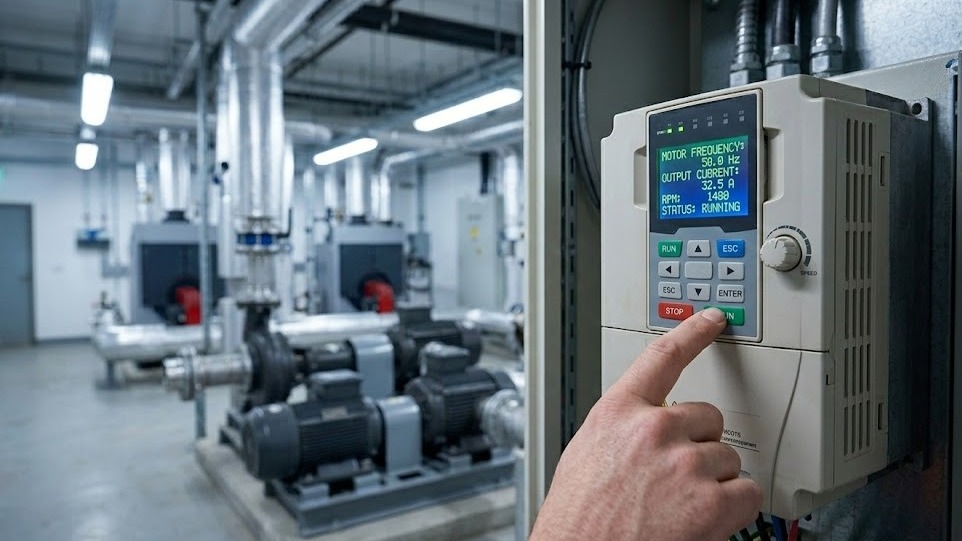
Variable speed pumps deliver significant energy savings in commercial heating systems - when commissioned correctly. Improperly configured pumps waste energy, create comfort issues, and fail to deliver the efficiency gains that justify their higher upfront cost. The difference between a pump operating at 30% energy savings and one consuming more power than a fixed-speed equivalent often comes down to setup parameters configured during commissioning.
The challenge lies in translating system requirements into pump controller settings. Unlike fixed-speed pumps that simply run at full capacity, variable speed drives require precise configuration of pressure setpoints, control modes, and operational limits. Get these parameters wrong, and the pump either cycles excessively, runs at unnecessarily high speeds, or fails to maintain adequate system pressure during peak demand periods.
Understanding Variable Speed Drive Operating Modes
Modern variable speed pumps from Grundfos and Wilo offer multiple control modes, each suited to different system configurations. Selecting the appropriate mode forms the foundation of effective commissioning of variable speed pumps.
Constant Pressure Mode
Constant Pressure Mode maintains a fixed differential pressure regardless of flow rate. This mode suits systems with minimal static head and relatively uniform distribution layouts. The pump adjusts speed to maintain the setpoint pressure at all flow conditions. For a typical commercial office building with four floors, a constant pressure setpoint of 2.5 bar might maintain adequate pressure to all terminal units whilst allowing the pump to reduce speed during low-load conditions.
Proportional Pressure Mode
Proportional Pressure Mode reduces the pressure setpoint as flow decreases, following a calculated curve. This mode delivers greater energy savings in systems where friction losses dominate and static head represents a small portion of total system pressure. A system with 8 metres of static head and 15 metres of friction loss at design flow would benefit from proportional pressure control, potentially reducing pump power consumption by an additional 15-20% compared to constant pressure mode.
Constant Temperature Mode
Constant Temperature Mode adjusts pump speed to maintain a target temperature differential across the system. This mode proves particularly effective in heating systems where maintaining a specific ΔT ensures optimal boiler efficiency and system performance. Setting a 20°C differential in a commercial heating system helps prevent return temperatures from rising too high, which would reduce condensing boiler efficiency.
Constant Flow Mode
Constant Flow Mode maintains a fixed flow rate regardless of system pressure changes. Whilst less common in variable speed applications, this mode suits specific processes requiring consistent flow delivery, such as heat exchanger circuits or DHW circulation systems, where minimum flow rates ensure adequate heat transfer.
The selection between these modes depends on system characteristics determined during the design phase. Systems with high static head components (vertical risers, heat exchangers with significant pressure drop) generally perform better with proportional pressure control. Low-rise buildings with extensive horizontal distribution benefit from a constant pressure mode.
Calculating and Setting Pressure Setpoints
Pressure setpoint configuration represents the most critical parameter in VSD pump setup. Set too high, the pump wastes energy overcoming unnecessary pressure. Set too low, terminal units receive insufficient flow, creating comfort complaints and system balancing issues.
Pressure Calculation Components
The setpoint calculation starts with determining the pressure required at the index circuit - the hydraulic path requiring the greatest pressure to achieve design flow. This includes:
Static Head: The vertical distance from the pump centreline to the highest system point. A four-storey commercial building with 3.5-metre floor heights and a plantroom on the ground floor requires approximately 1.4 bar to overcome static head (14 metres × 0.1 bar/metre).
Friction Losses: Pressure drop through pipework, fittings, valves, and terminal units along the index circuit at design flow conditions. A 60-metre equivalent pipe length with a design flow velocity of 1.2 m/s might generate 3.0 metres (0.3 bar) of friction loss in a 50mm steel pipe.
Control Valve Authority: The pressure drop across control valves at design conditions, typically requiring 0.3-0.5 bar for effective modulation. Insufficient control valve pressure drop results in poor controllability and hunting behaviour.
Equipment Pressure Drop: Manufacturer-specified pressure losses through heat exchangers, fan coil units, or radiator valves. A plate heat exchanger might require 0.4 bar at design flow, whilst a fan coil unit control valve needs 0.3 bar for proper modulation.
Adding these components for the index circuit provides the minimum pump differential pressure at design flow conditions. For the example system: 1.4 bar (static) + 0.3 bar (friction) + 0.3 bar (control valve) + 0.4 bar (heat exchanger) = 2.4 bar total required pressure.
In constant pressure mode, this calculated value becomes the setpoint. In proportional pressure mode, this represents the maximum pressure at design flow, with the minimum pressure (at zero flow) set to the static head component plus a small margin - typically 1.6 bar for this example system.
Configuring Speed and Power Limits
Operational limits prevent the pump from operating outside its efficient range or exceeding system design parameters. These boundaries protect both the pump and the system whilst optimising energy consumption.
Minimum Speed Setting
Minimum Speed Setting prevents the pump from running too slowly, which can cause several issues. Most central heating pumps require minimum speeds of 30-40% to maintain adequate motor cooling and prevent bearing damage. Additionally, extremely low speeds may fail to maintain minimum flow requirements through boilers or heat exchangers. Setting a 35% minimum speed ensures the pump delivers at least 35% of its maximum flow rate, typically sufficient for minimum system circulation requirements.
Maximum Speed Setting
Maximum Speed Setting limits the upper operational boundary, preventing the pump from attempting to compensate for system problems by running at full capacity. If a system has been designed for 80% of the pump's maximum flow capacity, setting a 90% maximum speed limit provides operational headroom whilst preventing the pump from running continuously at full speed if a major system fault occurs. This limit also protects against excessive noise and vibration at very high speeds.
Power Limiting
Power Limiting caps the maximum electrical power consumption, which proves valuable in installations with electrical supply constraints or where energy budgets must be strictly controlled. Setting a power limit 10-15% above the calculated design point power consumption allows normal operation whilst preventing excessive energy use if system conditions change. For a pump with 2.2 kW design point power consumption, a 2.5 kW power limit provides adequate margin.
Differential Pressure Limits
Differential Pressure Limits prevent the pump from generating excessive pressure that could damage system components. Setting a maximum differential pressure 20% above the design setpoint protects against sensor failures or control issues that might otherwise cause the pump to generate dangerously high pressures. A system designed for 2.4 bar would benefit from a 3.0 bar maximum pressure limit.
Setting Up Pressure Sensor Configuration
Accurate pressure sensing forms the foundation of effective variable speed pump control. Sensor location, calibration, and configuration directly impact pump performance and energy consumption during VSD pump setup.
Sensor Location Strategy
Sensor Location Strategy determines where the pump measures system pressure. Most commercial installations use differential pressure sensors measuring the difference between pump discharge and suction. This arrangement allows the pump to maintain the pressure it generates regardless of static pressure changes in the system.
The sensor location relative to the pump affects setpoint requirements. A sensor mounted directly at the pump measures the full pressure differential the pump generates. Sensors located remotely in the system measure lower pressures due to friction losses between the pump and sensor location. If a sensor is positioned 30 metres from the pump along the flow pipe, friction losses might reduce the measured pressure by 0.15 bar compared to the pump discharge pressure. The setpoint must account for this difference.
Sensor Calibration
Sensor Calibration ensures the pump controller receives accurate pressure readings. Most installations use 4-20mA pressure transmitters, where 4mA represents zero pressure and 20mA represents the sensor's maximum range. A 0-10 bar sensor outputs 12mA at 5 bar (50% of range). The pump controller must be configured with the correct sensor range to interpret the signal accurately.
Calibration verification involves comparing sensor readings against a calibrated test gauge at several pressure points. Discrepancies greater than 2% of reading indicate sensor drift or configuration errors requiring correction. An uncalibrated sensor reading 2.8 bar when the actual pressure is 2.4 bar causes the pump to operate at 86% of the required speed, potentially creating flow deficiency issues at terminal units.
Sensor Filtering
Sensor Filtering smooths pressure fluctuations that might cause erratic pump speed changes. Most controllers offer adjustable time constants, typically ranging from 1-30 seconds. A 5-second filter time constant means the controller responds to the average pressure over the previous 5 seconds rather than to instantaneous values. Systems with rapid load changes benefit from shorter time constants (2-3 seconds), whilst stable systems perform better with longer filtering (8-10 seconds) that prevents unnecessary speed adjustments.
Programming Response Characteristics
How quickly and aggressively the pump responds to pressure changes significantly impacts system stability and energy consumption. Response characteristics require careful tuning during commissioning of variable-speed pumps.
Proportional Gain
Proportional Gain determines how much the pump speed changes in response to pressure deviations from the setpoint. Higher gain values create faster, more aggressive responses. Lower values produce gentler, more stable operation. A system requiring a 2.4 bar setpoint with a proportional gain of 0.5 would increase pump speed by 5% if the pressure drops to 2.3 bar (0.1 bar error × 0.5 gain × 100 = 5% speed increase).
Excessive proportional gain causes hunting - the pump speed oscillates around the correct value without settling. Insufficient gain results in sluggish response and prolonged periods where system pressure deviates from the setpoint. Most commercial heating systems perform well with proportional gain values between 0.3 and 0.6, though optimal settings depend on system volume, distribution layout, and load change characteristics.
Integral Time
Integral Time addresses sustained pressure errors that proportional control alone cannot eliminate. If system pressure remains 0.05 bar below the setpoint despite proportional action, integral control gradually increases the pump speed until the error disappears. Integral time constants typically range from 30 to 120 seconds. Shorter times create faster correction but risk overshoot and instability. A 60-second integral time proves suitable for most commercial heating applications.
Derivative Action
Derivative Action responds to the rate of pressure change, providing anticipatory control that helps prevent overshoot during rapid load changes. Whilst theoretically beneficial, derivative action often introduces instability in real-world systems with sensor noise and should typically be disabled or set to minimal values (5-10 seconds maximum) during commissioning.
Acceleration and Deceleration Ramps
Acceleration and Deceleration Ramps control how quickly the pump speed can change. Rapid acceleration creates water hammer and mechanical stress, whilst excessively slow ramps prevent the pump from responding adequately to load changes. Setting 10-15 second ramps for both acceleration and deceleration provides smooth operation without compromising response time. A pump ramping from 40% to 70% speed over 12 seconds changes speed at approximately 2.5% per second, rapid enough for most load changes whilst avoiding mechanical shock.
Establishing Differential Pressure Reset Strategies
Differential pressure reset dynamically adjusts the pressure setpoint based on system demand, delivering substantial energy savings beyond basic variable speed operation. Proper reset configuration requires understanding system characteristics and control valve positions.
Valve Position Reset
Valve Position Reset monitors control valve positions throughout the system and reduces pump pressure setpoint when all valves operate well below fully open. If the most open valve in the system is only 70% open, the system has excess pressure - the pump could reduce its setpoint whilst still maintaining adequate flow to all terminal units. National Pumps and Boilers supplies pump valves with position feedback capability that enables this strategy.
The reset algorithm typically maintains the most open valve at 85-90% open by adjusting pump pressure. This ensures adequate control authority whilst minimising energy waste. A system initially commissioned at 2.4 bar might operate at 1.8 bar during partial load conditions when terminal units require less flow, reducing pump power consumption by approximately 40% compared to constant 2.4 bar operation.
Temperature-Based Reset
Temperature-Based Reset adjusts the pressure setpoint based on system supply or return temperatures, recognising that lower heating loads require less flow and therefore less pump pressure. As outdoor temperature rises and heating demand decreases, the pressure setpoint reduces proportionally. A system might operate at a full 2.4 bar setpoint when the outdoor temperature is -3°C, reducing linearly to 1.6 bar at 15°C outdoor temperature.
Time-Based Reset
Time-Based Reset reduces the pressure setpoint during periods of predictably low demand, such as night setback or weekend operation. A commercial office building might operate at 2.4 bar during occupied hours (07:00-19:00 weekdays) but reduce to 1.8 bar during unoccupied periods when only frost protection and minimal heating is required. This strategy alone can reduce daily energy consumption by 15-20% in buildings with significant unoccupied periods.
Verifying System Performance Post-Commissioning
VSD pump setup configuration must be validated through systematic performance testing that confirms the pump delivers the required flow and pressure whilst operating efficiently.
Flow Verification
Flow Verification at multiple load conditions ensures the pump provides adequate flow to all terminal units. Testing should include minimum load (typically 20-30% of design), part load (50-60%), and peak load (95-100%) conditions. Portable ultrasonic flow meters or balancing valve readouts provide flow measurements at representative terminal units. A properly commissioned system delivers design flow ±10% to all tested locations at peak load conditions.
Pressure Distribution Testing
Pressure Distribution Testing measures differential pressure at various points in the distribution system, confirming that pressure setpoints provide adequate control valve authority throughout. Measurements at the nearest and furthest terminal units from the pump reveal whether pressure drop calculations accurately reflected actual system characteristics. Excessive pressure at nearby units (greater than 20% above calculated values) indicates opportunities for setpoint reduction and energy savings.
Energy Consumption Monitoring
Energy Consumption Monitoring compares actual power consumption against design predictions across the load range. A properly configured variable speed pump consumes approximately 13% of full-load power at 50% flow in proportional pressure mode, compared to 50% power consumption for a fixed-speed pump. Actual consumption significantly exceeding these values indicates commissioning issues requiring investigation.
Control Stability Observation
Control Stability Observation involves monitoring pump speed and system pressure over 15-30 minute periods during stable load conditions. Speed should remain relatively constant (±5% variation), with smooth transitions during load changes. Hunting behaviour - pump speed oscillating with periods of 30-120 seconds - indicates excessive proportional gain or inadequate integral time requiring adjustment.
Temperature Differential Monitoring
Temperature Differential Monitoring in heating systems confirms that flow rates achieve target temperature drops. A system designed for 20°C ΔT should consistently achieve 18-22°C differential at design load conditions. Lower differentials indicate excessive flow (pressure setpoint too high or pump oversized), whilst higher differentials suggest insufficient flow (pressure setpoint too low or system restrictions).
Common Commissioning Errors and Corrections
Several recurring issues affect variable speed pump installations, typically stemming from incorrect parameter configuration during commissioning.
Excessive Setpoint Pressure
Excessive Setpoint Pressure represents the most common error, often resulting from applying inappropriate safety margins to calculated requirements. Setting pressure 30-40% above calculated needs wastes energy and creates control valve authority problems. A system requiring 2.4 bar commissioned at 3.2 bar consumes approximately 35% more energy whilst forcing control valves to operate in restricted positions where controllability suffers. Correction involves systematically reducing setpoint pressure whilst monitoring terminal unit performance, stopping when the most hydraulically remote unit just achieves design flow.
Inadequate Minimum Speed Settings
Inadequate Minimum Speed Settings cause pump cycling and motor cooling issues. Pumps configured with 20% minimum speeds may cycle on and off during very low load conditions rather than running continuously at low speed, creating mechanical wear and reducing efficiency. Increasing the minimum speed to 35-40% typically eliminates cycling whilst maintaining acceptable energy performance.
Incorrect Control Mode Selection
Incorrect Control Mode Selection fundamentally limits system efficiency. Systems with significant static head components commissioned in constant pressure mode waste energy maintaining full pressure during low-flow conditions when proportional pressure mode would reduce pressure appropriately. Converting a 6-storey building system from constant to proportional pressure mode typically reduces annual energy consumption by 12-18%.
Sensor Calibration Errors
Sensor Calibration Errors cause the pump to maintain incorrect pressure, either wasting energy (sensor reading low, pump compensating by running faster) or creating performance issues (sensor reading high, pump running slower than required). Regular sensor verification against calibrated reference gauges identifies drift requiring correction.
Conclusion
Commissioning variable-speed pumps demands systematic attention to operating modes, pressure setpoints, response characteristics, and performance verification. The difference between a pump delivering 40% energy savings and one barely outperforming fixed-speed alternatives lies entirely in how thoroughly these parameters are configured and validated.
Systems commissioned with calculated pressure setpoints, appropriate control modes, properly tuned response characteristics, and verified through comprehensive performance testing consistently achieve their efficiency potential whilst maintaining reliable operation. Those configured with default settings or excessive safety margins waste energy and create operational issues that undermine the business case for variable speed technology.
Proper VSD pump setup ensures optimal energy performance whilst maintaining system reliability across all operating conditions. For technical guidance on commissioning or selecting appropriate equipment for commercial heating applications, contact us for expert support.