

Common Commissioning Mistakes That Reduce Pump Efficiency
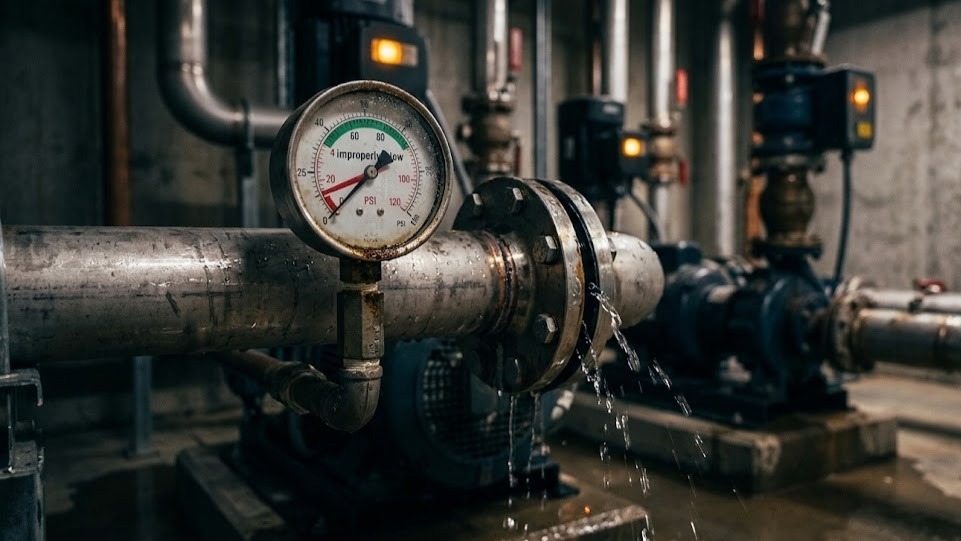
Properly commissioned pumps can achieve 90-95% of their design efficiency, yet field studies consistently show commercial installations operating at 60-70% efficiency. This 25-35% performance gap costs UK building operators thousands annually in wasted energy whilst creating maintenance issues that shorten equipment lifespan. The problem isn't the equipment - it's how it's set up.
National Pumps and Boilers encounters these pump commissioning mistakes across commercial HVAC installations, district heating schemes, and industrial process systems. Most stem from rushed installations, inadequate documentation, or assumptions that factory settings suit site conditions. Understanding these common pump errors allows mechanical contractors and building services engineers to deliver systems that meet design specifications from day one.
Failing to Verify Actual System Resistance
The most fundamental commissioning error involves assuming design calculations match real-world conditions. System resistance curves change between design and installation due to pipe routing modifications, additional fittings, or valve selections that differ from specifications.
Commissioning engineers who skip pressure differential measurements across the pump operate blind. A system designed for 6 metres head might actually require 8 metres due to installation changes, forcing the pump to operate off its efficiency curve. This single oversight can reduce pump efficiency by 15-20% whilst increasing energy consumption proportionally.
Proper verification requires measuring pressure at pump suction and discharge using calibrated gauges or transducers. Compare actual differential pressure against design values at various flow rates. Discrepancies exceeding 10% indicate system resistance issues requiring investigation before finalising pump settings.
Incorrect Impeller Trimming Decisions
Many contractors trim pump impellers during commissioning to match system requirements, but poor execution creates permanent efficiency losses. Impeller trimming based on discharge pressure alone ignores flow requirements, often resulting in over-trimmed impellers that cannot deliver design flow rates.
Proper Impeller Trimming Approach
The correct approach measures both pressure and flow simultaneously. A pump delivering correct pressure but only 80% of design flow has been over-trimmed - it's working harder to overcome resistance it shouldn't face. This scenario appears across commercial buildings where commissioning teams focus solely on achieving target pressures without verifying flow rates at critical zones.
Before trimming any impeller, document baseline performance with the full impeller installed. Measure flow rates at design points using ultrasonic flow meters or calibrated balancing valves. Calculate the required impeller diameter using manufacturer pump curves, then trim conservatively - removing 5% diameter reduces flow by approximately 5% and head by 10%. Multiple small adjustments beat aggressive single cuts.
Neglecting Variable Speed Drive Configuration
Grundfos pumps and other premium equipment ship with variable frequency drives (VFDs) that require site-specific programming. Default factory settings rarely match actual system characteristics, yet 40% of commissioning reports reviewed show VFDs operating on manufacturer defaults.
Critical VFD Parameters Requiring Configuration
Pressure setpoint location: Should reflect the most hydraulically remote point, not pump discharge. A differential pressure sensor at the furthest heat exchanger or terminal unit ensures adequate pressure throughout the system whilst preventing over-pumping.
PID control parameters: Factory PID settings (proportional, integral, derivative) suit generic applications. Fine-tuning these parameters for specific system volumes, pipe lengths, and load characteristics prevents hunting, overshoot, and unnecessary speed cycling that wastes energy.
Minimum and maximum speed limits: Setting minimum speed too low causes pump efficiency to drop and can create cavitation. Maximum speed limits prevent over-pressurisation during low-load conditions. Most commercial heating applications perform best with 30-90% speed ranges.
Pressure compensation curves: Modern VFDs support differential pressure setpoint reduction as flow decreases. This proportional pressure control can save 10-15% additional energy compared to constant differential pressure strategies.
Inadequate Air Removal Procedures
Air trapped in central heating equipment and process systems creates multiple efficiency problems. Air pockets reduce effective system volume, create noise, accelerate corrosion, and most critically, reduce pump performance by introducing compressible fluid into what should be incompressible flow.
Effective Air Removal Process
Commissioning teams often vent systems at fill but fail to perform proper air elimination during initial operation. Pumps running at full speed during initial fill entrain air throughout the system. This air takes hours or days to migrate to high points where it can be vented.
Effective air removal requires systematic procedures:
- Fill systems slowly from the lowest point with pumps off, allowing air to rise naturally to venting points
- Open all automatic air vents and manual vent points before starting pumps
- Run pumps at 50% speed initially, increasing gradually over 2-4 hours
- Revisit all high points for manual venting 24 hours after initial fill
- Monitor system pressure - slow pressure drops over days indicate ongoing air release
Systems with inadequate air removal show characteristic symptoms: fluctuating discharge pressure, inconsistent flow rates, and pump performance 10-20% below expectations even when other parameters appear correct.
Bypassing Proper Flow Balancing
Pump efficiency depends on delivering design flow rates to each system branch. Unbalanced systems force pumps to generate excess pressure to satisfy the most resistant circuits whilst over-serving low-resistance paths. This increases both pump energy consumption and system pressure drop.
Flow Balancing Best Practices
Commissioning reports frequently show "flow balanced to within 15% of design" - a tolerance that sounds acceptable but creates significant efficiency losses. A branch receiving 15% excess flow whilst another gets 15% under-design flow forces the pump to operate at 115% of design head to satisfy the starved circuit.
Professional balancing requires measuring actual flow at each branch using calibrated balancing valves or flow meters. Adjust balancing valves iteratively, starting from branches furthest from the pump and working back towards the source. Document final valve positions and flow rates - this data proves invaluable during future system modifications.
Wilo pumps with integrated flow measurement simplify this process by providing real-time flow data, but manual verification at critical branches remains essential. Target flow rates within ±5% of design values for optimal pump efficiency.
Ignoring Pump Curve Operating Points
Every pump has a best efficiency point (BEP) - the flow rate where it converts electrical energy to hydraulic energy most effectively. Operating significantly left or right of this point reduces efficiency and can cause mechanical problems.
Operating Point Analysis
Common pump errors often result in operation at 50-60% of BEP flow rates. This occurs when system resistance exceeds design assumptions, forcing the pump back on its curve. Operating left of BEP creates recirculation within the pump, increasing internal losses, generating heat, and accelerating wear on seals and bearings.
During commissioning, plot actual operating points on manufacturer pump curves. If the operating point falls outside 70-130% of BEP flow, investigate system resistance issues before accepting the installation. Options include:
- Adjusting system balancing to reduce unnecessary resistance
- Modifying pipe sizing at bottleneck locations
- Selecting alternative impeller sizes to shift the BEP
- In extreme cases, replacing the pump with a model better suited to actual conditions
Operating at BEP typically delivers 80-85% wire-to-water efficiency. Moving 30% away from BEP drops efficiency to 65-70% - a 20% energy penalty that persists throughout the system's operational life.
Insufficient Documentation and Handover
Complete commissioning documentation enables ongoing optimisation and troubleshooting. Yet 60% of commercial installations lack adequate records of actual operating parameters, making future performance verification impossible.
Essential Commissioning Documentation
Baseline performance data: Pump power consumption, flow rates, pressure differentials, and speed settings under various load conditions. This establishes performance benchmarks for comparison during maintenance or when investigating efficiency degradation.
System resistance curves: Measured pressure-flow relationships across the full operating range. This data helps diagnose future changes in system resistance caused by fouling, valve failures, or modifications.
Control system settings: Complete VFD parameters, setpoints, PID values, and any custom programming. Without this information, control system faults can require complete recommissioning.
Balancing valve positions: Documented positions of all balancing valves with corresponding flow rates. This prevents inadvertent adjustment during maintenance and provides a baseline for rebalancing after system modifications.
National Pumps and Boilers recommends creating commissioning records that building operators can actually use - not just compliance documents filed and forgotten. Include clear explanations of why specific settings were chosen and what symptoms indicate deviation from proper operation.
Poor Integration With Building Management Systems
Modern pumps integrate with building management systems (BMS) to enable monitoring and optimisation, but commissioning teams often establish only basic connectivity. The pump shows "running" status on the BMS whilst critical performance data remains unmonitored.
Effective BMS Integration Requirements
Performance trending: Configure the BMS to log pump power consumption, flow rates, differential pressure, and speed at 15-minute intervals. This data reveals efficiency degradation, control issues, and opportunities for optimisation invisible during spot checks.
Alarm configuration: Set meaningful alarm thresholds for parameters indicating efficiency problems - not just equipment failures. Alerts for operating points outside normal ranges, excessive power consumption, or pressure instabilities allow intervention before minor issues become major problems.
Demand-based scheduling: Programme pumps to operate based on actual heating or cooling demand rather than fixed schedules. Proper BMS integration can reduce pump operating hours by 20-30% in many commercial applications.
Skipping Performance Verification Testing
Final performance verification testing confirms the commissioned system meets design specifications. This step gets omitted when projects run behind schedule, leaving systems that appear functional but operate inefficiently.
Comprehensive Verification Testing
Full-load performance: With all zones calling for heating/cooling, verify the pump delivers design flow at design pressure differential whilst consuming expected power. Deviations exceeding 10% require investigation.
Part-load efficiency: Test VFD operation at 75%, 50%, and 25% load conditions. Pump efficiency should remain above 70% of peak efficiency down to 40% flow. Steeper efficiency drops indicate control problems or poor pump selection.
Response characteristics: Verify the system responds appropriately to load changes. Pressure should stabilise within 30-60 seconds of load changes without hunting or overshoot. Poor response indicates PID tuning issues.
Energy consumption validation: Compare measured energy consumption against design predictions across various load conditions. Discrepancies exceeding 15% indicate efficiency problems requiring resolution before handover.
Moving Forward With Proper Commissioning
The pump commissioning mistakes outlined above share a common thread - they result from treating commissioning as a checkbox exercise rather than a systematic verification process. Proper commissioning requires time, calibrated instruments, technical knowledge, and attention to detail that many projects fail to budget adequately.
Building operators facing efficiency problems in existing installations should review commissioning documentation (if it exists) and measure current performance against design specifications. Many efficiency issues can be resolved through recommissioning - adjusting settings, rebalancing flows, and optimising control parameters based on actual operating data.
For new installations, specifying adequate commissioning time and requiring comprehensive performance verification protects against these common pump errors. The additional cost of proper commissioning - typically 2-3% of equipment cost - returns multiples in energy savings and equipment longevity.
Engineers seeking guidance on specific pump applications or commissioning challenges can contact us for technical support tailored to particular system requirements and performance objectives.