

Comparing Energy Consumption: Old Fixed-Speed vs. Modern Variable Speed Pumps
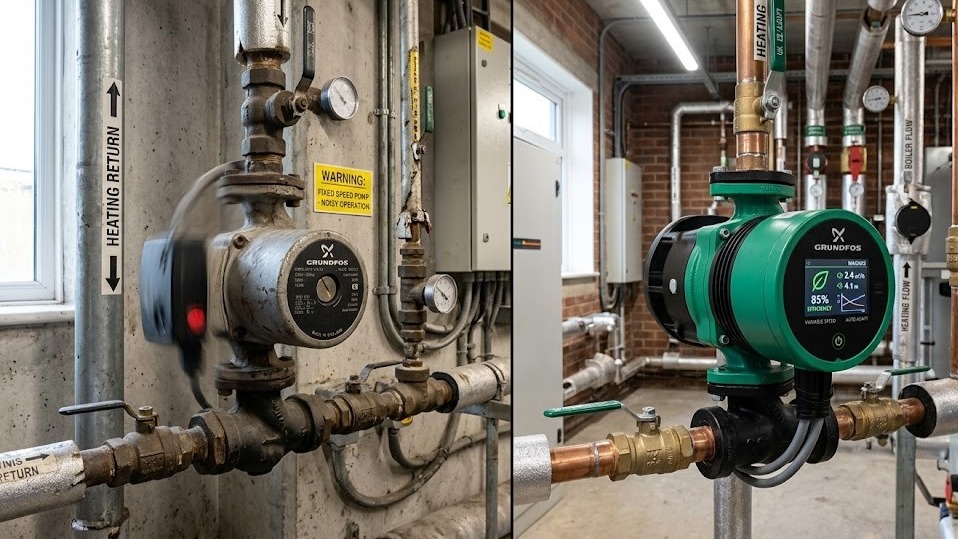
Heating and plumbing systems account for approximately 60% of energy consumption in UK commercial buildings, with circulation pumps representing a significant portion of that load. For facilities managers and heating engineers working with older installations, the difference between fixed-speed and variable-speed pump technology can mean thousands of pounds in annual operating costs.
The shift from fixed-speed to variable-speed pumps isn't simply about upgrading equipment - it represents a fundamental change in how circulation systems consume energy. Fixed-speed pumps operate at constant output regardless of system demand, whilst modern variable speed pumps adjust their performance to match real-time requirements. Understanding the fixed vs variable speed pump energy implications helps building operators make informed decisions about system upgrades and energy reduction strategies.
National Pumps and Boilers supplies both fixed-speed and variable-speed circulation pumps for commercial and domestic applications, with technical support available to help engineers assess VSD pump savings potential in existing systems.
How Fixed-Speed Pumps Consume Energy
Traditional fixed-speed circulation pumps operate at a constant speed determined by the motor's design and the electrical supply frequency. These pumps run at full capacity whenever activated, regardless of whether the heating system requires maximum flow or minimal circulation.
Constant Power Draw Characteristics
A typical fixed-speed commercial heating pump rated at 1.5 kW draws that full power continuously during operation. In a system running 12 hours daily, this translates to 18 kWh per day or approximately 6,570 kWh annually. At current UK commercial electricity rates of around £0.25 per kWh, this single pump costs £1,642.50 per year to operate.
The inefficiency becomes more pronounced when considering actual system demand. During mild weather, when only partial heating capacity is needed, fixed-speed pumps continue operating at full power. The excess flow must be managed through bypass valves or throttling devices, which waste energy by converting it to heat through friction rather than reducing consumption at the source.
Mechanical Losses and Heat Generation
Fixed-speed pumps generate significant waste heat through constant operation. The motor runs continuously at full load, producing heat that serves no useful purpose in the heating system. This thermal loss represents wasted electrical energy that contributes to the building's cooling load during warmer months.
Bearing friction, seal wear, and motor inefficiencies compound these losses. Older fixed-speed pumps typically operate at 40-60% efficiency, meaning nearly half the electrical input converts to waste rather than useful hydraulic work.
Variable Speed Pump Energy Efficiency Principles
Variable speed pumps incorporate electronic controls that adjust motor speed to match system demand. These pumps use variable frequency drives (VFDs) or electronically commutated motors (ECMs) to modulate output, fundamentally changing the energy consumption profile and maximising VSD pump savings.
Proportional Power Reduction
The relationship between pump speed and power consumption follows the affinity laws of fluid dynamics. When pump speed reduces by 50%, power consumption drops to approximately 12.5% of full load - not 50%. This cubic relationship (power varies with the cube of speed) creates dramatic energy savings during partial load operation.
A variable speed pump operating at 60% capacity uses roughly 22% of full power. During mild weather when heating demand drops, this characteristic delivers substantial savings compared to fixed-speed operation.
Pressure Differential Control
Modern variable speed pumps from manufacturers like Grundfos incorporate differential pressure sensors that continuously monitor system requirements. The pump adjusts speed to maintain optimal pressure across the heating circuit, eliminating the energy waste associated with throttling valves and bypass arrangements.
This intelligent control matches pump output to actual demand rather than forcing the system to dissipate excess capacity. The result is a system that consumes only the energy required for current heating needs.
Real-World Energy Consumption Comparisons
Practical field data from UK commercial installations demonstrates the fixed vs variable speed pump energy differences across various building types and operating conditions.
Office Building Case Study
A 5,000 m² office building in the UK replaced three fixed-speed central heating pumps (each rated 2.2 kW) with variable-speed equivalents. The fixed-speed installation consumed 19,140 kWh annually across all three pumps operating 10 hours daily, 250 days per year.
After upgrading to variable speed pumps with proportional pressure control, annual consumption dropped to 7,656 kWh - a 60% reduction. The £2,871 annual saving provided a return on investment within 3.2 years, accounting for equipment costs and installation labour.
The energy reduction came primarily from reduced operation during shoulder seasons (spring and autumn) when heating demand varied significantly throughout the day. Variable speed control allowed the pumps to operate at 30-40% capacity during these periods rather than full output, demonstrating significant VSD pump savings.
Residential Development Comparison
A 48-unit residential development replaced fixed-speed communal heating pumps serving individual flats. The original 1.1 kW fixed-speed pump ran continuously (8,760 hours annually), consuming 9,636 kWh per year at a cost of £2,409.
The replacement variable speed pump with weather compensation control reduced consumption to 3,277 kWh annually - a 66% reduction worth £1,590 per year. The improved control also eliminated complaints about overheating in individual flats, as the system could maintain lower flow rates during mild weather.
Warehouse and Industrial Applications
A 12,000 m² warehouse with radiant heating panels operated fixed-speed pumps totalling 5.5 kW combined capacity. Annual consumption reached 13,200 kWh (operating 2,400 hours per year) at a cost of £3,300.
Variable speed pump replacement with zone control reduced consumption to 4,752 kWh annually - a 64% reduction worth £2,112. The improvement came from matching pump output to actual zone demand rather than maintaining full circulation across all panels regardless of heating requirements.
Calculating Payback Periods for Pump Upgrades
Understanding the financial case for upgrading from fixed to variable speed pumps requires an accurate assessment of current consumption, projected savings, and installation costs.
Energy Audit Methodology
Begin by measuring actual operating hours and power consumption of existing fixed-speed pumps. Many older installations lack sub-metering, requiring temporary monitoring equipment to establish baseline consumption. Record pump nameplate ratings, actual running hours, and load profiles across different seasons.
Calculate annual energy costs using current electricity rates, including both unit costs and any capacity charges that apply to commercial installations. Factor in projected rate increases over the equipment's expected lifespan (typically 15-20 years for quality circulation pumps).
Cost-Benefit Analysis
Variable speed pump upgrades typically cost £800-£2,500 per pump for commercial applications, depending on size and control sophistication. This includes the pump unit, variable frequency drive or ECM motor, differential pressure sensors, and installation labour.
For a typical commercial installation consuming 8,000 kWh annually with fixed-speed pumps, a 60% reduction saves 4,800 kWh worth £1,200 per year. With upgrade costs of £1,800, the simple payback period is 1.5 years. Accounting for maintenance cost reductions (variable speed pumps experience less mechanical stress) and potential electricity rate increases improves the business case further.
Building Regulations Compliance
Part L of the Building Regulations requires energy-efficient circulation pumps in new installations and major renovations. Variable speed pumps with specific fan power (SFP) ratings below defined thresholds meet these requirements more readily than fixed-speed alternatives.
For projects requiring Building Control approval, specifying variable speed pumps from manufacturers like Wilo ensures compliance whilst delivering VSD pump savings from day one.
Technical Considerations for Retrofit Projects
Converting existing fixed-speed installations to variable speed control requires careful assessment of system compatibility and control integration.
Electrical Supply Requirements
Variable speed pumps with VFDs may require different electrical protection than fixed-speed equivalents. The variable frequency drive generates harmonic distortion that can affect sensitive electronic equipment on the same electrical circuit. Proper electrical design includes harmonic filtering and appropriate cable sizing to accommodate the control equipment.
ECM pumps (such as those in the Grundfos Magna3 range) integrate the motor and control electronics, simplifying installation compared to separate VFD units. These pumps typically connect to standard electrical supplies without additional filtering requirements.
System Pressure and Flow Balancing
Older heating systems designed around fixed-speed pumps may include oversized pipework and excessive bypass arrangements. When retrofitting variable speed pumps, review the system hydraulics to ensure proper flow distribution at reduced pump speeds.
Thermostatic radiator valves (TRVs) and zone valves must function correctly to provide demand signals to the variable speed pump. Faulty or seized valves prevent the pump from reducing output, negating potential energy savings. A system audit should identify and replace defective control valves before pump replacement.
Control Integration Options
Variable speed pumps offer multiple control modes suited to different applications:
Proportional pressure control maintains constant differential pressure across the system, suitable for installations with multiple zones and variable demand patterns.
Constant temperature control adjusts pump speed to maintain target flow or return temperatures, ideal for weather-compensated systems.
External control input allows building management systems (BMS) to command pump speed based on broader system requirements, enabling integration with comprehensive energy management strategies.
Selecting the appropriate control mode depends on the existing system architecture and available control infrastructure. Quality pump valves and sensors must provide accurate feedback signals for optimal variable speed operation.
Maintenance and Lifecycle Cost Considerations
Beyond direct energy savings, variable speed pumps offer maintenance advantages that improve whole-life costs.
Reduced Mechanical Wear
Variable speed pumps operate at reduced speeds during partial load conditions, decreasing bearing loads, seal wear, and impeller erosion. This gentler operation extends service intervals and reduces spare parts requirements compared to fixed-speed pumps running continuously at full capacity.
Soft-start capabilities in variable speed drives eliminate the mechanical shock associated with across-the-line starting of fixed-speed motors. This reduces stress on couplings, pipe connections, and system components, particularly in older installations with ageing pipework.
Improved System Reliability
Variable speed control eliminates water hammer and pressure surges that damage system seals and components. Gradual speed changes prevent the rapid pressure fluctuations that cause premature component failure in fixed-speed systems.
The reduced mechanical stress translates to longer equipment life - quality variable speed pumps from established manufacturers typically achieve 15-20 years of service compared to 10-15 years for continuously-running fixed-speed equivalents.
Diagnostic Capabilities
Modern variable speed pumps include monitoring functions that track operating hours, power consumption, and performance trends. These diagnostic features enable predictive maintenance strategies, alerting engineers to developing problems before they cause system failures.
Integration with building management systems allows remote monitoring of pump performance, facilitating proactive maintenance scheduling and energy consumption tracking across multiple sites.
Conclusion
The energy consumption difference between fixed-speed and variable-speed pumps represents one of the most cost-effective improvements available in commercial heating systems. Field data consistently demonstrates 55-70% energy reductions in typical UK applications, with payback periods of 1.5-4 years depending on system size and operating patterns.
The fixed vs variable speed pump energy comparison extends beyond simple electricity savings. Variable speed technology reduces mechanical wear, improves system reliability, and provides diagnostic capabilities that support proactive maintenance strategies. For facilities managers facing ageing pump infrastructure, the business case for variable speed upgrades combines immediate energy cost reduction with long-term operational benefits.
Building Regulations increasingly favour variable speed technology, making upgrades during system refurbishment or expansion a practical necessity. Engineers specifying replacement pumps should evaluate variable speed options as standard practice rather than premium alternatives.
National Pumps and Boilers stocks variable speed circulation pumps from leading manufacturers, with technical support available to assess VSD pump savings potential in existing installations. For guidance on pump selection, system compatibility, or energy audit methodology, contact us for expert advice tailored to specific applications.