

Energy Efficiency Index (EEI) Explained: What the Ratings Mean for Running Costs
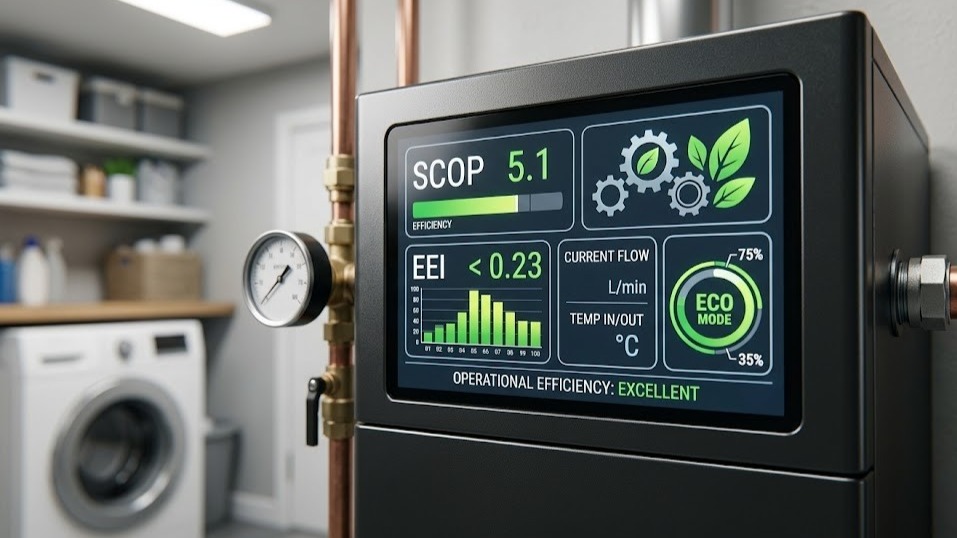
Circulation pumps account for roughly 10% of electricity consumption in European buildings - a figure that translates to billions of kilowatt-hours annually across commercial and domestic heating systems. The Energy Efficiency Index (EEI) was introduced specifically to address this, creating a standardised metric that allows heating engineers, contractors, and facilities managers to compare pump efficiency accurately and predict long-term running costs.
Understanding EEI rating pumps transforms pump selection from guesswork into calculated decision-making. A pump with an EEI of 0.20 versus 0.27 might seem like a marginal difference on paper, but over a 15-year operational lifespan in a commercial building, that gap represents thousands of pounds in electricity costs and substantial carbon emissions.
What the Energy Efficiency Index Actually Measures
The energy efficiency index pumps system rates circulation pumps based on their electrical consumption relative to a reference benchmark. The lower the EEI value, the more efficient the pump. This isn't a simple measurement of power draw - the calculation accounts for the pump's hydraulic performance across its entire operating range, weighted toward the partial load conditions where most pumps spend the majority of their runtime.
ErP Directive (Energy-related Products Directive 2009/125/EC) established mandatory EEI thresholds for circulators sold in the UK and EU. From 1 August 2015, standalone circulators must achieve EEI ≤ 0.23. Integrated products (pumps built into boilers or systems) face a slightly relaxed threshold of EEI ≤ 0.27. These aren't voluntary recommendations - they're legal requirements that fundamentally changed the circulation pump market.
The calculation methodology itself is complex, involving hydraulic efficiency measurements at multiple operating points, motor efficiency factors, and control system capabilities. For specifiers and installers, the critical takeaway is simpler: lower EEI values directly correlate with lower electricity consumption for equivalent hydraulic work.
Breaking Down EEI Rating Categories
EEI ≤ 0.20 (Premium Efficiency)
Pumps achieving this threshold represent current best-in-class efficiency. Grundfos pumps like the Alpha3 and Magna3 series, along with Wilo pumps such as the Stratos MAXO, consistently achieve EEI rating pumps between 0.15 and 0.20. These pumps incorporate permanent magnet motors, advanced control algorithms, and optimised hydraulic designs.
In practical terms, a premium efficiency pump consumes approximately 30-40% less electricity than a pump at the 0.23 threshold. For a medium-sized commercial system running 5,000 hours annually, this translates to roughly 400-600 kWh saved per pump per year. At current commercial electricity rates (approximately £0.25/kWh), that's £100-150 annual savings per pump - before accounting for maintenance reductions from lower operating temperatures and mechanical stress.
EEI 0.21-0.23 (Compliant Standard)
This range represents the minimum legal threshold for standalone circulators. Pumps in this category deliver acceptable efficiency for most applications, though they lack the advanced features and optimisation of premium models. Many mid-range commercial circulators from established manufacturers fall into this bracket.
The performance gap between EEI 0.20 and 0.23 matters more in high-runtime applications. A pump operating 8,000 hours annually in a district heating system or large commercial building will show measurably higher running costs at EEI 0.23 compared to 0.18, potentially justifying the capital cost premium of a more efficient model.
EEI 0.24-0.27 (Integrated Product Threshold)
Pumps integrated into boilers, heat interface units, or packaged systems may legally achieve up to EEI 0.27. This allowance recognises the design constraints of integrated products, where space limitations, hydraulic requirements, and system integration factors may prevent achieving standalone pump efficiency levels.
Facilities managers evaluating packaged heating equipment should still scrutinise integrated pump efficiency. A boiler with an integrated circulator at EEI 0.27 versus 0.22 will show noticeably higher electricity consumption over its lifespan, even if the boiler's thermal efficiency is identical.
EEI > 0.27 (Non-Compliant Legacy)
Older pumps exceeding EEI 0.27 remain in countless UK heating systems, installed before ErP regulations took effect. Unregulated circulators from the 1990s and early 2000s often operated at EEI values between 0.40 and 0.60 - consuming two to three times the electricity of current compliant models for identical hydraulic output.
Identifying and replacing these legacy pumps represents one of the most cost-effective energy efficiency interventions available. The payback period for upgrading from an unregulated pump to a modern EEI rating pumps model at 0.20 typically ranges from 18 to 36 months in commercial applications with reasonable runtime hours.
Calculating Real-World Running Cost Differences
To translate EEI rating pumps into actual operating costs, consider a typical commercial heating application: a secondary circuit pump in a 500 kW heating system, operating 4,500 hours annually (October through April, 15 hours daily average).
Scenario comparison: EEI 0.40 (old unregulated) vs EEI 0.20 (modern efficient)
An older circulator delivering 10 m³/h at 4 metres head might consume 180 watts continuously at EEI 0.40. The equivalent modern pump achieves the same hydraulic performance at approximately 90 watts with EEI 0.20.
- Annual consumption difference: (180W - 90W) × 4,500 hours = 405 kWh
- Annual cost saving at £0.25/kWh: £101.25
- 15-year lifecycle saving: £1,518.75 (excluding inflation and electricity price increases)
This calculation excludes additional benefits: reduced heat gain in plant rooms, lower mechanical wear extending service intervals, and improved system control from variable speed operation standard in efficient pumps.
For larger commercial systems with multiple pumps, the cumulative effect amplifies substantially. A district heating scheme with fifteen circulation pumps upgrading from EEI 0.35 to 0.18 could realistically save £2,000-3,000 annually in electricity costs alone.
How EEI Ratings Connect to Variable Speed Operation
The energy efficiency index pumps calculation methodology heavily weights part-load performance because real heating systems rarely operate at full design capacity. A properly sized heating system might run at 100% load for only 5-10% of its annual runtime, spending the majority of operating hours at 30-60% capacity.
Fixed-speed pumps maintain constant flow regardless of system demand, wasting energy during partial load conditions. Variable speed pumps with proportional pressure control adjust motor speed to match actual system requirements, delivering dramatic efficiency improvements during the 90-95% of runtime when full flow isn't needed.
This operational reality explains why pumps with permanent magnet motors and integrated variable speed drives dominate the EEI ≤ 0.20 category. The technology isn't just about motor efficiency - it's about matching energy input to hydraulic output across the entire operating envelope.
Heating engineers specifying central heating equipment should prioritise pumps with automatic proportional pressure control (ΔP-v or AUTOADAPT modes). These control algorithms continuously optimise pump speed based on system resistance, delivering the lowest possible EEI values in actual operating conditions.
EEI Impact on Different System Types
Domestic Central Heating (Single-Dwelling)
Modern combi and system boilers almost universally incorporate EEI-compliant integrated pumps. The efficiency difference between EEI 0.23 and 0.19 in a domestic context amounts to roughly £15-25 annually - noticeable but not transformative.
The greater domestic opportunity lies in replacing standalone circulators in older systems. Properties with separate pumps for primary circuits, DHW pumps for cylinder circulation, or zone pumps for multi-circuit systems often retain unregulated models consuming 60-100 watts continuously when modern equivalents use 15-30 watts.
Commercial Heating Systems
Commercial applications show the most dramatic returns from efficient circulation pumps. Multiple pumps operating extended hours amplify the cost impact of EEI differences. A medium-sized office building might operate six to eight circulation pumps across primary circuits, secondary zones, and DHW systems.
Upgrading all pumps to EEI ≤ 0.20 models during a plant room refurbishment typically delivers 2-3 year payback periods through reduced electricity consumption. The improvement becomes even more compelling when combined with proper system balancing and control optimisation - efficient pumps operating in well-designed systems consistently outperform predictions.
District Heating and Heat Networks
Large-scale heating networks present the most significant efficiency opportunities and the highest absolute cost savings from low EEI rating pumps. Network distribution pumps may operate 7,000-8,500 hours annually, making even small efficiency improvements financially material.
Commercial circulators specifically engineered for heat network applications prioritise reliability, efficiency, and remote monitoring capabilities. For network operators evaluating lifecycle costs, the electricity consumption difference between EEI 0.18 and 0.25 over a 20-year asset life can exceed the initial capital cost of the pump itself.
Beyond EEI: Additional Efficiency Considerations
While EEI provides standardised comparison, other factors influence total system efficiency and operating costs:
Hydraulic Matching: An EEI 0.18 pump oversized by 50% will consume more electricity and deliver worse system performance than a correctly sized EEI 0.23 pump. Proper system calculations accounting for actual pipe sizing, heat emitter characteristics, and control valve pressure drops remain fundamental to efficiency.
Control Integration: Modern efficient pumps offer multiple control modes beyond simple fixed speed operation. Proportional pressure (ΔP-v), constant pressure (ΔP-c), constant temperature, and flow-adaptive algorithms each suit different system architectures. Selecting appropriate control modes can improve effective efficiency by 15-25% beyond the rated EEI value.
System Balancing: Even the most efficient pump cannot overcome poor system hydraulics. Unbalanced systems force pumps to generate excessive pressure to serve the most remote circuits, wasting energy throughout the distribution network. Combining low EEI pumps with proper balancing valves and commissioning delivers compound efficiency benefits.
Seasonal Variation: Heating systems in the UK operate seasonally, with shoulder months (September, October, April, May) representing significant runtime at very low loads. Pumps with excellent part-load efficiency show disproportionate savings during these extended low-demand periods.
Identifying Upgrade Opportunities in Existing Systems
Facilities managers and building operators can identify cost-effective pump upgrade opportunities through a simple assessment:
High-Priority Candidates
Pumps operating more than 4,000 hours annually with no visible efficiency labelling likely predate ErP regulations. These represent the highest-value upgrade targets. Plant room surveys should photograph pump nameplates - older models typically show only power input (watts) without EEI ratings.
Pumps running excessively hot to the touch indicate poor efficiency, with electrical energy converting to waste heat rather than hydraulic work. Thermal imaging during heating season operation quickly identifies inefficient circulators worth replacing.
Moderate-Priority Targets
Pumps with visible EEI ratings between 0.24-0.27 in high-runtime applications justify evaluation. Calculate annual operating hours, measure actual power consumption with a plug-in meter or current clamp, and compare against predicted consumption of EEI ≤ 0.20 alternatives.
Systems with multiple pumps (primary/secondary configurations, multi-zone systems) show better upgrade economics than single-pump systems due to cumulative savings across all units.
Lower-Priority Situations
Single domestic pumps already achieving EEI ≤ 0.23 with moderate runtime (3,000 hours annually or less) typically don't justify proactive replacement purely for efficiency gains. Focus upgrade investment on higher-consumption applications first.
However, when pumps require replacement due to failure or during system modifications, always specify EEI ≤ 0.20 models regardless of application. The marginal capital cost premium is negligible compared to lifecycle benefits.
Specifying Efficient Pumps for New Installations
New heating system designs should target EEI ≤ 0.20 as the standard specification for all standalone circulators. The market now offers an extensive choice at this efficiency level across all common flow and head requirements.
When reviewing packaged equipment with integrated pumps, request specific EEI values for included circulators. Manufacturers offering integrated pumps at EEI 0.22-0.23 demonstrate better overall system design than those at the 0.27 threshold.
For commercial projects, specify pumps with building management system (BMS) integration capability. Modern efficient circulators from manufacturers like Grundfos and Wilo offer Modbus, BACnet, or proprietary communication protocols enabling remote monitoring, performance optimisation, and predictive maintenance.
Consider total lifecycle cost in value engineering exercises. A pump with 15% higher capital cost but 35% lower running costs will deliver positive net present value within 3-5 years in typical commercial applications. Resist pressure to downgrade pump efficiency specifications to meet initial budget targets - the operational cost penalty far exceeds the capital saving.
Regulatory Compliance and Future Efficiency Requirements
Current ErP requirements represent minimum standards, not best practice. The European Commission reviews ErP thresholds periodically, with expectations that future revisions will tighten EEI limits further. Specifying pumps substantially better than current minimums provides future-proofing against regulatory changes.
Building Regulations Part L (Conservation of Fuel and Power) doesn't explicitly mandate EEI values but requires reasonable provision for energy-efficient fixed building services. Compliance demonstrations increasingly reference pump efficiency as evidence of reasonable provision, particularly in commercial applications where pumping energy represents measurable building consumption.
For projects pursuing BREEAM or other environmental certifications, circulation pump efficiency contributes to energy credits. Specifying EEI ≤ 0.20 pumps throughout provides supporting evidence for efficient system design.
Making the Upgrade Decision
The business case for efficient circulation pumps strengthens with every electricity price increase and carbon reduction target. Systems currently operating unregulated legacy pumps should prioritise upgrades - the payback periods are compelling and the technology is mature.
Even systems with compliant pumps at EEI 0.23 warrant evaluation for upgrade to EEI ≤ 0.20 models in high-runtime commercial applications. The incremental efficiency improvement may appear modest, but multiplied across operating hours and system lifespan, the savings justify replacement.
Conclusion
The Energy Efficiency Index transformed circulation pump selection from a purely hydraulic specification exercise into a comprehensive efficiency and cost analysis. EEI rating pumps provide the standardised metric needed to compare pumps accurately, predict operating costs reliably, and justify investment in premium efficiency equipment.
For heating systems operating significant annual hours, the running cost differences between EEI categories are substantial and measurable. A pump at EEI 0.20 versus 0.40 can save £100-150 annually in a typical commercial application - savings that compound across multiple pumps and accumulate over 15-20 year equipment lifespans.
The market now offers an extensive choice of high-efficiency pumps at EEI ≤ 0.20 across all common applications. Specifying these models as standard practice for new installations and prioritising legacy pump upgrades in existing systems represents one of the most cost-effective building services efficiency interventions available. The technology is proven, the savings are predictable, and the payback periods justify investment across commercial and domestic applications alike.
For technical guidance on selecting appropriate efficient circulators for specific system requirements, contact us for expert advice tailored to your specific application. At National Pumps and Boilers, proper pump selection requires matching hydraulic performance, control capabilities, and efficiency ratings to actual system characteristics.