

Essential Accessories That Improve Boiler Room Efficiency
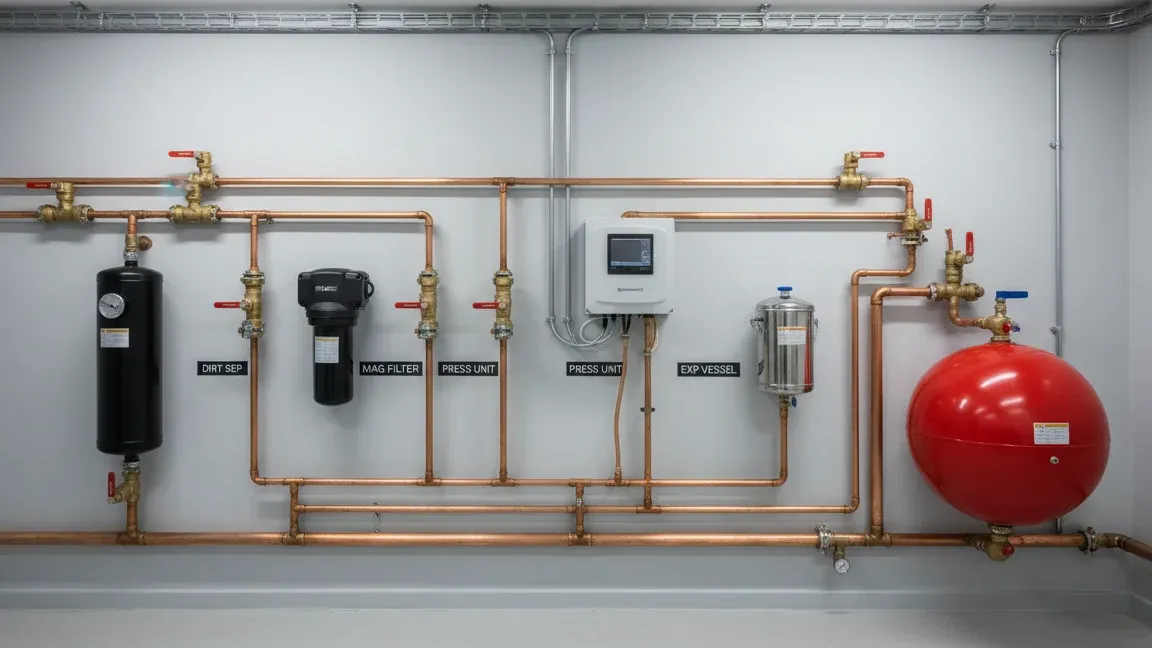
Modern commercial heating systems waste thousands of pounds annually through inadequate accessory specification that limits performance below potential. A 500kW commercial boiler running without basic efficiency accessories typically consumes 15-20% more fuel than properly equipped systems, translating to £8,000-12,000 in unnecessary annual costs for an average UK commercial building operating throughout the heating season.
The difference between an efficient boiler room and an inefficient one rarely lies in the boiler itself. Leading manufacturers produce highly efficient boilers capable of impressive performance, but that efficiency potential remains unrealised without proper supporting accessories. The accessories surrounding the boiler - from economisers to water treatment systems - determine whether that equipment delivers its rated efficiency or falls significantly short throughout its service life.
Understanding Boiler Room Efficiency Fundamentals
The Real Cost of Inefficient Boiler Operations
Commercial boiler inefficiency manifests in three primary cost centres: fuel consumption, maintenance expenditure, and premature equipment replacement. A boiler operating at 75% efficiency instead of 90% efficiency wastes £15,000 annually for every £100,000 in fuel costs. Over a typical 15-year boiler lifespan, that single inefficiency costs £225,000 in excess fuel alone.
Maintenance costs compound these losses significantly over time. Boilers without proper water treatment develop scale deposits that reduce heat transfer efficiency by 3-5% annually whilst simultaneously increasing maintenance requirements. A 3mm scale buildup on heat exchanger surfaces reduces efficiency by approximately 10% and increases fuel consumption proportionally throughout the heating season.
The absence of basic monitoring accessories delays problem detection, transforming minor issues into major failures. A failing accessory like a faulty low water cut-off device can destroy a £50,000 boiler in minutes, whereas a £400 replacement part and proper monitoring would have prevented the failure entirely. These catastrophic losses underscore why accessories represent essential investments rather than optional additions.
Equipment replacement cycles accelerate when boilers operate without proper protection and optimisation. Systems lacking water treatment, proper pressure control, and combustion optimisation typically require replacement 3-5 years earlier than well-equipped installations. The accessory investment that extends equipment life delivers returns far exceeding initial costs.
How Accessories Enhance System Performance
Boiler accessories improve efficiency through five primary mechanisms: heat recovery, combustion optimisation, system protection, operational control, and energy distribution. Each category addresses specific efficiency losses inherent in boiler operation that cannot be eliminated through boiler design alone.
Heat recovery accessories capture energy otherwise lost through flue gases, blowdown water, and condensate discharge. An economiser recovering heat from flue gases typically improves overall system efficiency by 5-8%, recovering energy that would otherwise exit the building at 150-200°C and provide no useful heating.
Combustion optimisation accessories maintain ideal fuel-to-air ratios despite varying loads and conditions. Oxygen trim systems, for example, continuously adjust combustion air to maintain optimal excess oxygen levels, preventing the 1% efficiency loss that occurs for every 15% excess air above optimal levels.
Protection accessories prevent the efficiency degradation that accompanies scale formation, corrosion, and thermal stress. Proper water treatment maintains heat exchanger cleanliness, preserving the heat transfer efficiency that deteriorates rapidly in untreated systems. National Pumps and Boilers supplies comprehensive accessory ranges that address all these efficiency factors.
Critical Safety and Control Accessories
Pressure Relief and Safety Valves
Every commercial boiler requires properly sized pressure relief valves rated for the system's maximum allowable working pressure. These valves prevent catastrophic failures but also indicate system health through their operation patterns. Frequent relief valve discharge signals control problems that waste energy through excessive pressure cycling.
Safety valve sizing follows specific calculations based on boiler heat input and steam generation capacity. Undersized valves create safety hazards; oversized valves may leak at normal operating pressures, wasting energy and requiring premature replacement. For a typical 500kW commercial boiler, the relief valve should be sized for approximately 110% of maximum steam generation capacity.
Testing schedules matter for both safety and efficiency outcomes. Relief valves require annual testing to verify proper operation. Valves that fail to reseat properly after testing waste energy through continuous small leaks that can total hundreds of pounds annually in lost steam or hot water.
Pump valves and isolation components work alongside safety valves to provide comprehensive system protection. Proper valve infrastructure enables maintenance without compromising safety device accessibility.
Temperature and Pressure Gauges
Accurate monitoring enables operators to identify efficiency problems before they escalate into major issues. A boiler running 10°C above optimal supply temperature wastes approximately 3% in fuel costs whilst accelerating system wear. Quality gauges with 1-2% accuracy enable precise temperature control that maintains efficiency.
Gauge placement determines monitoring effectiveness throughout the system. Supply and return temperature gauges positioned at the boiler enable calculation of temperature differential, a key efficiency indicator. Pressure gauges before and after major components identify flow restrictions that force pumps to work harder, consuming excess electrical energy.
Digital gauges with data logging capabilities provide efficiency insights impossible with analogue instruments alone. Trend analysis reveals gradual efficiency deterioration, enabling proactive maintenance that prevents the 15-20% efficiency losses typical of neglected systems.
Low Water Cut-Off Devices
Low water conditions destroy boilers rapidly whilst creating serious safety hazards for personnel. Modern low water cut-off devices use conductivity probes or float mechanisms to shut down burners before water levels drop dangerously low. These devices cost £300-800 but protect £30,000-100,000 boiler investments.
Proper installation requires careful attention to manufacturer specifications regarding probe height and location. Incorrectly positioned probes either trigger nuisance shutdowns that disrupt building heating or fail to protect against actual low water conditions that damage equipment.
Testing protocols require monthly verification of low water cut-off function. This testing identifies probe fouling from poor water treatment, a condition that compromises protection whilst indicating water quality problems that reduce efficiency through scale formation and corrosion.
Efficiency-Boosting Accessories
Economisers and Heat Recovery Systems
Economisers represent the single highest-impact boiler accessory for efficiency improvement, typically delivering 5-8% fuel savings with 3-5 year payback periods. These heat exchangers transfer energy from flue gases to incoming feedwater, reducing the fuel required to reach target temperatures.
Non-condensing economisers recover sensible heat from flue gases, reducing stack temperatures from 200-250°C to 120-150°C. Condensing economisers extract both sensible and latent heat, cooling flue gases below their dew point to recover additional energy from water vapour condensation. This approach achieves stack temperatures of 50-70°C and efficiency improvements of 8-12%.
Sizing economisers requires analysis of flue gas temperatures, flow rates, and feedwater conditions. Undersized economisers fail to capture available heat; oversized units cost more without proportional benefit. For a 500kW boiler, a properly sized economiser typically measures 1.2-1.8 square metres of heat transfer surface.
Remeha and other leading manufacturers offer integrated economiser options for new installations, whilst retrofit economisers suit existing systems seeking efficiency improvements.
Blowdown Heat Recovery Units
Boiler blowdown removes concentrated dissolved solids, preventing scale formation and corrosion. This necessary process discharges water at boiler operating temperature, wasting significant energy. A 500kW steam boiler with 5% blowdown rate wastes approximately £2,500 annually in energy discharged with blowdown water.
Blowdown heat recovery units capture this energy using heat exchangers that transfer heat from blowdown water to incoming feedwater. Recovery efficiency of 60-80% is typical, reducing fuel consumption whilst simultaneously reducing thermal stress on drainage systems.
Flash tank systems separate steam from blowdown water at atmospheric pressure, recovering flash steam for low-pressure applications like feedwater heating or domestic hot water. This approach suits larger installations where flash steam can be used productively.
Payback periods for blowdown heat recovery range from 2-4 years depending on blowdown rates and fuel costs. Systems requiring frequent blowdown due to poor water quality see the fastest payback, though improving water treatment reduces both blowdown requirements and heat recovery system sizing needs.
Variable Speed Drive Pumps
Fixed-speed pumps consume constant electrical power regardless of system demand, wasting energy during partial load conditions that represent 60-80% of annual operating hours. Variable speed drives adjust pump speed to match actual demand, reducing electrical consumption by 30-50% in typical commercial applications.
Pump energy consumption follows the cube law: reducing pump speed by 20% cuts energy consumption by approximately 50%. This relationship makes variable speed control highly effective for systems with varying loads, such as central heating distribution and domestic hot water circulation.
Proper implementation requires careful attention to minimum flow requirements, control integration, and system protection. Pumps running too slowly may cause flow-related problems; systems without proper bypass protection may experience pressure issues during low-demand periods.
Grundfos and Wilo manufacture pumps with integrated variable speed drives optimised for commercial heating applications. These units include built-in protection features and simplified control integration that reduces installation complexity.
Water Treatment and Quality Accessories
Chemical Feed Systems
Untreated water destroys boiler efficiency through scale formation and corrosion that accumulates over time. Scale deposits act as insulators, reducing heat transfer and forcing boilers to operate at higher temperatures to achieve target outputs. Each millimetre of scale reduces efficiency by approximately 3-4%, whilst corrosion creates leaks and failures that necessitate expensive repairs.
Automated chemical feed systems maintain proper water chemistry by dosing treatment chemicals in proportion to makeup water addition. These systems cost £800-2,500 depending on capacity and sophistication but prevent efficiency losses worth thousands annually.
Treatment programmes address multiple water quality parameters simultaneously: hardness control prevents scale, oxygen scavengers prevent corrosion, pH adjustment optimises system protection, and dispersants keep suspended solids from depositing on heat transfer surfaces.
Monitoring requirements include regular testing of key parameters: total dissolved solids, pH, conductivity, and treatment chemical residuals. Systems operating outside target ranges experience accelerated efficiency degradation regardless of equipment quality.
Water Softeners and Filtration
Hard water contains calcium and magnesium that precipitate as scale when heated, coating heat exchanger surfaces and reducing efficiency progressively. Water softeners remove these minerals through ion exchange, preventing scale formation that would otherwise reduce efficiency by 10-15% annually.
Softener sizing depends on water hardness and makeup water volume for the specific installation. A commercial system requiring 5,000 litres of makeup water weekly in an area with 300ppm hardness needs approximately 40-50 litres of resin capacity to provide adequate service between regenerations.
Regeneration cycles consume salt and water whilst temporarily taking the softener offline. Properly sized systems regenerate during low-demand periods, maintaining continuous protection. Twin-tank systems provide uninterrupted soft water by alternating service and regeneration between tanks.
Pre-filtration removes suspended solids that foul softener resin and damage system components. Five-micron filtration typically provides adequate protection for commercial systems, removing particles that would otherwise accumulate in heat exchangers and control valves.
Condensate Return Systems
Condensate represents both recovered water and recovered energy that should not be wasted. Each litre of condensate returned at 80°C contains approximately 335kJ of thermal energy compared to makeup water at 10°C. Returning this condensate reduces both water consumption and fuel costs substantially.
Lowara condensate pumps overcome elevation differences and distance to return condensate from steam traps and heat exchangers to the boiler feedwater system. Pump sizing must account for total dynamic head including elevation, friction losses, and system pressure.
Condensate quality monitoring prevents contamination from entering the boiler system. Contaminated condensate introduces impurities that cause corrosion and scaling, negating the benefits of water treatment. Conductivity monitoring provides early warning of condensate contamination, enabling isolation of problem areas before damage occurs.
DHW pumps and other circulation equipment should be selected with similar attention to efficiency and reliability for maximum system performance.
Control and Automation Accessories
Modulating Burner Controls
On/off burner operation wastes energy through thermal cycling and standby losses. Each burner start involves pre-purge and post-purge cycles that discharge heated air from the combustion chamber. In systems with frequent cycling, these purge losses can total 5-8% of annual fuel consumption.
Modulating burners adjust firing rate continuously to match load, eliminating cycling losses whilst maintaining stable system temperatures. Efficiency improvements of 8-12% are typical when replacing on/off controls with modulating systems in applications with variable loads.
Turndown ratio determines modulating burner effectiveness across load ranges. A 10:1 turndown ratio allows the burner to operate at 10% of maximum capacity, matching low loads without cycling. Higher turndown ratios provide better efficiency at partial loads that dominate annual operating hours.
Vaillant and other leading boiler manufacturers incorporate modulating controls in their commercial products, but retrofit options exist for older equipment seeking efficiency improvements.
Building Management System Integration
Connecting boiler controls to building automation delivers efficiency gains through coordinated operation across all building systems. BMS integration enables strategies like optimal start/stop that calculates the latest possible boiler start time to achieve target temperatures, reducing unnecessary heating before occupancy.
Communication protocols like BACnet and Modbus enable standardised integration between boiler controls and building management platforms. Modern boilers increasingly include native BMS connectivity, simplifying integration in new installations.
Remote monitoring capabilities allow facility managers to track boiler performance from any location with internet access. Real-time alerts notify managers of efficiency deviations, enabling rapid response before minor issues escalate into major problems.
Outdoor Reset Controls
Outdoor reset controls adjust supply water temperature based on outdoor conditions, reducing temperatures during mild weather when full output isn't required. This simple strategy delivers fuel savings of 5-15% depending on climate and building characteristics.
Setting outdoor reset curves requires understanding building heat loss characteristics and system response times. Properly configured curves maintain comfort whilst minimising fuel consumption across all weather conditions.
Expansion vessels and other system components must be sized to accommodate the temperature variations that outdoor reset control creates during operation.
Insulation and Heat Loss Prevention
Removable Insulation Jackets
Uninsulated valves and fittings in boiler rooms waste surprising amounts of energy through radiation and convection. A single uninsulated 50mm valve can waste £200-400 annually in lost energy. Comprehensive insulation of all exposed hot surfaces typically delivers 2-5% overall efficiency improvement.
Removable insulation jackets provide thermal protection whilst maintaining maintenance access to valves and fittings. These jackets use high-temperature insulation materials enclosed in durable fabric covers that withstand boiler room conditions.
Specifying removable versus permanent insulation requires balancing efficiency with maintenance requirements. Components requiring frequent access benefit from removable jackets, whilst static pipework suits permanent insulation that provides better thermal performance.
Pipe Insulation Systems
Uninsulated distribution piping loses significant heat between the boiler room and building spaces served. Proper insulation maintains supply temperatures and reduces fuel consumption by ensuring heat reaches intended destinations rather than dissipating en route.
Insulation thickness selection follows British Standards based on pipe size, temperature differential, and location. Building Regulations specify minimum insulation requirements, but exceeding these minimums often provides cost-effective additional savings.
Different insulation materials suit various applications based on temperature range, moisture exposure, and physical durability requirements. Mineral wool, glass fibre, and foam products each have advantages in specific applications.
Conclusion
Boiler accessories represent essential investments that determine whether commercial heating systems achieve their efficiency potential or waste significant resources through preventable losses. The accessories discussed - from economisers to water treatment systems - address specific efficiency losses that boilers alone cannot eliminate.
The financial case for comprehensive accessory specification proves compelling when considering total cost of ownership rather than initial purchase price alone. Energy savings, extended equipment life, reduced maintenance costs, and avoided failures deliver returns that exceed accessory costs many times over throughout system service life.
For expert guidance on accessory selection and system optimisation, Contact Us to discuss specific requirements. Professional assessment ensures accessory specifications match boiler room needs whilst delivering maximum value through improved efficiency and reliability.