

How Buffer Tanks Improve Boiler and Heat Pump Performance
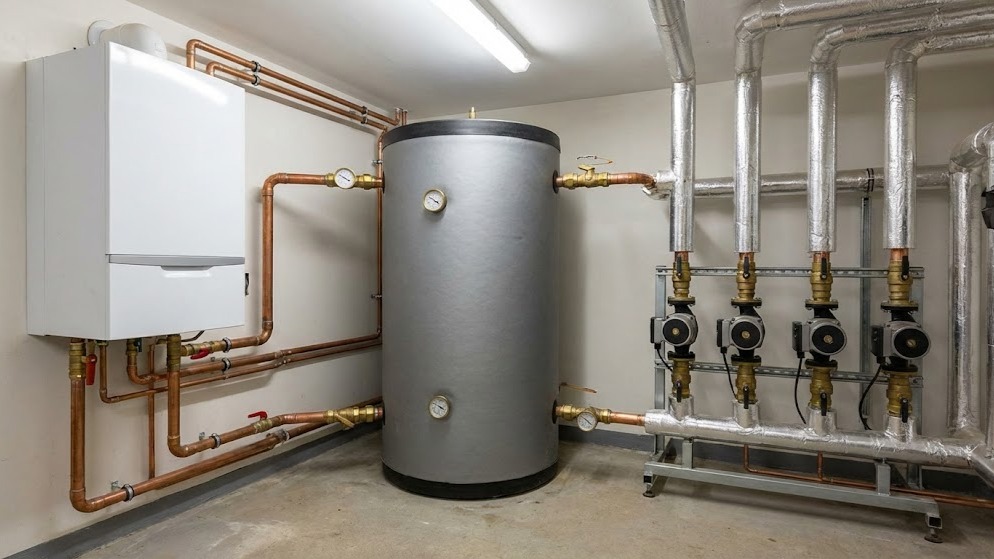
Heat generators achieve their rated efficiency only when operating under optimal conditions. In practice, variable building loads force boilers and heat pumps to cycle frequently or modulate across wide ranges, reducing efficiency below laboratory test conditions. Buffer tanks transform this situation by providing thermal mass that enables heat generators to operate more consistently at their most efficient conditions, regardless of instantaneous building demand.
Understanding how buffer tanks improve buffer tank boiler efficiency and heat pump performance helps justify investment in thermal storage. The efficiency gains, reduced maintenance requirements, and extended equipment life that properly sized buffers provide typically deliver returns exceeding their installed cost within a few years of operation.
The Relationship Between Buffers and Heat Generators
Buffer tanks interact with heat generation equipment by absorbing output when generation exceeds demand and supplementing generation when demand exceeds instantaneous capacity. This decoupling allows heat generators to operate according to their optimal patterns rather than slavishly following every fluctuation in building load.
The buffer tank boiler efficiency relationship works through several mechanisms. Boilers can complete full combustion cycles without premature shutdown, reach and maintain condensing temperatures, and modulate smoothly across their operating range. Each of these factors contributes to efficiency gains that accumulate across thousands of operating hours.
Thermal storage performance benefits apply equally to heat pumps, where stable operating conditions prove even more critical for efficiency. Heat pump coefficient of performance depends heavily on compressor operation patterns, with sustained running at optimal conditions delivering significantly better efficiency than frequent cycling.
The magnitude of improvement depends on the mismatch between generator characteristics and load patterns. Systems with highly variable loads or oversized generators benefit most from buffering, whilst closely matched systems may see smaller gains. Professional assessment identifies where buffering delivers the greatest value.
How Buffers Improve Boiler Performance
Modern condensing boilers achieve their headline efficiency figures only when operating conditions support condensation. Real-world installation conditions often prevent this, leading to actual efficiency substantially below rated performance. Buffer tanks help address several factors that compromise boiler efficiency.
Enabling Condensing Operation
Condensing boilers extract latent heat from combustion products by cooling flue gases below their dew point, causing water vapour to condense and release additional energy. This process only occurs when return water temperature falls below approximately 55°C, with efficiency improving progressively as return temperatures drop further.
Systems without buffers often experience return temperatures too high for condensing operation. Quick cycling and inadequate heat extraction from emitters return water to the boiler before it has cooled sufficiently. The boiler operates in non-condensing mode, achieving efficiency little better than older non-condensing designs.
Buffer tanks support thermal storage performance by enabling complete heat extraction before water returns to the boiler. The extended flow path and additional thermal mass ensure that return temperatures fall to levels supporting condensing operation. Sustained condensing delivers efficiency gains of ten to fifteen percent compared to non-condensing operation.
Quality boilers from manufacturers like Remeha achieve excellent efficiency when system conditions support their design operation. Buffer installation helps create these conditions regardless of building load characteristics.
Reducing Cycling and Thermal Stress
Each boiler start-stop cycle wastes fuel during the purge and ignition sequence before useful heat production begins. Frequent cycling accumulates these losses into significant annual fuel waste. Buffer tanks enable longer run times that amortise start-up losses across greater useful output.
Thermal stress from cycling affects boiler longevity as well as efficiency. Heat exchangers experience temperature cycling that causes expansion and contraction stress. Over thousands of cycles, this stress causes fatigue damage leading to eventual failure. Reducing cycling frequency extends heat exchanger service life proportionally.
Buffer tank boiler efficiency improvements include reduced ignition component wear. Electrodes, ignition transformers, and flame sensing equipment all experience wear during start-up sequences. Reducing start frequency extends the interval between ignition system maintenance or replacement.
The relationship between buffer sizing and cycling reduction follows predictable patterns. Larger buffers enable longer run times but require more space and capital. Optimal sizing balances cycling reduction benefits against practical constraints to achieve the best overall outcome.
Supporting Modulating Operation
Modern boilers modulate their firing rate to match output to demand, improving efficiency compared to simple on-off operation. However, modulation only works effectively when loads remain stable long enough for the boiler to find and maintain appropriate firing rates.
Highly variable loads cause boilers to hunt continuously, modulating up and down without settling at efficient operating points. The constant adjustment wastes fuel and stresses modulation components. Buffer tanks smooth these variations, enabling boilers to modulate to stable firing rates that match averaged demand.
Cascade boiler arrangements particularly benefit from buffering. Multiple boilers serving common loads require stable conditions to sequence efficiently. Buffers prevent the rapid load swings that cause cascade controllers to stage boilers on and off unpredictably.
Circulation pumps from Grundfos ensure effective heat transfer between boilers and buffer tanks. Variable speed pumps prove particularly valuable for matching flow rates to varying boiler outputs whilst maintaining optimal temperature differentials.
How Buffers Enhance Heat Pump Performance
Heat pumps benefit from buffering even more than boilers because their efficiency depends so heavily on stable operating conditions. The coefficient of performance that determines heat pump economics varies significantly with operating patterns.
Defrost Cycle Management
Air source heat pumps periodically reverse their refrigerant cycle to defrost outdoor coils that accumulate ice during cold, humid weather. During defrost, the heat pump extracts heat from the building rather than supplying it, temporarily reversing its function.
Without buffering, defrost cycles cause noticeable temperature drops in supply water that affect building comfort. Occupants experience cooling during the defrost period, followed by temperature recovery that may overshoot before stabilising. These fluctuations compromise comfort despite adequate average heat delivery.
Buffer tanks provide thermal storage performance that maintains supply temperatures during defrost operations. The stored heat substitutes for heat pump output during the defrost period, preventing temperature drops that would otherwise affect the building. Comfort remains consistent regardless of defrost timing.
The buffer volume required for effective defrost management depends on defrost duration and frequency. Colder, more humid climates require more frequent defrost cycles, demanding larger buffers to maintain supply temperatures. Professional sizing considers local climate conditions.
Optimising Compressor Operation
Heat pump compressors achieve their best efficiency during sustained operation at moderate loading. Frequent starting imposes high electrical demand during motor acceleration, whilst running at extreme modulation points reduces thermodynamic efficiency.
Buffer tank boiler efficiency principles apply similarly to heat pump compressors. Stable loads enable compressors to operate continuously at efficient points rather than cycling or hunting across their operating range. The thermal storage performance improvement translates directly to reduced electricity consumption.
Inverter-driven heat pumps modulate compressor speed to match output to demand. This capability improves efficiency compared to fixed-speed units but still benefits from buffering. Stable loads enable inverters to settle at optimal speeds rather than continuously adjusting.
Cold weather performance particularly benefits from buffering. Heat pumps already work harder during cold conditions, making efficiency optimisation especially valuable. Buffers help maintain the stable conditions that support optimal refrigerant cycle operation despite challenging ambient conditions.
Managing Variable Refrigerant Conditions
Heat pump refrigerant cycles operate most efficiently when conditions remain stable. Variable loads cause fluctuating pressures and temperatures within the refrigerant system, reducing thermodynamic efficiency and potentially stressing components.
Buffering smooths the load variations that cause refrigerant system instability. The heat pump sees consistent demand from the buffer charging process rather than erratic demand from building loads. This consistency enables the refrigerant cycle to operate at steady, efficient conditions.
The relationship between buffer sizing and heat pump capacity matters more than for boilers. Heat pumps cannot shed excess capacity as easily as modulating boilers, making adequate buffer volume essential for preventing short cycling and maintaining refrigerant system stability.
Systems combining heat pumps with expansion vessels must account for the additional system volume that buffers introduce. Expansion provision requires reassessment when significant buffer capacity is added.
Measuring Performance Improvements
Quantifying the benefits of buffer installation supports investment decisions and verifies that installed systems perform as expected. Various approaches enable measurement of efficiency gains and operational improvements.
Efficiency Gains Quantification
Energy monitoring before and after buffer installation reveals efficiency improvements directly. Comparing fuel consumption against heat delivery for equivalent periods shows the efficiency gain that buffering provides. Proper measurement accounts for weather differences between comparison periods.
Thermal storage performance improvements appear in generator operating patterns. Monitoring run times, cycle counts, and modulation behaviour reveals how buffering changes generator operation. Longer runs, fewer cycles, and more stable modulation all indicate improved conditions.
Payback calculations compare buffer investment against annual energy savings. Typical commercial installations achieve payback within two to five years depending on generator type, load characteristics, and energy prices. Heat pump installations often achieve faster payback due to their greater sensitivity to operating conditions.
National Pumps and Boilers supplies monitoring equipment that enables ongoing tracking of system performance. Continuous monitoring identifies degradation requiring attention and confirms that efficiency gains persist over time.
Operational Benefits Assessment
Maintenance requirements typically reduce following buffer installation. Fewer start-stop cycles mean less wear on ignition components, controls, and mechanical parts. Maintenance intervals extend whilst unexpected failures decrease.
Equipment longevity improvements may take years to become apparent but represent significant value. Boilers and heat pumps achieving additional years of service provide returns exceeding their buffer investment. This benefit compounds as equipment costs increase over time.
Building comfort often improves noticeably following buffer installation. More stable supply temperatures translate to more consistent space temperatures, reducing complaints and improving occupant satisfaction. This qualitative benefit may prove as valuable as quantifiable efficiency gains.
Conclusion
Buffer tanks improve both buffer tank boiler efficiency and heat pump performance through mechanisms that enable optimal generator operation regardless of building load characteristics. The efficiency gains, reduced maintenance, and extended equipment life that proper buffering provides deliver returns exceeding installation costs.
Understanding thermal storage performance benefits helps justify buffer investment and guides appropriate sizing decisions. Both boilers and heat pumps benefit from buffering, though the specific mechanisms and magnitude of improvement differ between technologies.
Facilities managers and building services engineers seeking to optimise heat generator performance should consider buffer installation as part of comprehensive efficiency programmes. Professional assessment identifies where buffering delivers the greatest benefits for each specific installation.
For guidance on buffer tank specification and quality heating equipment, contact the National Pumps and Boilers team for expert technical support.