

How Flow Meters Help Identify System Problems Early
Commercial heating systems demand precision monitoring to maintain efficiency, prevent costly failures, and ensure regulatory compliance. Without proper oversight, seemingly minor issues escalate into system-wide breakdowns that disrupt operations and inflate energy costs. Modern heating monitoring equipment transforms reactive maintenance into predictive management, giving facilities teams the data needed to optimise performance before problems emerge.
The monitoring equipment market offers diverse solutions ranging from basic temperature sensors to sophisticated building management systems. Each type serves specific functions within commercial heating infrastructure, from tracking boiler performance to managing complex multi-zone distribution networks. Understanding which equipment suits particular applications determines whether a facility achieves genuine operational insight or simply accumulates unused data. Selecting appropriate HVAC measurement devices ensures comprehensive system visibility.
Temperature and Pressure Monitoring Devices
Temperature and pressure sensors form the foundation of any commercial heating monitoring strategy. These HVAC measurement devices provide real-time feedback on system operating conditions, alerting engineers to deviations that signal potential failures or inefficiencies. Proper heating monitoring equipment selection ensures accurate data collection.
Thermocouples and RTD Sensors
Resistance temperature detectors (RTDs) deliver superior accuracy across the temperature ranges typical in commercial heating applications. Unlike thermocouples, RTDs maintain consistent precision throughout their operational lifespan, making them ideal for monitoring flow and return temperatures in boiler circuits. Grundfos pumps frequently integrate with RTD-based monitoring systems to optimise circulation based on actual thermal demand.
Installation locations critically affect sensor reliability. Flow temperature sensors mounted directly in pipework provide faster response times than immersion pockets, though the latter simplify maintenance. Return temperature monitoring enables accurate calculation of system efficiency by measuring the temperature differential across heating circuits.
Pressure Transducers
Pressure monitoring prevents catastrophic failures in commercial heating systems. Transducers continuously measure system pressure at critical points including boiler outlets, pump discharge lines, and expansion vessels. When pressure exceeds safe parameters, automated alerts prevent relief valve discharge or vessel rupture.
Modern pressure transducers output standardised 4-20mA signals compatible with building management systems, enabling centralised monitoring across multiple heating zones. Differential pressure measurement across filters and heat exchangers provides early warning of fouling conditions that reduce efficiency and increase pump energy consumption. This monitoring capability protects system integrity.
Flow Measurement Equipment
Quantifying water flow through commercial heating systems reveals inefficiencies invisible to temperature monitoring alone. Flow meters identify circulation problems, detect leaks, and verify that monitoring equipment receives adequate data for accurate performance calculations.
Ultrasonic Flow Meters
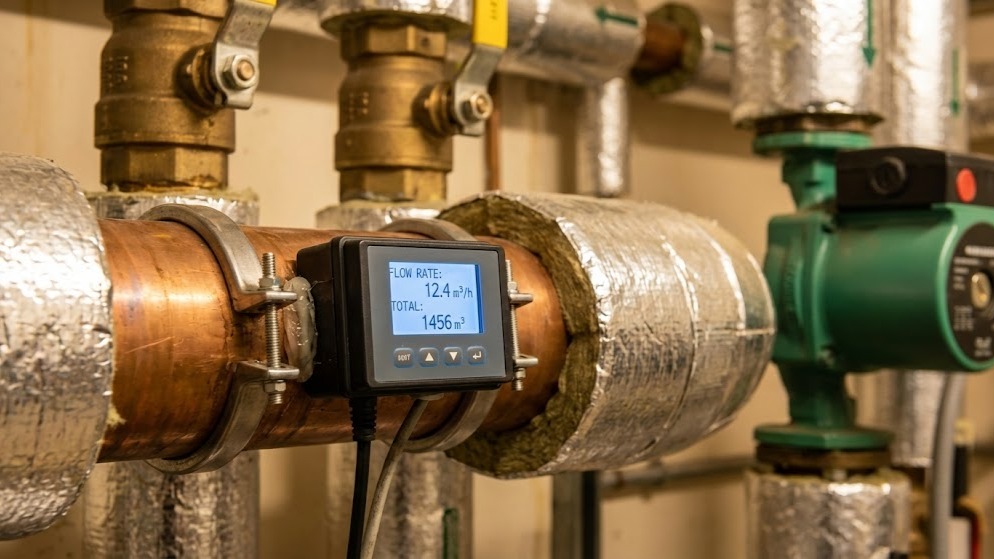
Non-invasive ultrasonic meters clamp onto existing pipework without system shutdown, making them ideal for retrofit monitoring projects. Transit-time ultrasonic technology measures flow velocity by comparing ultrasonic signal propagation in flow direction versus against flow. These devices suit large-bore distribution mains where inline meter installation proves impractical.
Accuracy depends heavily on proper installation. Straight pipe runs of at least ten pipe diameters upstream and five diameters downstream eliminate turbulence that skews readings. Regular verification against known flow conditions maintains measurement integrity as pipe conditions change over time.
Electromagnetic Flow Meters
Electromagnetic meters offer superior accuracy for critical measurement points in commercial heating systems. These inline devices measure flow by detecting voltage generated as conductive fluid moves through a magnetic field. With no moving parts, electromagnetic meters maintain calibration longer than mechanical alternatives whilst introducing minimal pressure drop.
Integration with variable-speed central heating pumps enables sophisticated control strategies. When flow measurement reveals excessive circulation, pump speed reduces automatically to match actual demand, cutting electrical consumption without compromising comfort. These HVAC measurement devices deliver precise data for system optimisation.
Energy Metering Systems
Heat meters quantify thermal energy delivered by commercial heating systems, providing the data essential for accurate cost allocation, performance benchmarking, and efficiency improvement programmes.
Thermal Energy Meters
Combining flow measurement with matched temperature sensors, thermal energy meters calculate heat delivery using the formula: Energy = Flow Rate × Temperature Differential × Specific Heat Capacity. British Standard BS EN 1434 specifies accuracy requirements for fiscal metering applications where heat costs are allocated to individual tenants or departments.
Calculator modules integrate flow and temperature data, compensating for fluid density variations across operating temperatures. Pulse or M-Bus outputs transmit consumption data to building management systems for analysis and reporting. National Pumps and Boilers supplies complete metering packages matched to specific system requirements, ensuring measurement accuracy meets both operational and regulatory standards.
Sub-Metering Strategies
Effective sub-metering divides large commercial heating systems into monitored zones aligned with building usage patterns. Individual meters track consumption for distinct areas such as office floors, warehouse spaces, or retail units. This granular data identifies inefficient zones requiring attention whilst fairly distributing heating costs among multiple occupants.
Meter sizing critically affects accuracy. Oversized meters operating at low flow rates sacrifice precision, whilst undersized units introduce excessive pressure drop. Proper specification considers both peak demand and typical operating conditions to maintain accuracy across the full load range. This metering approach ensures reliable data collection.
Combustion Analysis Equipment
Boiler efficiency depends entirely on combustion quality. Portable and fixed combustion analysers measure flue gas composition, enabling precise burner tuning that maximises efficiency whilst minimising emissions.
Flue Gas Analysers
Modern analysers measure oxygen, carbon monoxide, and carbon dioxide concentrations in flue gases, calculating combustion efficiency from these values combined with flue gas temperature. Annual boiler servicing includes combustion analysis to verify compliance with Building Regulations Part L efficiency requirements.
Fixed analysers providing continuous monitoring detect efficiency degradation between service intervals. When oxygen levels deviate from optimal ranges, automated alerts prompt investigation before efficiency losses accumulate. Integration with boiler controls enables trim adjustments maintaining peak efficiency as fuel characteristics or ambient conditions change.
Emissions Monitoring
Commercial boilers exceeding 20MW thermal input require continuous emissions monitoring under Environmental Permitting regulations. These systems track nitrogen oxide (NOx) and carbon monoxide emissions, generating compliance reports and triggering alarms when emission limits are approached.
Building Management System Integration
Standalone monitoring devices provide limited value without integration into comprehensive building management systems (BMS). These platforms aggregate data from diverse sensors, enabling sophisticated analysis and automated control responses.
Protocol Compatibility
Modern monitoring systems communicate via standardised protocols including BACnet, Modbus, and M-Bus. Protocol selection affects system flexibility and integration costs. BACnet offers superior interoperability across manufacturers, whilst Modbus remains common in industrial applications. M-Bus specifically targets utility metering applications with efficient two-wire connectivity.
Gateway devices bridge legacy equipment using proprietary protocols to modern BMS platforms, extending monitoring capabilities without wholesale system replacement. When specifying new equipment, protocol compatibility deserves equal consideration to measurement accuracy. Heating monitoring equipment integration depends on proper protocol selection.
Data Analytics Capabilities
Raw sensor data requires interpretation to deliver actionable insights. Advanced BMS platforms apply analytics identifying patterns invisible in individual measurements. Degree-day normalisation reveals efficiency trends independent of weather variations. Regression analysis correlates heating consumption with occupancy patterns, identifying wasteful operation during unoccupied periods.
Predictive analytics leverage historical data forecasting equipment failures before they occur. When pump vibration sensors detect bearing wear patterns, maintenance schedules automatically adjust preventing unexpected breakdowns. Contact the team for guidance on selecting monitoring equipment compatible with existing building management infrastructure whilst providing expansion capacity for future requirements.
Pump Performance Monitoring
Circulation pumps consume significant electrical energy in commercial heating systems. Dedicated pump monitoring equipment tracks performance parameters revealing efficiency opportunities and predicting maintenance requirements.
Vibration Analysis
Accelerometers mounted on pump casings detect vibration signatures indicating bearing wear, impeller damage, or mounting problems. Vibration frequency analysis distinguishes normal operation from developing faults, enabling condition-based maintenance that replaces components before catastrophic failure occurs.
Wireless vibration sensors eliminate cabling costs whilst enabling monitoring of pumps in difficult-to-access locations. Battery-powered units transmit periodic measurements to central collectors, building long-term performance histories that identify gradual degradation trends. These HVAC measurement devices simplify retrofit installations.
Power Monitoring
Three-phase power analysers measure electrical consumption, power factor, and current imbalance across pump motor phases. Increasing power consumption at constant load indicates mechanical problems such as bearing friction or impeller fouling. Power factor monitoring identifies motor inefficiency, whilst phase imbalance reveals electrical supply problems requiring attention.
Variable-speed pumps benefit particularly from power monitoring. Comparing actual power consumption against manufacturer performance curves verifies that drive systems operate correctly and that system resistance matches design expectations. Excessive power consumption at given flow rates indicates fouling, valve throttling, or other inefficiencies requiring investigation. Wilo pumps integrate effectively with comprehensive monitoring systems.
Leak Detection Systems
Undetected leaks waste energy, damage buildings, and compromise system pressure. Modern leak detection equipment identifies even minor losses before they escalate into emergency repairs. These measurement devices protect building infrastructure.
Acoustic Leak Detection
Pressurised water escaping through pipe defects generates ultrasonic noise. Sensitive acoustic sensors detect these characteristic frequencies, pinpointing leak locations without destructive investigation. Portable acoustic detectors enable periodic surveys of accessible pipework, whilst permanently installed sensors provide continuous monitoring of critical areas.
Correlation technology compares signals from multiple sensors, calculating precise leak positions along pipe runs. This approach proves particularly valuable in concealed distribution systems where visual inspection proves impossible.
Pressure Decay Testing
Automated pressure testing isolates system sections, monitoring pressure stability over extended periods. Pressure drops exceeding acceptable thresholds indicate leakage requiring investigation. Modern controllers perform tests during unoccupied periods, minimising disruption whilst maintaining continuous leak surveillance.
Wireless Monitoring Solutions
Wireless technology eliminates cabling costs whilst enabling monitoring of previously inaccessible equipment. Battery-powered sensors communicate via mesh networks, transmitting data to central gateways for BMS integration.
LoRaWAN Networks
Long-range wide-area network (LoRaWAN) technology suits large commercial sites with distributed heating equipment. Sensors transmit data up to several kilometres to central gateways, penetrating building structures that defeat conventional wireless protocols. Battery life exceeding five years eliminates maintenance burdens associated with frequent battery replacement. This wireless monitoring approach suits distributed facilities.
Bluetooth and WiFi Solutions
Short-range wireless protocols suit dense sensor deployments in plant rooms and boiler houses. Bluetooth Low Energy sensors communicate with nearby gateways, whilst WiFi-enabled devices connect directly to existing network infrastructure. These approaches simplify installation but require careful network planning ensuring reliable coverage across monitored areas.
Conclusion
Effective commercial heating system management depends on comprehensive monitoring equipment delivering accurate, timely data about system performance. From basic temperature sensors to sophisticated building management integration, each monitoring technology addresses specific operational requirements whilst contributing to overall system insight.
Successful monitoring strategies balance measurement accuracy against installation complexity and ongoing maintenance requirements. Wireless solutions reduce installation costs but introduce battery management considerations. Inline flow meters provide superior accuracy but require system shutdown for installation. Proper equipment selection considers both immediate measurement needs and long-term system evolution.
Modern heating monitoring equipment transforms commercial heating from reactive repair to predictive optimisation. Real-time performance data identifies efficiency opportunities, prevents costly failures, and ensures regulatory compliance. As energy costs rise and emissions regulations tighten, comprehensive monitoring transitions from optional enhancement to operational necessity. National Pumps and Boilers provides technical support to discuss monitoring solutions matched to specific commercial heating system requirements and operational objectives.