

How Monitoring Data Helps Justify Energy Efficiency Upgrades
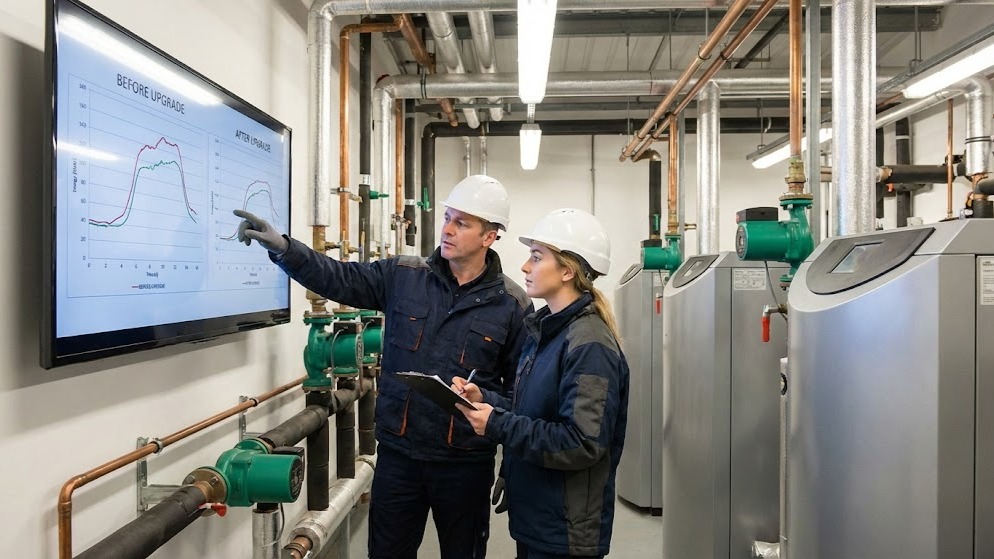
Heating engineers face a familiar challenge when proposing system upgrades: convincing decision-makers to invest in energy-efficient equipment without concrete evidence of current waste. Property managers and facilities directors need more than theoretical savings projections; they require verifiable data that demonstrates where energy disappears and quantifies the financial impact of inefficiency.
Modern monitoring systems transform this conversation. Rather than presenting estimated payback periods based on manufacturer claims, heating professionals can now document actual energy consumption patterns, identify specific inefficiencies, and calculate precise savings potential. This shift from speculation to measurement fundamentally changes how organisations approach capital expenditure decisions for heating infrastructure. Monitoring data efficiency upgrades analysis provides the foundation for confident investment decisions.
National Pumps and Boilers supplies monitoring-compatible equipment alongside traditional heating components, recognising that data-driven decision-making has become standard practice for commercial and industrial facilities throughout the UK.
What Monitoring Systems Actually Measure
Effective monitoring extends beyond simple electricity consumption readings. Comprehensive systems track multiple parameters that reveal system performance and inefficiency sources.
Flow rate monitoring identifies pumps operating at excessive speeds or systems with inadequate circulation. When a Grundfos pump runs continuously at maximum capacity despite variable demand, flow data exposes this waste immediately. The same applies to domestic hot water systems where recirculation pumps maintain unnecessarily high flow rates during low-demand periods.
Temperature differential measurements between flow and return pipes indicate heat transfer efficiency. A narrow temperature differential suggests poor heat exchange, either from oversized pumps moving water too quickly through heat emitters or from system imbalances preventing proper distribution. Commercial buildings frequently discover that specific zones receive excessive flow whilst others remain underserved, creating simultaneous overheating and cold complaints.
Pressure monitoring reveals system losses and pump performance degradation. Gradual pressure drops often indicate developing leaks or air accumulation, whilst excessive pressure points to incorrect pump sizing or failed pressure control equipment. Expansion vessels that no longer maintain proper pre-charge pressure force pumps to work harder, increasing electrical consumption whilst reducing system lifespan. Performance metrics investment analysis requires comprehensive pressure data.
Runtime data exposes control system failures and scheduling inefficiencies. Boilers that fire during unoccupied periods or pumps that run continuously when intermittent operation would suffice represent straightforward waste that monitoring immediately identifies.
Establishing Baseline Performance Before Upgrades
Accurate baseline data proves essential for justifying capital expenditure and measuring post-installation improvements. Installing monitoring equipment 4-8 weeks before proposing upgrades provides sufficient data to establish normal operating patterns across varying weather conditions and occupancy levels.
The monitoring period should capture seasonal variations where possible. A heating system assessed only during mild autumn weather may not reveal the full extent of inefficiency that emerges during peak winter demand. Similarly, summer monitoring of DHW pumps and hot water systems can miss seasonal usage patterns that affect annual energy consumption.
Data collection must account for operational schedules. Schools, offices, and industrial facilities each present distinct usage patterns. A manufacturing plant operating three shifts requires different analysis than an office building with predictable 9-5 occupancy. Weekend and holiday periods often expose control system failures that waste energy when buildings stand empty.
Monitoring reveals the gap between design intent and actual performance. Systems installed 15-20 years ago frequently operate far from original specifications due to component wear, control drift, or building usage changes. A circulation pump specified for 6-metre head might now overcome 9 metres due to partially closed valves, accumulated system debris, or pipework modifications, consuming significantly more electricity than design calculations suggested. Monitoring data efficiency upgrades decisions depend on accurate baseline establishment.
Identifying Specific Inefficiency Sources
Raw monitoring data becomes valuable when analysis identifies specific problems with quantified costs. Several inefficiency patterns appear repeatedly across commercial heating installations.
Constant-speed pumps serving variable loads represent one of the most common waste sources. A fixed-speed circulator moving water at full flow regardless of demand consumes maximum power continuously. Monitoring data showing 24/7 operation at consistent power draw, combined with temperature data revealing unnecessary circulation during low-demand periods, builds a clear case for variable-speed alternatives.
Oversized equipment wastes energy through continuous cycling and poor part-load efficiency. Boilers significantly larger than actual demand fire briefly, shut down, then repeat this inefficient pattern. Monitoring data showing short burn times (under 5 minutes) followed by extended standby periods indicates oversizing. The electrical consumption of pumps cycling on and off adds to the waste.
Failed or absent controls allow equipment to run without purpose. Temperature sensors that no longer provide accurate readings cause boilers to overheat buildings or pumps to circulate unnecessarily. Monitoring systems with independent temperature measurement expose these control failures by showing equipment operation that does not correspond to actual thermal demand.
System imbalances force pumps to work harder whilst delivering poor comfort. When monitoring reveals high flow rates combined with narrow temperature differentials, the system likely suffers from short-cycling or preferential flow paths. Some circuits receive excessive flow whilst others starve, forcing higher overall circulation rates to satisfy all zones. Performance metrics investment in rebalancing delivers rapid returns.
Calculating Financial Impact From Monitored Data
Converting monitoring data into financial projections requires systematic calculation that accounts for actual operating patterns rather than theoretical assumptions.
Electrical consumption costs emerge directly from power monitoring. A 750W circulator running continuously consumes 6,570 kWh annually. At current commercial electricity rates averaging £0.25-0.30 per kWh, this single pump costs £1,640-1,970 yearly. If monitoring reveals the pump actually needs to operate only 60% of the time, the waste amounts to £656-788 annually from this single component.
Gas consumption analysis requires correlating boiler runtime data with weather conditions and building occupancy. Degree-day analysis helps separate heating demand from waste. When monitoring shows boilers consuming gas during mild weather or unoccupied periods, the excess consumption translates directly to unnecessary cost. A commercial boiler wasting 10% of annual gas consumption in a facility using 500,000 kWh yearly represents £2,000-2,500 in avoidable costs at typical commercial gas rates.
Maintenance cost implications appear in monitoring data showing excessive cycling, continuous operation, or components working outside design parameters. Pumps running constantly rather than intermittently require more frequent bearing replacement and seal service. Boilers short-cycling accumulate ignition cycles that accelerate component wear. Quantifying these accelerated maintenance requirements strengthens the business case for efficiency upgrades.
Comfort-related productivity impacts prove harder to quantify but monitoring data showing temperature instability, inadequate heating during occupied periods, or zone imbalances provides evidence of problems affecting building users. Whilst difficult to assign precise financial values, documented comfort complaints correlating with monitored performance issues add weight to upgrade proposals. Monitoring data efficiency upgrades analysis must capture these broader impacts.
Presenting Data to Decision-Makers
Technical professionals understand pump curves and heat loss calculations, but financial decision-makers require different presentations focused on costs, payback periods, and risk mitigation.
Visual data presentation proves more persuasive than tables of numbers. Graphs showing 24-hour pump operation patterns immediately communicate waste when overlaid with building occupancy schedules. Temperature charts revealing overheating or inadequate warmth during occupied hours make comfort problems visible. Trend lines showing gradual efficiency degradation over months demonstrate that problems worsen without intervention.
Comparative scenarios help decision-makers understand options. Present current measured performance alongside projected performance with proposed upgrades, showing specific consumption reductions. Include multiple upgrade pathways, perhaps comparing variable-speed Wilo pumps against current fixed-speed equipment, or high-efficiency condensing boilers against existing conventional models.
Payback calculations should reflect actual monitored consumption rather than theoretical estimates. When monitoring data shows a pump consuming £1,800 annually in electricity, and a variable-speed replacement would reduce this by 50%, the £900 annual saving provides a concrete payback period against the upgrade cost. Including maintenance cost reductions and anticipated energy price increases strengthens the financial case.
Risk factors deserve explicit mention. Monitoring data showing equipment operating outside design parameters indicates elevated failure risk. A circulation pump drawing excessive current or exhibiting bearing noise alongside performance data builds a case for proactive replacement rather than emergency repair. The cost differential between planned upgrades and emergency callouts often justifies earlier action. Performance metrics investment decisions require comprehensive risk assessment.
Monitoring Post-Installation Performance
Installing monitoring equipment before upgrades creates the framework for verifying that improvements deliver promised savings. Post-installation monitoring proves the business case and identifies any commissioning issues requiring adjustment.
Immediate verification catches commissioning problems whilst contractors remain on-site. If a new variable-speed pump does not reduce electrical consumption as projected, monitoring data helps diagnose whether the issue stems from incorrect speed settings, control programming errors, or system conditions different from initial assessment.
Seasonal verification confirms that savings persist across varying conditions. A heating upgrade that performs well in autumn might reveal different characteristics during peak winter demand or summer shutdown. Continuous monitoring through a full year provides confidence that efficiency improvements remain consistent.
Ongoing optimisation uses monitoring data to fine-tune system operation over time. Building usage patterns change, weather varies, and equipment performance gradually shifts. Monitoring systems that initially justified upgrades continue providing value by identifying emerging inefficiencies before they become significant problems.
Documentation for future decisions creates institutional knowledge about what interventions deliver results. When the next upgrade cycle approaches, historical monitoring data showing actual performance improvements from previous projects reduces uncertainty and builds confidence in proposed investments. Monitoring data efficiency upgrades verification ensures accountability.
Regulatory and Compliance Considerations
Building Regulations Part L increasingly emphasises actual energy performance rather than design calculations alone. Monitoring systems provide the evidence required to demonstrate compliance and identify where buildings fall short of regulatory expectations.
Energy Performance Certificate assessments benefit from monitored data showing actual consumption patterns rather than relying solely on theoretical models. When monitored performance significantly exceeds EPC predictions, this discrepancy justifies investigation and remedial action.
SECR reporting requirements (Streamlined Energy and Carbon Reporting) mandate that many organisations report energy consumption and efficiency measures. Monitoring systems provide the granular data needed for accurate reporting whilst identifying opportunities for the efficiency improvements that regulations increasingly require.
Future-proofing against regulatory changes becomes easier with monitoring infrastructure in place. As building energy standards tighten and carbon reporting requirements expand, organisations with established monitoring systems adapt more readily than those starting from zero baseline knowledge. Performance metrics investment protects against regulatory risk.
Equipment Compatibility and Integration
Modern heating equipment increasingly includes monitoring capabilities as standard or optional features, simplifying data collection and reducing installation costs.
Pump-integrated monitoring appears in many commercial circulators from manufacturers including Grundfos, Wilo, and others. These pumps report power consumption, flow rates, and operating hours directly, eliminating the need for separate monitoring hardware. When specifying replacement central heating pumps, selecting models with integrated monitoring adds minimal cost whilst providing ongoing performance visibility.
Boiler management systems in commercial equipment typically include extensive monitoring capabilities. Modern controls track firing rates, runtime hours, efficiency metrics, and fault conditions. Ensuring this data feeds into centralised monitoring systems rather than remaining isolated in individual boiler controllers maximises its value for efficiency analysis.
Building management system integration allows heating equipment monitoring to combine with broader facilities data including occupancy, weather conditions, and other building services. This integration reveals relationships between heating system operation and external factors, enabling more sophisticated analysis than isolated equipment monitoring provides.
Making the Case for Monitoring Investment
Organisations hesitant to invest in efficiency upgrades often resist spending on monitoring equipment first. Framing monitoring as an assessment tool rather than a permanent installation reduces this barrier.
Temporary monitoring programs using rented or borrowed equipment can establish baseline data sufficient for upgrade decisions. A 6-8 week monitoring period provides enough information to identify major inefficiencies and calculate potential savings. The modest cost of temporary monitoring equipment typically represents 1-3% of potential upgrade expenditure, a minor investment for substantially improved decision confidence.
Phased implementation begins with monitoring highest-consumption equipment or systems suspected of significant inefficiency. Initial monitoring might focus on primary circulation pumps and boiler plant in a large commercial building, with expansion to secondary systems once the value becomes evident.
Monitoring as commissioning verification justifies the investment by serving dual purposes. Equipment installed to justify upgrades remains in place to verify that improvements deliver promised results, providing ongoing value beyond the initial assessment period. Performance metrics investment in monitoring infrastructure delivers continuous returns.
Conclusion
Monitoring data transforms energy efficiency upgrades from speculative proposals to evidence-based investments. By documenting actual consumption patterns, identifying specific inefficiency sources, and quantifying financial impacts, heating professionals provide decision-makers with the concrete information required for confident capital expenditure approval.
The shift from theoretical calculations to measured performance reduces uncertainty whilst revealing opportunities that design assessments alone might miss. Systems operating far from original specifications, failed controls, and usage pattern changes all emerge clearly in monitoring data, building compelling cases for intervention. Monitoring data efficiency upgrades analysis has become essential for professional heating system management.
Modern heating equipment increasingly includes monitoring capabilities that simplify data collection whilst providing ongoing performance visibility. Organisations investing in efficiency improvements benefit from verification that upgrades deliver promised savings and early warning of emerging problems requiring attention.
For technical guidance on monitoring-compatible heating equipment and system efficiency improvements, contact the team at National Pumps and Boilers for expert advice tailored to specific facility requirements.