

How Smart Pump Controls Automatically Adjust to Building Demand
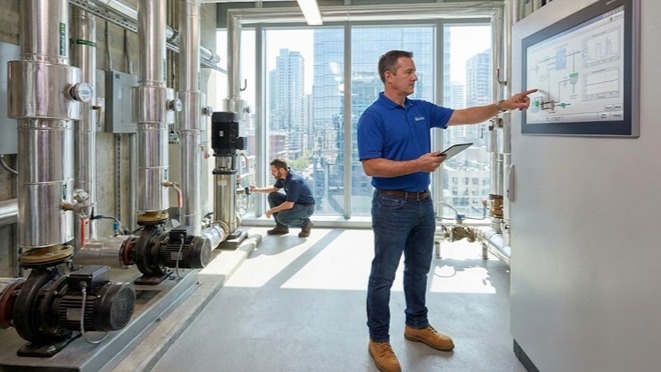
Building heating and cooling systems waste energy when pumps run at full capacity regardless of actual demand. Traditional fixed-speed circulators push water through hydronic systems at constant rates, even when zones close, occupancy drops, or outdoor temperatures reduce heating loads. This inefficiency drives up electricity costs and accelerates component wear.
Smart pump controls eliminate this waste by continuously monitoring system conditions and adjusting pump speed in real time. These intelligent systems use variable frequency drives (VFDs), pressure sensors, and control algorithms to match water flow precisely to building requirements. The result: energy savings of 30-60% compared to fixed-speed operation, alongside improved comfort and extended equipment life.
National Pumps and Boilers supplies smart pump controls integrated with leading brands - equipment that transforms how commercial and large residential buildings manage heating, cooling, and hot water distribution.
How Traditional Fixed-Speed Pumps Waste Energy
Conventional circulators operate at a single speed set during commissioning. When a building's 20-zone heating system only needs to supply five occupied areas, the pump still pushes full flow through the pipework. Control valves throttle flow to closed zones, creating resistance that the pump works against - consuming electricity to generate heat in the motor rather than useful circulation.
This creates three problems. First, electricity costs remain high even during low-demand periods. A 2.2 kW pump running 24/7 at full speed consumes 19,272 kWh annually, costing approximately £4,800 at current commercial rates. Second, constant high-speed operation wears bearings, seals, and impellers faster than variable-speed running. Third, excessive flow velocities generate noise and can cause erosion in pipework and valves.
The Building Regulations Part L recognises this inefficiency. Since 2006, most new commercial heating and cooling systems must incorporate variable-speed pumps with automatic controls that respond to system demand. Yet thousands of older buildings still operate fixed-speed circulators installed before these requirements.
The Technology Behind Automatic Demand Response
Smart pump controls combine three elements: variable frequency drives, pressure or temperature sensors, and control algorithms. The VFD adjusts motor speed by varying electrical frequency supplied to the pump - reducing speed from 2,900 rpm to 1,450 rpm cuts power consumption by approximately 87% according to affinity laws governing centrifugal pumps.
Pressure-Based Control Systems
Pressure sensors mounted in the distribution pipework monitor differential pressure - the difference between supply and return lines. When control valves close in response to satisfied thermostats, differential pressure rises. The control system detects this increase and reduces pump speed until pressure returns to the setpoint. When valves open to meet heating demand, pressure drops, and the pump accelerates.
Temperature-Based Control Strategies
Temperature-based control offers an alternative approach. Sensors measure supply and return water temperatures. A widening temperature differential indicates reduced flow through heat emitters - zones are closed or demand is low. The controller reduces pump speed to narrow the differential back to the target range, ensuring adequate flow through active zones whilst eliminating unnecessary circulation.
Grundfos pumps like the Magna3 and Alpha3 series incorporate these controls directly into the pump assembly. The integrated design simplifies installation and eliminates the need for separate VFD panels and external sensors in many applications.
Proportional Pressure Control vs Constant Pressure
Two control strategies dominate commercial applications: constant differential pressure and proportional differential pressure. Understanding the difference determines energy savings and system performance.
Constant Differential Pressure Operation
Constant differential pressure maintains fixed pressure at the sensor location regardless of flow rate. When demand drops and valves close, the pump slows to maintain the setpoint pressure. This approach suits systems with minimal pipe friction losses or where the most remote heat emitters require full design pressure even at low flows.
Proportional Differential Pressure Benefits
Proportional differential pressure reduces the pressure setpoint as flow decreases. If design pressure is 3 bar at full flow, the controller might target 1.5 bar at 50% flow. This strategy recognises that friction losses in pipework decrease dramatically at lower velocities. A system requiring 3 bar to overcome friction at 10 litres/second might need only 1 bar at 5 litres/second.
The proportional approach typically saves 10-20% more energy than constant pressure control in larger buildings with significant pipe runs. Wilo pumps like the Stratos MAXO series offer adjustable proportional curves that installers can optimise during commissioning to match specific system characteristics.
Integration With Building Management Systems
Modern adaptive pump control systems communicate via BACnet, Modbus, or proprietary protocols, allowing integration with building management systems (BMS). This connectivity enables sophisticated control strategies that respond to occupancy schedules, outdoor temperature compensation, and energy management programmes.
Automated Scheduling and Setback
A BMS can signal pumps to enter night setback mode outside occupied hours, reducing circulation to minimum frost protection levels. During morning warm-up periods, the system can temporarily increase pump speed to accelerate heat delivery before occupants arrive. Weather compensation algorithms adjust pump speed based on outdoor temperature - colder weather triggers higher flow rates whilst mild conditions reduce circulation.
Diagnostic Data and Predictive Maintenance
Integration also provides diagnostic data. BMS dashboards display real-time power consumption, operating hours, alarm conditions, and performance trends. Facility managers receive alerts when pumps operate outside normal parameters, enabling predictive maintenance before failures occur.
The DAB pumps DConnect system exemplifies this approach. Wireless connectivity allows multiple pumps across a building to share data and coordinate operation, optimising the entire distribution network rather than individual circuits in isolation.
Automatic Duty Standby Switching
Large commercial buildings often specify duty-standby pump configurations for redundancy. Traditional systems require manual changeover or simple timer-based rotation. Adaptive pump control automates this process whilst optimising energy use.
Intelligent Load Sharing
Twin-pump controllers monitor both machines continuously. The duty pump handles normal demand using variable-speed control. If demand exceeds the capacity of a single pump, the controller starts the standby unit and modulates both to share the load. When demand drops, the system returns to single-pump operation.
Automatic Rotation for Equal Wear
Automatic rotation ensures equal wear across both pumps. Rather than running one machine continuously until failure, the controller switches duty designation weekly or monthly. This approach extends service life and ensures the standby pump remains exercised and ready for emergency operation.
Advanced systems from manufacturers like Lowara incorporate predictive algorithms that anticipate demand changes. If the system detects rapid pressure drops indicating sudden load increases, it can pre-start the standby pump to prevent pressure dips that affect comfort.
Energy Savings in Real-World Applications
Documented case studies demonstrate the financial impact of smart pump controls. A 15,000 m² office building in Manchester replaced three fixed-speed heating circulators with variable-speed equivalents. Annual electricity consumption for circulation dropped from 47,200 kWh to 18,100 kWh - a 62% reduction worth £7,275 per year. The £12,400 upgrade cost achieved payback in 20 months.
Domestic Hot Water Applications
A Birmingham hotel with 200 rooms upgraded its domestic hot water recirculation system. The original 1.5 kW pump ran continuously at full speed. A smart pump with occupancy-linked controls reduced runtime and speed during low-demand periods. Annual consumption fell from 13,140 kWh to 4,380 kWh, saving £2,190 annually.
Long-Term Financial Impact
These savings compound over equipment life. A pump operating 15 years at reduced energy consumption delivers cumulative savings that dwarf initial investment. The Energy Saving Trust estimates that variable-speed pumps in commercial buildings typically save £1.50-£3.00 per watt of installed pump power annually.
Installation Considerations for Retrofit Applications
Upgrading existing systems to smart pump controls requires attention to several factors. Pipe sizing designed for high-velocity fixed-speed operation may create excessive friction at lower flow rates, limiting the effective turndown range. Systems with undersized pipework might achieve only 30-40% energy savings rather than the 50-60% possible in well-designed installations.
Electrical Infrastructure Requirements
Electrical infrastructure must support VFD operation. Variable frequency drives can generate harmonic distortion that affects sensitive electronic equipment. Installations may require line reactors or isolation transformers to maintain power quality, particularly in buildings with medical equipment or precision manufacturing processes.
Control Valve Authority
Control valve authority becomes critical with variable-speed pumps. Valves must have sufficient authority to regulate flow effectively across the reduced pressure differentials that smart pump controls create. Undersized or poorly selected valves may hunt or fail to close completely, undermining system performance.
Professional Commissioning
Professional commissioning ensures optimal performance. Installers must set pressure setpoints, configure proportional curves, adjust acceleration and deceleration ramps, and verify sensor calibration. Contact us for guidance on selecting and commissioning adaptive pump control systems for specific applications.
Maintenance and Diagnostic Capabilities
Smart pump controls reduce maintenance requirements whilst improving fault detection. Variable-speed operation minimises mechanical stress - bearings, seals, and couplings last longer when pumps spend most operating hours at 60-80% speed rather than continuous full-speed running.
Built-In Diagnostics
Built-in diagnostics monitor parameters that indicate developing problems. Gradual increases in power consumption at a given flow rate suggest bearing wear or impeller damage. Unexpected speed increases to maintain pressure setpoints might indicate control valve failures, pipe blockages, or system leaks.
Operational Data Logging
Many systems log operational data that helps troubleshoot performance complaints. If building occupants report cold zones, facility managers can review pump speed, pressure, and flow data to determine whether circulation issues or other factors cause the problem. This diagnostic capability reduces troubleshooting time and prevents unnecessary component replacement.
The Grundfos range includes pumps with LED displays showing real-time power consumption, flow estimates, and alarm codes. This interface allows maintenance staff to assess pump operation without specialised test equipment or BMS access.
Compliance With Current Building Regulations
The Building Regulations 2010 (as amended) require energy-efficient circulation pumps in most new and substantially renovated buildings. Part L1A (new dwellings) and Part L2A (new buildings other than dwellings) specify that wet central heating systems must use pumps with specific fan power (SFP) values below defined thresholds.
Commercial System Requirements
For commercial buildings, systems with design flow rates exceeding 5 litres/second must incorporate variable-speed drives with automatic controls responding to system demand. Fixed-speed pumps remain acceptable only in small systems where the additional cost of variable-speed control cannot be justified.
ErP Directive Standards
These requirements reflect European ErP (Energy-related Products) Directive standards. Pumps must achieve minimum Energy Efficiency Index (EEI) ratings - typically 0.23 or lower for standalone circulators and 0.20 for pumps with integrated controls. Most smart pump controls from established manufacturers exceed these minimum standards.
Specification documents should reference British Standard BS EN 16297-1, which defines energy efficiency requirements for standalone circulators and circulators integrated in products. This ensures compliance with both Building Regulations and ErP requirements.
Selecting the Right Smart Pump Control System
Application requirements determine the appropriate control strategy and equipment specification. Small commercial buildings or large domestic properties with single-zone or limited multi-zone heating often suit integrated smart pumps like the Grundfos Alpha3 or Wilo Yonos MAXO. These units combine pump, motor, VFD, and control electronics in a compact assembly that replaces traditional circulators directly.
Larger Commercial Systems
Larger commercial systems with multiple circuits, duty-standby requirements, or complex control sequences need dedicated pump controllers. These systems use separate VFD panels that manage one or more pumps whilst interfacing with BMS networks and multiple sensor inputs. Manufacturers like Wilo and Lowara offer pre-engineered control panels that simplify specification and installation.
Proper Pump Sizing
Flow rate, head pressure, and system volume determine pump sizing. Smart pump controls cannot overcome fundamental mismatches between pump capacity and system requirements. Undersized pumps run continuously at maximum speed, eliminating efficiency benefits. Oversized pumps operate at the bottom of their performance curves where efficiency suffers and control stability decreases.
Hydraulic calculations should account for variable-speed operation. Design pressure drops can be lower than traditional fixed-speed systems because pumps can increase speed temporarily during peak demand periods rather than sizing for worst-case continuous operation.
Future Developments in Adaptive Pump Control
Emerging technologies promise further efficiency improvements and enhanced functionality. Machine learning algorithms analyse historical demand patterns and weather data to predict heating and cooling requirements hours in advance. Adaptive pump control systems can pre-adjust speed and staging to match anticipated loads, improving response times and comfort.
Wireless Sensor Networks
Wireless sensor networks eliminate the need for hardwired pressure and temperature sensors. Battery-powered sensors communicate via Bluetooth or proprietary mesh networks, reducing installation costs and enabling sensor placement in locations where wiring proves impractical.
Cloud-Based Analytics
Cloud-based analytics platforms aggregate data from multiple buildings, identifying optimisation opportunities that single-site analysis might miss. Property portfolios can benchmark pump performance across locations, prioritising upgrade investments where savings potential is greatest.
Renewable Energy Integration
Integration with renewable energy systems represents another development area. Smart pump controls can prioritise operation during periods of high solar generation or low-cost grid electricity, shifting energy consumption to times when carbon intensity and costs are lowest.
Conclusion
Smart pump controls deliver measurable benefits: energy savings of 30-60%, reduced maintenance costs, improved comfort control, and compliance with current Building Regulations. These systems automatically adjust circulation to match building demand, eliminating the waste inherent in fixed-speed operation.
The technology has matured beyond early adoption challenges. Reliable products from manufacturers like Grundfos, Wilo, and DAB offer proven performance in thousands of installations. Integration capabilities allow these systems to function as coordinated elements within broader building management strategies rather than isolated components.
For commercial buildings, large residential developments, and industrial facilities, the financial case for adaptive pump control is compelling. Payback periods typically range from 18 months to 3 years, with benefits continuing throughout equipment life. The combination of energy savings, reduced maintenance, and improved system performance makes variable-speed control the clear choice for new installations and retrofit upgrades.
National Pumps and Boilers supplies the complete range of smart pump controls and compatible equipment for heating, cooling, and hot water applications. Get in touch for technical advice on selecting and specifying variable-speed pump systems that match specific building requirements and deliver maximum efficiency gains.