

How Strainer Blockage Reduces Pump Performance (And What It Costs)
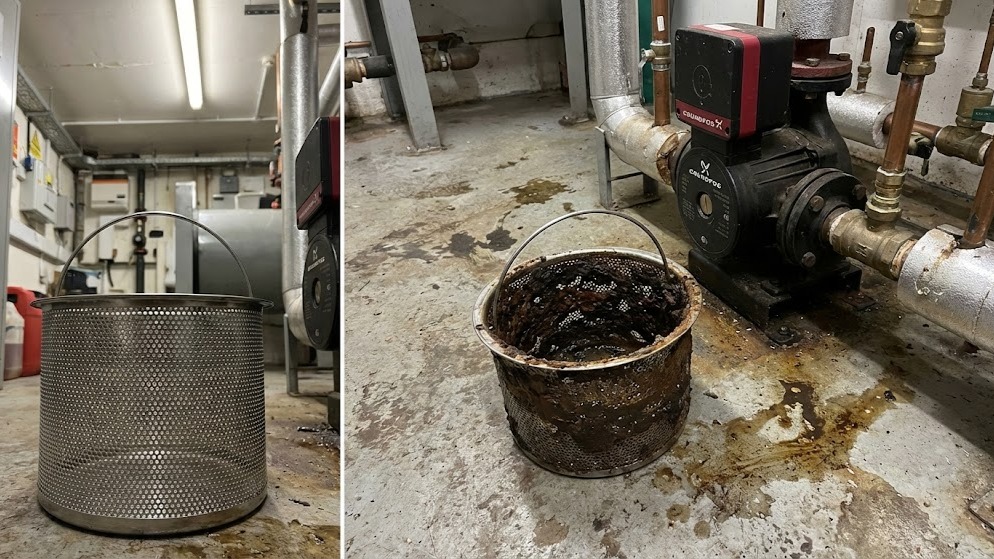
A blocked strainer does not announce itself with alarms or warning lights. Instead, it quietly erodes pump performance, inflates energy bills, and accelerates wear on expensive components. By the time heating engineers notice flow problems or pressure drops, the damage to system efficiency has already been accumulating for weeks.
The financial impact extends beyond immediate energy waste. Strainer blockage forces pumps to work harder, shortens bearing life, increases maintenance frequency, and can trigger complete system failures during peak demand. For commercial heating installations, a single blocked strainer can cost thousands in lost efficiency before anyone identifies the root cause. Understanding blocked strainer performance effects helps prevent these costly failures.
What Happens Inside a Blocked Strainer
Strainers protect pumps by capturing debris before it reaches impellers, bearings, and seals. Every heating system generates contamination: installation swarf, corrosion products, pipe scale, and flux residue all accumulate in system water. The strainer mesh intercepts these particles, but as debris builds up, the open area for water flow progressively shrinks.
When debris covers 30-40% of the mesh surface, flow resistance increases exponentially. Water struggles to pass through the remaining open area, creating a pressure differential across the strainer body. This differential, the difference between inlet and outlet pressure, directly indicates blockage severity.
A clean Y-strainer typically creates minimal pressure drop, often less than 0.1 bar at design flow rates. As blockage develops, this can rise to 0.3 bar, 0.5 bar, or higher. That additional resistance does not just disappear: the pump must work significantly harder to overcome it, consuming more energy and generating additional heat. Clogged filter flow costs accumulate from the moment blockage begins developing.
The blockage pattern matters too. Debris rarely distributes evenly across the mesh. Instead, it tends to accumulate in zones of highest velocity, creating localised restrictions that force water through progressively smaller openings. This uneven blockage can create turbulent flow patterns that amplify energy losses beyond what pressure readings alone might suggest.
How Blockage Degrades Pump Performance
Circulation pumps are designed to deliver specific flow rates against calculated system resistance. When strainer blockage increases that resistance, the pump's operating point shifts along its performance curve. Flow rate drops, pressure differential changes, and efficiency plummets.
Consider a Grundfos pump installation sized to deliver 2.0 m³/h against 4 metres of head. With a clean strainer, the pump operates at its design point, typically where efficiency peaks at 60-70%. Add 0.4 bar (approximately 4 metres) of additional resistance from strainer blockage, and the pump now faces 8 metres total head.
At this new operating point, flow rate might drop to 1.6 m³/h, a 20% reduction. Worse, the pump now operates far from its efficiency peak, converting a greater proportion of electrical input into waste heat rather than useful hydraulic work. Efficiency can drop from 65% to 45% or lower, meaning 44% more energy consumption to move 20% less water.
The relationship between blocked strainer performance and energy waste is not linear. Small amounts of blockage create disproportionate efficiency losses because they push the pump away from its optimal operating range. A strainer that is 50% blocked does not just reduce performance by 50%: it can double energy consumption while delivering only 60-70% of design flow. Clogged filter flow costs escalate rapidly once blockage begins.
Temperature differentials across the system reveal this performance degradation. If return temperatures rise or flow temperatures drop, insufficient circulation from strainer blockage is often responsible. The boiler continues firing, but reduced flow prevents effective heat distribution, creating comfort problems that prompt increased boiler cycling and further energy waste.
Quantifying the Cost Impact
For a commercial heating system with a 1.5 kW circulation pump running 4,000 hours annually, the numbers become stark quickly. At £0.25 per kWh, baseline running costs total £1,500 per year. When strainer blockage forces the pump into inefficient operation, that figure escalates rapidly.
A 40% efficiency loss from moderate blockage increases annual energy consumption to 2,100 kWh, costing £2,100, an extra £600 per year. Severe blockage pushing efficiency down 60% drives costs to £2,400 annually, wasting £900 on a single circulation pump. Scale that across multiple pumps in a commercial building, and annual waste easily reaches £5,000-£10,000.
Energy costs represent only the visible expense. Strainer blockage accelerates mechanical wear throughout the system. Pumps running against excessive resistance generate more heat, stressing bearings and seals. Bearing life, typically rated for 50,000-80,000 hours under design conditions, can halve when pumps operate continuously in overload.
Early bearing failure means unplanned maintenance, emergency callouts, and potential system downtime. Replacing bearings on a commercial circulator costs £300-£600 in parts and labour. If blockage-induced overload triggers failures every 3-4 years instead of 7-8 years, maintenance costs effectively double. Clogged filter flow costs extend well beyond direct energy waste.
System-wide effects multiply these costs. Reduced flow from blocked strainers prevents adequate heat distribution, prompting occupants to increase thermostat settings. The boiler fires more frequently, cycling inefficiently and consuming extra fuel. For a commercial gas boiler, excessive cycling can waste 10-15% of annual fuel consumption, potentially thousands of pounds on larger installations.
Where Blockage Develops Fastest
Not all strainers block at the same rate. Location, system cleanliness, and water treatment determine how quickly debris accumulates. Understanding high-risk positions helps target inspection efforts where they deliver maximum value.
Strainers installed immediately after new pipework face the highest contamination load. Installation debris, including metal filings, pipe dope, flux residue, and cutting oils, concentrates in these positions during initial system fill and commissioning. Even after thorough flushing, residual contamination continues migrating toward strainers for weeks after commissioning.
Older systems with aging steel pipework generate continuous corrosion products. Black iron oxide sludge accumulates steadily, particularly in systems without effective water treatment. Strainers protecting DHW pumps in these installations may require cleaning every 6-12 months to maintain performance.
Systems with poor pressure control experience accelerated debris generation. Frequent pressure fluctuations dislodge scale and corrosion products from pipe walls, sending them toward strainers. Buildings with expansion vessels that have lost their charge or are undersized for the system volume see this effect repeatedly.
Strainer mesh size influences blockage rate significantly. Fine mesh (60-80 mesh) captures smaller particles but blocks faster. Coarse mesh (20-40 mesh) allows longer intervals between cleaning but permits more particles to reach pump internals. Specifying appropriate mesh size requires balancing protection level against maintenance frequency.
Detecting Blockage Before Performance Collapses
Waiting for obvious symptoms, including inadequate heating, pump noise, or complete failure, means accepting weeks or months of efficiency losses. Proactive detection catches blockage early, when cleaning takes minutes and performance remains intact.
Pressure differential measurement provides the most reliable early warning. Installing pressure gauges on both sides of the strainer creates a permanent monitoring system. Record the differential when the strainer is clean, typically 0.05-0.15 bar at design flow. When readings exceed 0.25-0.3 bar, cleaning is required.
For critical installations, differential pressure switches automate this monitoring. Set the switch to trigger at 0.3 bar differential, and it signals when cleaning is needed without requiring manual gauge readings. This approach works particularly well for Wilo pump installations in commercial buildings where multiple strainers need monitoring.
Flow rate measurement offers another detection method. Ultrasonic flow meters installed on the pump discharge reveal when flow drops below design values. A 10-15% flow reduction typically indicates developing blockage, even before pressure differentials become obvious. This method works best on systems with stable heat loads where flow rates should remain relatively constant.
Temperature monitoring can indicate blockage indirectly. If return temperatures rise while flow temperatures remain constant, insufficient circulation is likely. Compare current temperature differentials to commissioning data: significant changes often point to strainer blockage reducing system flow.
Energy monitoring provides the business case for regular inspection. Smart meters tracking pump power consumption reveal when electrical draw increases above baseline. A 20-30% increase in pump energy consumption, without corresponding changes in system demand, typically indicates blockage forcing the pump into inefficient operation.
Proper Cleaning Procedures That Restore Full Performance
Cleaning a blocked strainer seems straightforward: isolate the pump, remove the strainer cap, extract the mesh, and rinse it clean. In practice, shortcuts during this process often leave residual debris that allows blockage to redevelop rapidly.
Before opening the strainer, isolate both sides with pump valves and drain the section. Many engineers skip full drainage, assuming they can work quickly to minimise spillage. This approach leaves water in the strainer body that carries debris into the mesh threads and sealing surfaces, creating leaks when reassembled.
Remove the strainer cap carefully, noting the orientation of any gasket or seal. The mesh basket often contains significant debris that can spill into the valve body if removed carelessly. Extract the basket slowly, keeping it upright until clear of the strainer body.
Inspect the mesh under good lighting before cleaning. Heavy debris buildup, particularly if compacted into the mesh, may indicate inadequate system cleaning or absent water treatment. Photograph the debris: it provides valuable evidence if discussing system cleanliness with clients or contractors.
Rinse the mesh thoroughly from the clean side (inside surface) outward, using water pressure to push debris through the mesh rather than forcing it deeper into the openings. A hosepipe or pressure washer works effectively, but avoid excessive pressure that might damage fine mesh. Backflushing, flowing water opposite to normal flow direction, removes trapped particles most effectively.
Examine the mesh after cleaning for damage. Corrosion, tears, or deformation compromise filtration effectiveness. Even small holes allow debris to pass through, defeating the strainer's protective function. Replace damaged mesh rather than reinstalling it.
Clean the strainer body interior, removing any debris from the cap threads and sealing surfaces. Old gasket material or debris on sealing surfaces causes leaks that require repeated rework. Replace the gasket or O-ring every time: reusing old seals risks leaks that necessitate another isolation and reopening.
Reassemble carefully, ensuring the mesh basket seats properly in the body. Tighten the cap to manufacturer specifications: overtightening can damage threads or distort sealing surfaces, while insufficient tightening causes leaks. Record the date and any observations in the system logbook.
After returning the system to service, monitor pressure differential and flow rate to confirm full performance restoration. If readings do not return to commissioning values, residual blockage or other system issues require investigation. Proper maintenance prevents ongoing performance degradation.
Preventing Blockage Through System Design and Maintenance
Regular cleaning addresses blockage after it develops. Proper system design and maintenance prevent excessive debris generation, extending intervals between strainer service and protecting pump longevity.
System cleanliness during installation determines baseline contamination levels. Thorough flushing before commissioning removes installation debris that would otherwise migrate to strainers. Power flushing older systems before pump replacement eliminates accumulated sludge that causes rapid strainer blockage on new equipment.
Chemical water treatment controls ongoing corrosion and scale formation. Inhibited glycol mixes or dedicated corrosion inhibitors protect steel pipework, reducing the iron oxide sludge that blocks strainers in untreated systems. For commercial installations, this single measure can extend strainer cleaning intervals from 6 months to 2-3 years.
Magnetic filters installed upstream of strainers capture ferrous debris before it reaches the mesh. These devices trap iron oxide particles using powerful magnets, removing them from circulation without creating flow resistance. Regular filter cleaning, typically every 6-12 months, prevents debris accumulation that would otherwise load strainers.
Pressure control prevents debris mobilisation. Stable system pressure, maintained by properly sized expansion vessels and correct fill pressure, minimises pressure fluctuations that dislodge scale and corrosion products. Systems that regularly lose pressure or experience frequent pressure relief valve discharge generate significantly more debris.
Strainer sizing affects blockage frequency. Oversized strainers with greater mesh surface area accumulate debris more slowly than undersized units. Specifying strainers with 50-100% excess capacity compared to minimum requirements extends cleaning intervals substantially, particularly in systems with known contamination issues.
When to Replace Rather Than Clean
Strainer bodies and mesh baskets eventually reach end of life. Recognising when replacement is more cost-effective than continued cleaning prevents false economy that leads to pump damage.
Corroded strainer bodies with pitted internal surfaces or damaged threads create recurring leak problems. After 15-20 years in aggressive water conditions, replacement often costs less than repeated repairs. Leaking strainers allow air ingress that causes pump cavitation and accelerated bearing wear, problems far more expensive than a new strainer.
Mesh baskets that require cleaning every 4-6 weeks indicate system contamination exceeding the strainer's capacity. Rather than accepting this maintenance burden indefinitely, installing a larger strainer or adding upstream magnetic filtration addresses the root cause. National Pumps and Boilers supplies strainers in various sizes specifically for these upgrade situations.
Strainers in systems with recurring blockage despite regular cleaning may have mesh sizes poorly matched to the debris profile. If fine particles consistently pass through coarse mesh, or if fine mesh blocks too rapidly, replacing the basket with appropriate mesh specification solves the problem permanently.
Conclusion
Strainer blockage represents one of the most common yet preventable causes of pump efficiency loss in heating systems. The performance degradation develops gradually, making it easy to overlook until energy costs have escalated significantly or pump failures occur. Understanding these effects enables early intervention.
The financial case for regular strainer inspection is compelling. Spending 30 minutes every 6-12 months to check and clean strainers prevents hundreds or thousands of pounds in wasted energy, extends pump life, and maintains system reliability. For commercial installations, this simple maintenance task delivers returns measurable in reduced energy bills within a single heating season.
Pressure differential monitoring, proper cleaning procedures, and preventive measures like water treatment and magnetic filtration transform strainer maintenance from reactive firefighting to planned, cost-effective system care. The pumps run efficiently, energy consumption stays within design parameters, and unexpected failures become rare. Clogged filter flow costs become a non-issue with proper maintenance protocols.
For technical guidance on strainer selection, cleaning procedures, or system protection strategies, contact the team at National Pumps and Boilers for expert support tailored to specific installation requirements.