

How to Assess the Remaining Service Life of Your Existing Pumps
Pump failures in commercial buildings rarely announce themselves with convenient warning signs. One day a circulator runs smoothly, the next it seizes during peak demand, leaving heating zones offline and occupants complaining. For facilities managers overseeing multiple sites, the question isn't whether pumps will eventually fail - it's how to predict when that failure will occur before it disrupts operations.
The average central heating pump installed in a commercial system operates between 12,000 and 15,000 hours annually. At this duty cycle, even premium equipment from manufacturers like Grundfos or Wilo shows measurable degradation after 8-10 years. The challenge lies in distinguishing pumps approaching end-of-life from those with years of reliable service remaining through effective pump lifespan assessment.
This assessment requires more than visual inspection. Bearing wear, impeller erosion, seal degradation, and motor winding deterioration all progress invisibly until performance drops below acceptable thresholds. Systematic evaluation prevents both premature replacement (wasting capital) and reactive failures (costing far more in emergency repairs and system downtime).
Performance Testing: Establishing Current Operating Capacity
The most reliable indicator of pump remaining service life comes from comparing current performance against nameplate specifications. This requires measuring three critical parameters under actual operating conditions.
Flow Rate Verification
Install ultrasonic flow meters on the pump discharge line during normal system operation. Compare measured flow against the design specification. A DHW pump originally rated for 45 litres per minute that now delivers only 38 l/min has lost 15% capacity - significant impeller wear or internal recirculation through degraded seals.
For systems without permanent flow measurement, portable clamp-on ultrasonic meters provide accurate readings without system shutdown. Take measurements at multiple points across the pump's normal operating range, not just at a single speed setting. Variable-speed pumps that perform acceptably at 80% speed but fail to meet demand at 100% speed reveal declining mechanical condition.
Differential Pressure Analysis
Measure suction and discharge pressure simultaneously while recording flow rate. Plot these values against the pump's published performance curve. Pumps operating significantly below their curve - delivering less head at a given flow rate - indicate worn impellers, increased internal clearances, or cavitation damage.
A properly maintained Grundfos UPS2 circulator should deliver 4.5 metres of head at 2.5 cubic metres per hour. The same pump measuring only 3.8 metres at that flow rate has lost 15% of its pressure-generating capacity. This degradation accelerates as clearances widen and efficiency drops further.
Power Consumption Monitoring
Record actual power draw using a quality power analyser, not just the building management system's estimates. Compare against nameplate ratings and the manufacturer's power curves. Pumps drawing significantly more power than specified for their current duty point indicate mechanical problems - seized bearings, rotor rub, or motor winding deterioration.
Conversely, pumps drawing less power than expected while delivering reduced flow often have severe internal wear. The motor spins freely because the impeller no longer moves sufficient water, reducing load on the motor but failing to meet system requirements. This performance testing data is crucial for accurate pump lifespan assessment.
Physical Inspection: Identifying Wear Patterns
Performance testing reveals declining capacity, but physical inspection identifies specific failure modes and estimates how rapidly degradation will progress.
Bearing Condition Assessment
Bearing failure accounts for approximately 40% of pump breakdowns in commercial heating systems. Early detection prevents catastrophic failure and secondary damage to shafts, seals, and motor windings.
Use a quality vibration analyser to measure bearing frequencies in three axes. Compare readings against ISO 10816 standards for rotating machinery. Velocity measurements exceeding 4.5 mm/s indicate developing problems; readings above 7.1 mm/s require immediate attention. Handheld vibration pens provide rough screening, but proper analysis requires frequency spectrum capability to identify specific bearing defects.
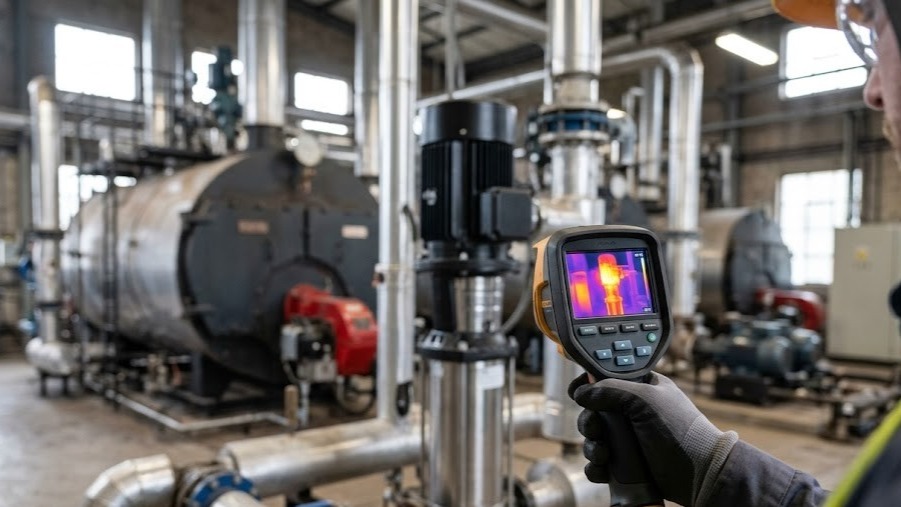
Temperature measurement supplements vibration analysis. Bearing housings running more than 10°C above ambient temperature (or significantly hotter than identical pumps in the same plantroom) indicate inadequate lubrication, bearing preload issues, or early bearing failure. Thermal imaging cameras quickly survey multiple pumps, identifying outliers for detailed investigation.
Seal and Coupling Examination
Mechanical seal leakage often progresses gradually. A pump weeping a few drops weekly may continue for months, while another develops a steady drip that rapidly accelerates to a stream. Inspect the seal drain port and pump base for crystalline deposits, corrosion, or water staining.
Check coupling alignment using dial indicators or laser alignment tools. Misalignment exceeding 0.1mm radial or 0.2mm axial accelerates bearing wear and creates vibration that damages seals. Pumps that were properly aligned during installation but now show significant misalignment have likely experienced foundation settlement or pipe strain - issues that will continue degrading components regardless of seal replacement.
Motor Winding Assessment
Motor failures in modern circulators typically result from overheating caused by mechanical problems rather than electrical defects. Insulation resistance testing using a 500V megohmmeter should show at least 100 megohms to ground for healthy windings. Readings below 50 megohms suggest moisture ingress or insulation deterioration.
Thermal imaging during operation reveals hot spots indicating winding failures, inadequate cooling, or excessive current draw in specific phases. Three-phase motors showing temperature differences exceeding 15°C between phases have developing winding faults that will progress to complete failure.
Operational History: Pattern Recognition
Equipment maintenance records reveal patterns that predict pump remaining service life more accurately than single-point inspections.
Maintenance Frequency Trends
Pumps requiring increasingly frequent attention follow a predictable failure curve. A circulator needing bearing lubrication annually for its first eight years, then requiring it every six months, signals accelerating wear. Similarly, seal replacements moving from 5-year intervals to 18-month intervals indicate deteriorating mechanical condition - worn shafts, damaged seal faces, or housing wear that prevents proper seal seating.
Review the past three years of maintenance records. Calculate the average interval between interventions. If that interval has decreased by 30% or more, the pump has entered the wear-out phase of its lifecycle and warrants replacement planning.
Failure Mode Analysis
The specific components requiring replacement reveal underlying conditions. Repeated seal failures suggest shaft wear, misalignment, or system contamination. Recurring bearing problems indicate lubrication issues, excessive vibration, or installation problems. Multiple motor failures point to electrical supply problems, inadequate ventilation, or mechanical overload.
A Wilo Stratos pump that consumed three mechanical seals in two years likely has shaft sleeve wear or housing damage that prevents proper seal operation. Replacing the seal again addresses the symptom, not the cause. The pump requires complete refurbishment or replacement.
System Integration: Context Matters
A pump's remaining service life depends partly on the system it serves. Identical pumps in different applications experience vastly different stress levels.
Operating Duty Cycle
Pumps running continuously at a steady load last longer than those cycling frequently or operating at extremes of their performance envelope. A primary heating circulator running 24/7 at 70% capacity experiences less stress than a booster pump cycling 15 times hourly between zero and 100% flow.
Calculate annual operating hours from building management system logs or runtime meters. Multiply by the average load percentage. A pump with 80,000 operating hours at 60% average load has experienced less actual wear than one with 60,000 hours at 90% load.
Water Quality Impact
System water chemistry profoundly affects pump longevity. Dissolved oxygen accelerates corrosion of ferrous components. Hardness causes scale buildup in tight clearances. Suspended solids erode impellers and damage seals.
Test system water for pH, hardness, dissolved oxygen, iron content, and suspended solids. Compare results against BSRIA BG29 guidelines for water treatment in closed heating systems. Pumps operating in systems with poor water quality require more aggressive replacement planning regardless of their current mechanical condition.
Thermal Stress Factors
Pumps handling water above 80°C experience accelerated seal and bearing degradation. DHW circulation pumps on systems maintaining 65°C for legionella control operate under significantly more stress than space heating circulators at 50°C.
Review system temperature logs. Pumps experiencing frequent temperature cycling - particularly rapid cooling followed by reheating - develop thermal stress cracks and seal deterioration faster than those at constant temperature, directly impacting pump lifespan assessment calculations.
Economic Decision Framework
Technical assessment identifies declining condition, but economic analysis determines optimal replacement timing.
Efficiency Degradation Costs
Pump efficiency drops as internal clearances increase and surfaces roughen. A circulator originally achieving 45% wire-to-water efficiency may degrade to 35% after ten years of service. For a 200W pump running 8,000 hours annually, this 10-percentage-point loss costs approximately £160 per year in excess electricity consumption at current UK commercial rates.
Calculate the energy cost difference between the existing pump's current efficiency and a modern replacement. Grundfos Alpha pumps with permanent magnet motors and automatic adaptation achieve 70-80% efficiency - nearly double that of older fixed-speed models. The energy savings alone may justify replacement before mechanical failure occurs.
Failure Risk Quantification
Estimate the cost of unplanned pump failure: emergency callout charges (typically £300-500 outside normal hours), expedited parts delivery, system downtime costs, and potential secondary damage. Compare this against the cost of planned replacement during scheduled maintenance.
For critical applications - primary heating circulators in care homes, DHW pumps in hotels, pressurisation pumps in high-rise buildings - the risk cost of unexpected failure often exceeds the equipment replacement cost. This shifts the economic optimum toward earlier replacement.
Implementing a Structured Assessment Programme
Ad-hoc pump inspections catch problems after symptoms appear. Systematic assessment programmes predict failures before they impact operations, enabling accurate pump lifespan assessment.
Quarterly Visual Surveys
Walk the plantroom quarterly, documenting visible indicators: unusual noise, vibration, leakage, overheating, or coupling wear. Photograph each pump from consistent angles to track gradual changes invisible during daily rounds. A seal that showed no leakage in January but displays minor weeping in April will likely require replacement before the next heating season.
Annual Performance Verification
Once yearly, measure flow, pressure, and power consumption for all critical commercial circulators. Compare results against previous years and nameplate specifications. Plot performance trends to identify gradual degradation before it causes operational problems.
Condition-Based Monitoring for Critical Assets
Install permanent vibration sensors and temperature monitoring on pumps whose failure would cause significant disruption. Modern wireless sensors transmit data to building management systems, triggering alerts when readings exceed preset thresholds. This continuous monitoring catches rapid deterioration between scheduled inspections, providing real-time pump remaining service life data.
Conclusion
Assessing pump remaining service life requires combining performance testing, physical inspection, operational history, and system context into a comprehensive pump lifespan assessment. Pumps showing more than 15% performance degradation, increasing maintenance frequency, or operating in demanding conditions warrant replacement planning regardless of their calendar age.
The most costly approach treats all pumps identically - either replacing them on fixed schedules (wasting serviceable equipment) or running them to failure (accepting unnecessary downtime and emergency costs). Systematic assessment identifies which pumps require immediate attention, which need monitoring, and which will provide years of additional service.
National Pumps and Boilers supplies replacement circulators, booster sets, and system pumps from manufacturers including Grundfos, Wilo, and DAB, along with the technical guidance to select equipment properly matched to system requirements. For assistance evaluating your existing pump installations or specifying replacements, contact us for expert advice on extending system reliability while controlling lifecycle costs.