

How to Calculate Annual Energy Costs for Your Commercial Pump System
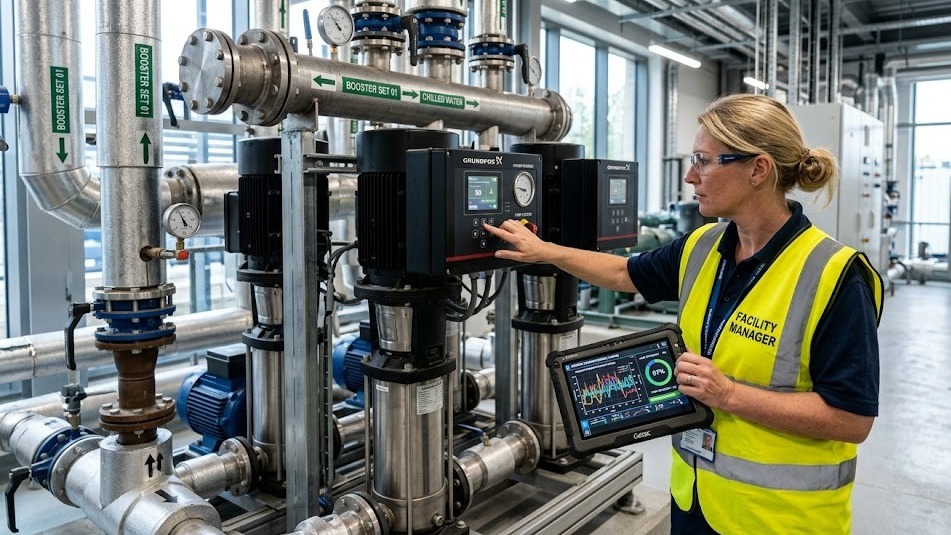
Commercial pump systems account for 20-40% of total energy consumption in most industrial facilities, yet many building managers struggle to accurately predict their running costs. A single 15kW circulation pump operating continuously can cost over £18,000 annually in electricity alone - making it essential to calculate pump energy costs accurately for budgeting, system optimisation, and equipment selection decisions.
Understanding how to calculate pump energy costs transforms energy bills from mysterious overhead into manageable, predictable expenses. This guide provides heating engineers, facilities managers, and mechanical contractors with the practical formulas, real-world examples, and cost-reduction strategies needed to control commercial pump operating expenses through effective pump running costs calculator methodologies.
The Basic Formula for Pump Energy Cost Calculation
The fundamental equation for calculating annual pump energy costs combines electrical consumption with operating hours and electricity rates:
Annual Energy Cost = (Motor Power × Operating Hours × Electricity Rate) / Motor Efficiency
Breaking this down into practical steps:
- Determine motor power rating - Found on the pump nameplate, typically measured in kilowatts (kW)
- Calculate annual operating hours - Multiply daily runtime by 365 days
- Apply current electricity rate - Use your commercial rate per kWh, typically 15-25p for UK businesses
- Factor in motor efficiency - Modern IE3 motors run at 90-95% efficiency; older models may be 75-85%
For a 7.5kW pump running 6,000 hours annually at £0.18/kWh with 92% efficiency:
Annual Cost = (7.5kW × 6,000 hours × £0.18) / 0.92 = £8,804
This baseline calculation provides the starting point, but real-world costs require adjustments for variable speed operation, load factors, and seasonal demand changes.
Understanding Motor Load Factors and Actual Power Draw
Pump nameplates display maximum rated power, but actual energy consumption depends on system demand. A 15kW pump rarely operates at full capacity continuously - typical load factors range from 60-85% depending on system design and control strategies.
Calculating Actual Power Consumption
Actual Power Draw = Rated Power × Load Factor × Motor Efficiency
A 15kW pump operating at 70% load with 93% motor efficiency actually draws:
15kW × 0.70 × 0.93 = 9.76kW
Over 8,760 hours (continuous annual operation) at £0.19/kWh:
Annual Cost = 9.76kW × 8,760 hours × £0.19 = £16,243
Compare this to the assumption-based calculation using full nameplate power:
15kW × 8,760 hours × £0.19 = £24,966
The difference of £8,723 demonstrates why accurate load factor assessment matters for budget forecasting and system optimisation decisions. When facilities managers calculate pump energy costs with proper load factor analysis, they avoid overestimating annual expenditure by 30-50%.
Accounting for Variable Speed Drive Efficiency
Variable speed drives (VSDs) reduce energy consumption by matching pump output to actual system demand, but they introduce additional efficiency considerations. VSDs themselves consume 2-5% of transmitted power as heat loss, while enabling 20-60% overall energy savings through reduced motor speed. Grundfos pumps with integrated VSD technology offer precise flow control and substantial energy reductions.
VSD Energy Calculation
Actual Power = (Motor Power × Load Factor³) / (Motor Efficiency × VSD Efficiency)
The cube relationship reflects the affinity laws - reducing pump speed by 20% cuts power consumption by approximately 50%. For a system operating at 70% speed:
Power Reduction = (0.70)³ = 0.343 (65.7% energy savings)
A 22kW pump running at 70% speed with 93% motor efficiency and 96% VSD efficiency:
Actual Power = (22kW × 0.343) / (0.93 × 0.96) = 8.44kW
Annual cost at £0.20/kWh for 7,500 hours:
8.44kW × 7,500 hours × £0.20 = £12,660
Without VSD, the same pump at fixed speed would cost:
22kW × 7,500 hours × £0.20 = £33,000
The VSD saves £20,340 annually - typically recovering installation costs within 18-36 months for commercial applications.
Calculating Seasonal and Part-Load Operation Costs
Commercial heating systems rarely operate at constant load throughout the year. Accurate pump running costs calculator methods require breaking annual operation into seasonal periods with different runtime and load characteristics.
Seasonal Calculation Method
- Heating Season (October-April, 5,040 hours) - 85% average load
- Shoulder Season (May, September, 1,460 hours) - 40% average load
- Summer DHW Only (June-August, 2,190 hours) - 25% average load
- Standby/Off (1,070 hours) - 0% load
For an 11kW central heating pump with 91% motor efficiency at £0.18/kWh:
- Heating Season: (11kW × 0.85 × 5,040 × £0.18) / 0.91 = £9,307
- Shoulder Season: (11kW × 0.40 × 1,460 × £0.18) / 0.91 = £1,273
- Summer DHW: (11kW × 0.25 × 2,190 × £0.18) / 0.91 = £1,187
- Total Annual Cost: £11,767
This seasonal approach provides 15-25% more accurate cost projections than simple full-load calculations, enabling better budget planning and identifying optimisation opportunities during specific operational periods.
Factoring in Duty-Standby Pump Configurations
Commercial systems typically include duty-standby or duty-assist pump arrangements for reliability. These configurations affect energy costs through alternation schedules, simultaneous operation periods, and standby power consumption.
Duty-Standby Calculation (Alternating Weekly)
Two identical 18.5kW pumps alternating weekly with one always off:
- Operating pump: 18.5kW × 4,380 hours (50% of year)
- Standby pump: 0.05kW standby power × 4,380 hours
- Each pump runs half the total hours
Annual cost at £0.19/kWh with 92% efficiency:
- Duty pump: (18.5kW × 4,380 × £0.19) / 0.92 = £16,820
- Standby consumption: 0.05kW × 4,380 × £0.19 = £42
- Total per pump: £16,862 × 2 pumps = £33,724 annual system cost
Duty-Assist Configuration (Both Running at Peak)
Same pumps with both operating during 2,000 peak hours and alternating for 6,760 base load hours:
- Peak period: (37kW × 2,000 × £0.19) / 0.92 = £15,304
- Base period: (18.5kW × 6,760 × £0.19) / 0.92 × 2 pumps = £27,086
- Total annual cost: £42,390
Understanding configuration impacts helps facilities managers evaluate whether duty-assist operation justifies the 26% cost increase for enhanced capacity during peak demand periods.
Incorporating Time-of-Use Tariffs and Peak Demand Charges
Commercial electricity tariffs vary significantly by time of day, with peak rates 2-4 times higher than off-peak. Facilities with time-of-use tariffs must calculate pump costs across different rate periods.
Example Time-of-Use Structure
- Peak (weekdays 16:00-19:00): £0.35/kWh - 780 hours annually
- Standard (weekdays 07:00-16:00, 19:00-23:00): £0.19/kWh - 3,640 hours annually
- Off-peak (nights and weekends): £0.12/kWh - 4,340 hours annually
For a 30kW commercial system with Wilo pumps operating continuously at 75% load and 94% efficiency:
- Peak cost: (30kW × 0.75 × 780 × £0.35) / 0.94 = £6,531
- Standard cost: (30kW × 0.75 × 3,640 × £0.19) / 0.94 = £13,982
- Off-peak cost: (30kW × 0.75 × 4,340 × £0.12) / 0.94 = £10,470
- Total annual cost: £30,983
Compare this to a flat-rate calculation at average £0.19/kWh:
(30kW × 0.75 × 8,760 × £0.19) / 0.94 = £37,817
The time-of-use tariff saves £6,834 annually, but only if operational patterns already align with off-peak periods. Shifting pump operation schedules specifically to exploit tariff structures requires careful analysis of system requirements and temperature control implications.
Using Actual Meter Data for Verification and Adjustment
Theoretical calculations provide planning baselines, but actual meter readings reveal real-world consumption including inefficiencies, control issues, and unexpected operating patterns. Comparing calculated versus measured consumption identifies optimisation opportunities.
Verification Process
- Record baseline meter reading at the pump isolator or dedicated sub-meter
- Calculate expected consumption using formulas above for the measurement period
- Compare actual versus calculated - variances above 10% warrant investigation
- Adjust calculations using actual consumption data for future projections
A facilities manager calculated £14,200 annual cost for a 12kW system but measured actual consumption showed £18,500 - a 30% variance indicating:
- Pump operating at higher load than designed (oversized for application)
- Motor efficiency degradation (bearings, alignment issues)
- Control system malfunction (pump not modulating properly)
- Incorrect baseline assumptions (longer runtime than planned)
Installing sub-metering on major pump systems costs £200-800 per circuit but provides the data accuracy needed for energy management, maintenance scheduling, and equipment replacement decisions. National Pumps and Boilers supplies compatible metering solutions for most commercial pump installations.
Calculating Lifecycle Costs: Energy Versus Capital Investment
Purchase price represents only 10-20% of total pump lifecycle costs - energy consumption over 15-20 years typically costs 5-10 times the initial equipment investment. Lifecycle cost analysis justifies premium efficiency equipment and VSD retrofits.
Lifecycle Cost Comparison
Standard Efficiency Pump:
- Equipment cost: £3,200
- Annual energy cost: £12,400 (15kW, 7,000 hours, £0.19/kWh, 89% efficiency)
- 15-year energy cost: £186,000
- Total lifecycle cost: £189,200
Premium Efficiency Pump with VSD:
- Equipment cost: £6,800 (£3,600 premium)
- Annual energy cost: £6,820 (30% average speed reduction, 96% VSD efficiency)
- 15-year energy cost: £102,300
- Total lifecycle cost: £109,100
The premium efficiency option saves £80,100 over system life despite costing £3,600 more initially - a 2,123% return on the efficiency investment. Simple payback occurs in 7.7 months, making this decision financially obvious for any system with multi-year service life.
When specifying replacement DHW pumps or upgrading existing systems, lifecycle cost analysis demonstrates why selecting equipment solely on purchase price costs significantly more in the long term.
Practical Tools and Resources for Ongoing Cost Monitoring
Several practical tools help mechanical contractors and facilities managers maintain accurate energy cost tracking:
Pump Energy Calculator Spreadsheets: Create custom pump running costs calculator spreadsheets incorporating your specific electricity rates, seasonal operating patterns, and equipment specifications. Update quarterly as tariffs change and operational patterns shift.
Building Management System Integration: Modern BMS platforms track pump runtime, power consumption, and efficiency metrics in real-time. Configure alerts for consumption anomalies indicating maintenance issues or control problems.
Manufacturer Sizing Software: Grundfos Product Center, Wilo-Select, and similar tools include energy cost calculators with detailed efficiency curves. Use these during specification to compare options accurately.
Annual Energy Audits: Schedule yearly reviews comparing calculated versus actual consumption, identifying efficiency degradation, and evaluating upgrade opportunities. Document baseline metrics for year-over-year comparison.
Sub-Metering Installation: Install dedicated electrical meters on major pump circuits (>5kW) for accurate consumption tracking. Modern meters with pulse outputs integrate directly into BMS platforms for automated monitoring.
For complex commercial systems with multiple expansion vessels, pressurisation units, and distributed pumping arrangements, professional energy audits identify optimisation opportunities that simple calculations miss.
Conclusion
Learning to calculate pump energy costs transforms guesswork into precise financial planning when facilities managers apply the formulas, load factor adjustments, and seasonal considerations detailed above. A typical 15kW commercial circulation pump costs £12,000-18,000 annually in electricity - making accurate cost calculation essential for budgeting, equipment selection, and optimisation decisions.
The key factors determining pump energy costs include motor efficiency ratings, actual load factors versus nameplate capacity, variable speed drive operation, seasonal demand patterns, and time-of-use electricity tariffs. Systems operating continuously at high load justify premium efficiency equipment and VSD retrofits that recover additional investment within 6-24 months through reduced energy consumption.
Regular verification using actual meter data identifies performance degradation, control issues, and optimisation opportunities that theoretical pump running costs calculator projections miss. Lifecycle cost analysis demonstrates why selecting pumps based solely on purchase price costs 5-10 times more than choosing efficient equipment with higher initial investment.
For technical guidance on pump selection, energy efficiency upgrades, or system optimisation strategies, contact us for expert advice tailored to your specific commercial application.