

How to Calculate the Right Boiler Output for Your Commercial Building
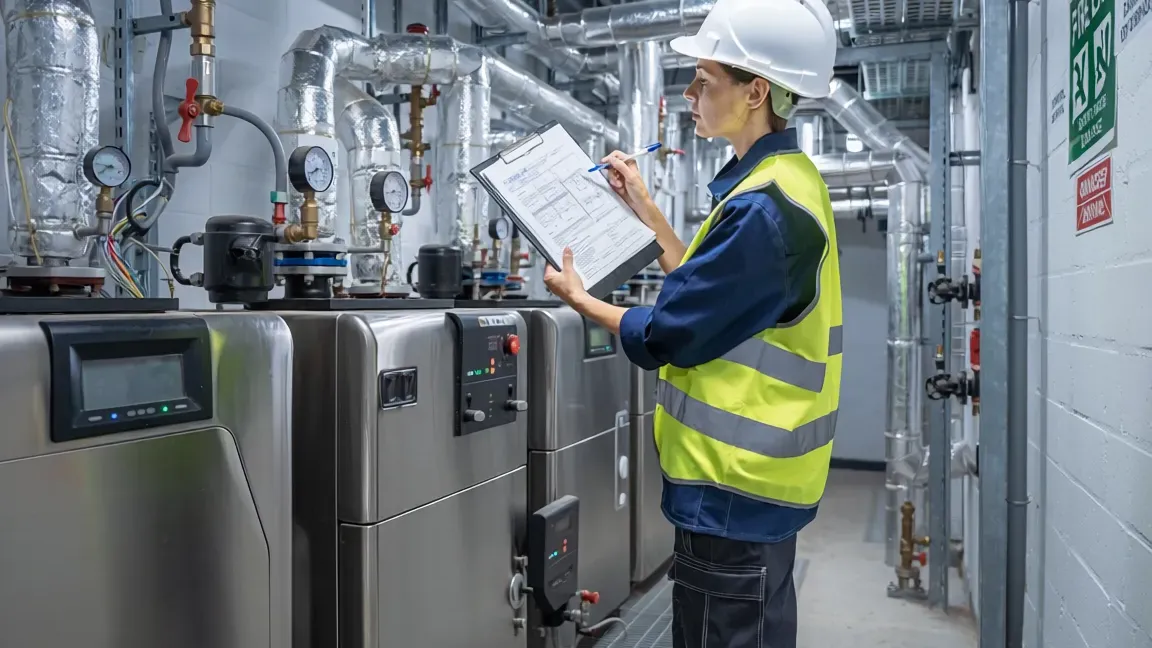
Undersizing a commercial boiler leads to inadequate heating, occupant complaints, and potential system failures during peak demand periods. Oversizing wastes capital expenditure, reduces efficiency through excessive cycling, and increases operational costs over the system's 15-20 year lifespan. Accurate commercial boiler output calculation determines system performance, energy efficiency, and long-term operational costs for buildings ranging from small retail units to large industrial facilities.
The calculation process centres on establishing total heat loss from the building fabric and ventilation systems, then adding domestic hot water (DHW) requirements whilst applying appropriate diversity factors. This boiler sizing methodology aligns with BS EN 12831 and Building Regulations Part L, providing a systematic approach that accounts for building-specific variables rather than relying on outdated rules of thumb.
Understanding Heat Loss as the Foundation
Heat loss calculation forms the bedrock of accurate boiler sizing. Every commercial building loses heat through its fabric - walls, roof, floor, windows, and doors - at rates determined by construction materials, insulation levels, and surface areas. The U-value of each building element quantifies this heat transfer, measured in watts per square metre per degree Kelvin (W/m²K).
Modern commercial buildings constructed to current Building Regulations typically achieve wall U-values of 0.18-0.26 W/m²K, whilst older buildings may exceed 1.5 W/m²K. This dramatic difference fundamentally affects heating requirements. A 1970s office building with single-glazed windows and minimal insulation might require 150-200 watts per square metre, whilst a contemporary building meeting current standards may need only 40-60 watts per square metre.
Ventilation Heat Loss
Ventilation heat loss accounts for the energy required to warm incoming fresh air to room temperature. Commercial buildings demand higher ventilation rates than domestic properties due to occupancy levels and Building Regulations requirements. An office space requires approximately 10 litres per second per person of fresh air, whilst spaces such as commercial kitchens or manufacturing facilities need substantially higher rates to manage humidity, odours, or process emissions.
The calculation multiplies air change rates by building volume and the temperature differential between outside design temperature and internal set point. For UK commercial buildings, external design temperatures typically range from -3°C to -5°C depending on location. Internal temperatures vary by building use - 19-21°C for offices, 16-18°C for warehouses, and 21-23°C for healthcare facilities.
UK Design Temperatures by Building Type
Establishing correct design temperatures is essential to any reliable heat loss calculation. Exposed hilltop locations face higher wind speeds increasing infiltration losses, whilst coastal buildings in Scotland require different design assumptions than sheltered urban sites in southern England. Building orientation also affects solar gain - south-facing glazing reduces heating demand in well-designed buildings, whilst north-facing facades offer no solar contribution during the heating season.
For commercial heating systems where pump performance and flow control accuracy are central to system efficiency, Grundfos pumping solutions provide the precision engineering needed to match output to variable building demand - making them a practical choice when commissioning systems across diverse commercial building types.
Key Variables in Commercial Boiler Sizing
Building volume and occupancy levels directly influence heating demand through both fabric losses and ventilation requirements. A 500m² office with 3-metre ceiling height and 50 occupants presents different challenges than a 500m² warehouse with 8-metre ceilings and minimal staff presence. The office requires more intensive ventilation heating but benefits from occupant heat gain, whilst the warehouse faces greater fabric losses from its increased surface area.
Operating hours significantly affect boiler selection. A retail unit operating 60 hours weekly with consistent daytime heating differs from a gym operating 100+ hours weekly with variable demand patterns. Systems requiring rapid morning warm-up after night setback need higher output capacity than continuously operated facilities, which influences both boiler capacity and controls specification.
DHW Requirements Across Building Types
DHW requirements vary enormously across commercial applications. A small office might need minimal DHW capacity for washroom facilities, whilst a hotel, leisure centre, or healthcare facility demands substantial simultaneous hot water delivery. The calculation must account for peak demand periods - morning showers in hotels, lunchtime peaks in restaurants, or shift changes in industrial facilities.
Correctly sized DHW pumps are critical to meeting peak demand without oversizing storage or boiler capacity. Selecting the right pump specification at the design stage avoids costly retrofits and prevents the persistent performance complaints that arise when hot water supply falls short of occupant expectations during high-usage periods.
Central Heating System Design Considerations
The central heating system design must reflect building-specific demand patterns rather than generic guidelines. Diversity factors, zone scheduling, and emitter types all influence the effective heating load placed on the boiler plant. A well-specified central heating configuration reduces peak demand on boiler plant, improving part-load efficiency and extending equipment service life across the system's full operational lifespan.
The Standard Heat Loss Calculation Method
The systematic calculation begins with measuring each room or zone within the commercial building. For each space, calculate fabric heat loss by multiplying the area of each building element - walls, windows, roof, floor - by its U-value and the temperature difference between internal set point and external design temperature.
Total fabric heat loss = Σ (Area × U-value × ΔT) for all building elements.
Fabric and Ventilation Heat Loss Formulas
Add ventilation heat loss using the formula: Ventilation loss = 0.33 × n × V × ΔT, where n represents air changes per hour and V equals room volume in cubic metres. The constant 0.33 accounts for the specific heat capacity of air and unit conversions.
For a 200m² open-plan office with 3-metre ceiling height (600m³ volume), assuming 1.5 air changes per hour, internal temperature 20°C, and external design temperature -3°C: Ventilation loss = 0.33 × 1.5 × 600 × 23 = 6,831 watts (approximately 6.8kW). This figure is then combined with fabric heat loss to produce the total zone demand.
Distribution Losses and Diversity Factors
Sum fabric and ventilation losses for each space, then total across the entire building. Apply a distribution loss factor of 10-15% to account for heat loss from pipework running through unheated spaces. This often-overlooked element adds significant load in buildings with extensive distribution systems or poorly insulated pipe runs, and omitting it leads to persistent underperformance in real-world conditions.
Diversity factors prevent oversizing when multiple heating zones rarely operate at maximum simultaneously. Commercial heating systems benefit from this diversity - not all spaces reach maximum demand at the same time. Apply diversity cautiously, however. Buildings with uniform occupancy patterns such as open-plan offices offer limited diversity benefits, whilst mixed-use buildings with varied zone schedules allow more meaningful reductions.
DHW Load Calculation
DHW load calculation depends on building type and usage. For office buildings, allow 30-50 watts per person for washroom facilities. Hospitality venues require detailed assessment of bath, shower, and kitchen demands, typically using simultaneous demand factors rather than summing maximum possible draw-offs. A 50-bedroom hotel does not require boiler capacity for 50 simultaneous showers, but must meet realistic peak demand - perhaps 15-20 simultaneous uses during the morning peak.
Pump valves are essential components in commercial DHW systems, managing flow distribution and preventing temperature stratification that undermines system efficiency. Specifying quality valve assemblies at the design stage protects long-term DHW performance in high-demand applications and reduces the risk of Legionella compliance issues arising from poor circulation.
Specific Considerations for Different Commercial Buildings
Different building types present distinct sizing challenges. Understanding sector-specific demand patterns ensures the commercial boiler output calculation reflects actual operating conditions rather than theoretical maximums that never occur in practice.
Office Buildings
Office buildings typically feature consistent heating patterns during business hours with night setback. Modern offices generate significant internal heat gains from IT equipment, lighting, and occupancy - often 15-25 W/m² from equipment alone. These gains reduce net heating demand but complicate calculations, particularly for perimeter zones with high glazing ratios that still require consistent heat input regardless of internal gains elsewhere.
For office heating systems where demand shifts considerably between occupied and unoccupied periods, Wilo pumps offer variable speed technology that adapts output to changing load conditions throughout the working day. This capability reduces energy consumption during shoulder periods without compromising comfort during peak occupancy hours.
Retail Premises
Retail premises face unique challenges from entrance door infiltration and display lighting heat gains. High street shops with frequent door opening lose substantial heat through air infiltration - potentially 30-50% of total heat loss. Calculations must account for this using infiltration factors based on door size, usage frequency, and whether lobbies or air curtains provide protection against cold air ingress.
Industrial and Warehouse Facilities
Industrial facilities range from light assembly operations to heavy manufacturing with process heating needs. Warehouse spaces with high ceilings and intermittent heating benefit from radiant heating systems rather than traditional convection, fundamentally changing boiler selection criteria. Manufacturing facilities with process steam or hot water requirements need integrated calculations accounting for both space heating and process loads running simultaneously.
For industrial and commercial applications requiring robust fluid handling equipment engineered for continuous operation, Armstrong products offer proven reliability across demanding environments. Specifying quality equipment at the design stage reduces lifecycle costs and minimises the risk of unplanned downtime in production-critical facilities.
Educational Establishments
Educational establishments experience extreme demand variations between term-time and holidays, occupied teaching hours and evenings. School buildings often operate 40-50 hours weekly during term but may sit unused for 13 weeks annually. The heating system must warm buildings rapidly on winter mornings after weekend shutdown whilst maintaining efficiency during occupied periods - a challenging combination that requires careful boiler sizing and controls specification.
Healthcare Facilities
Healthcare facilities demand reliable 24/7 heating with minimal temperature variation. Patient areas require 21-23°C consistently, whilst operating theatres need precise environmental control beyond standard commercial heating parameters. The calculation must ensure adequate capacity with built-in redundancy - typically specifying multiple boilers where the loss of the largest unit still maintains acceptable heating across clinical areas.
Remeha commercial boilers are well suited to healthcare applications, offering high modulation capability and the reliability standards that clinical environments require. For facilities where heating continuity directly affects patient welfare, selecting equipment with a proven track record in healthcare settings is a fundamental part of the design specification.
System Efficiency and Boiler Selection
Condensing boiler efficiency reaches 94-98% at low return temperatures, falling to 88-90% when return temperatures exceed 55°C. Commercial heating systems designed for 80/60°C flow/return temperatures prevent condensing operation, sacrificing 6-8% efficiency compared to systems operating at 70/40°C or lower. This efficiency difference translates directly to substantial operational cost variations over the system's 15-20 year lifespan.
Modulating Burners and Multiple Boiler Configurations
Modulating burners adjust output from 20-30% minimum to 100% maximum, matching boiler output to instantaneous demand. This capability reduces cycling losses, improves seasonal efficiency, and extends equipment life compared to simple on/off operation. A 200kW modulating boiler can operate continuously at 60kW during shoulder seasons rather than cycling on/off, maintaining stable temperatures whilst minimising standing losses throughout mild weather periods.
Multiple boiler configurations offer clear advantages over single large units in many commercial applications. Three 100kW boilers provide better part-load efficiency than one 300kW unit, as one or two boilers can meet reduced demand whilst others remain off. This configuration also provides built-in redundancy - if one boiler fails, the system continues operating at reduced capacity rather than facing total shutdown.
National Pumps and Boilers supplies a comprehensive range of commercial boiler configurations and ancillary equipment, helping contractors and M&E engineers match the right solution to specific building requirements and operational profiles across all commercial sectors.
Buffer Vessels and Weather Compensation
Buffer vessels decouple boiler operation from system demand, particularly valuable with multiple boilers or low-water-content systems. A 500-1000 litre buffer allows boilers to run at optimal output for minimum periods rather than short-cycling, improving both efficiency and reliability. The buffer also facilitates effective sequencing of multiple boilers, ensuring even run-time distribution that extends service intervals.
Weather compensation controls adjust flow temperature based on outdoor temperature, reducing system temperatures during mild weather. This control strategy can improve seasonal efficiency by 10-15% whilst maintaining occupant comfort. When combined with condensing boilers and low-temperature emitters, weather compensation enables consistent condensing operation throughout the heating season.
For modular commercial boiler solutions that accommodate future changes in building capacity or usage, Vaillant commercial boilers offer scalable configurations that allow output to be matched to evolving demand - reducing both capital outlay and long-term running costs as buildings develop over their operational lifespan.
Professional Calculation Tools and Resources
BS EN 12831 and Building Regulations Part L
BS EN 12831 provides the standardised methodology for heat loss calculation in buildings, specifying calculation procedures, design temperatures, and safety factors. This European standard ensures consistent, accurate calculations when properly applied, and accounts for thermal bridges, ground heat loss, and intermittent heating through established correction factors and procedures.
Building Regulations Part L (Conservation of Fuel and Power) sets minimum efficiency standards and calculation requirements for commercial heating systems. Compliance requires demonstrating that proposed systems meet Target Emission Rates through approved calculation software. The regulations also mandate commissioning records, controls documentation, and handover packs ensuring systems perform as designed throughout their operational life.
Software Tools and M&E Consultants
Professional heat loss software packages automate calculations whilst ensuring regulatory compliance. CIBSE-approved software handles complex buildings with multiple zones, varied construction types, and sophisticated control strategies. These tools generate room-by-room calculations, system sizing outputs, and compliance documentation, reducing calculation time whilst improving accuracy compared to manual methods on complex projects.
Mechanical and electrical (M&E) consultants bring expertise to projects where building characteristics, usage patterns, or regulatory requirements exceed standard applications. Projects exceeding £500k construction value, buildings with unusual geometry or critical usage, or facilities with non-negotiable reliability requirements benefit from professional design input. Consultants provide detailed specifications, tender documentation, and construction oversight ensuring systems meet performance requirements whilst optimising both capital and operational expenditure.
Common Sizing Mistakes to Avoid
Rule-of-thumb calculations based on floor area alone ignore building-specific factors that dramatically affect heating demand. The common "100 watts per square metre" guideline may approximate poorly-insulated older buildings but grossly oversizes modern construction. A contemporary office meeting current Building Regulations might need only 40-50 W/m², whilst a Victorian warehouse conversion could legitimately require 150+ W/m².
Ignoring building improvements leads to persistent oversizing at boiler replacement. Many commercial buildings undergo insulation upgrades, window replacement, or envelope improvements during their lifespan. Boiler replacement projects must reassess the heat loss calculation rather than matching previous boiler capacity. A building that required 400kW in 1990 might genuinely need only 250kW after insulation upgrades, yet often receives another oversized unit through inertia rather than proper analysis.
Failing to account for future expansion creates undersized commercial heating systems when buildings add extensions or increase occupancy. The calculation should consider planned developments within the system's design life. Speculative future growth is better addressed through system design flexibility - multiple boilers where additional units can be added, or oversized plant rooms accommodating future equipment - rather than oversizing boiler capacity from the outset.
Undersizing DHW capacity in high-demand applications causes persistent occupant complaints despite adequate space heating performance. Hotels, leisure centres, and healthcare facilities require careful DHW assessment using diversity factors appropriate to the specific building type. A 100-bedroom hotel might need 2-3MW instantaneous DHW capacity or substantial storage with rapid reheat capability to meet morning peak demand reliably.
Neglecting system losses from pipework, heat emitters, and control inefficiencies reduces available heating capacity at the point of use. Distribution losses in buildings with extensive pipe runs or poor insulation can reach 15-20% of total boiler output. The calculation must include these losses, particularly in older buildings with uninsulated pipework running through unheated voids or plant rooms.
Achieving Accurate Boiler Sizing
Accurate commercial boiler output calculation requires systematic assessment of building heat loss, DHW demand, and system losses whilst applying appropriate diversity and safety factors. The process combines established methodologies from BS EN 12831 with building-specific knowledge of construction standards, occupancy patterns, and operational profiles. This approach consistently delivers commercial heating systems sized to meet actual demand rather than arbitrary rules of thumb applied without proper analysis.
Professional assessment proves valuable for complex buildings, critical applications, or projects where the risks of undersizing are unacceptable. M&E consultants bring expertise in calculation methodology, equipment selection, and compliance with Building Regulations Part L, ensuring systems meet performance requirements whilst optimising both capital and operational costs over the system's lifetime.
For guidance on commercial boiler selection and system design tailored to specific building requirements, Contact Us to discuss project needs with heating system specialists experienced in commercial applications across diverse building types and sectors.