

How to Document Pump System Performance for Future Reference
Pump system failures rarely announce themselves with warning signs. A circulation pump that operated flawlessly for five years suddenly develops cavitation issues. A boiler system that maintained consistent pressure now experiences unexplained fluctuations. Without documented baseline performance data, heating engineers face an impossible task: diagnosing problems without knowing what "normal" looked like.
National Pumps and Boilers regularly encounters commercial heating systems where the absence of proper pump performance documentation turns routine maintenance into guesswork. When a facilities manager reports "the pump isn't working like it used to," the first question becomes: what performance metrics existed when the system was commissioned? In most cases, the answer is silence.
Why Performance Documentation Matters
Performance documentation transforms reactive maintenance into predictive system management. When a Grundfos pump shows a 15% reduction in flow rate, documented baseline data immediately reveals whether this represents normal wear or indicates an impending failure requiring urgent attention.
Financial and Operational Benefits
The financial implications extend beyond emergency repairs. Building services managers who maintain comprehensive pump performance documentation reduce unplanned downtime by 40-60% compared to facilities operating without documentation. Insurance claims for system failures require evidence that equipment received proper maintenance - documentation that proves regular monitoring and appropriate intervention.
Regulatory Compliance Requirements
British Standard BS 7671 and Building Regulations Part L increasingly emphasise energy efficiency verification. Without documented performance baselines, demonstrating compliance with seasonal efficiency requirements becomes problematic during audits. The Energy Performance of Buildings Regulations 2012 specifically requires evidence of system optimisation - documentation that many facilities cannot produce.
Essential Performance Metrics to Record
Effective pump system documentation captures specific technical parameters that reveal operational health. Vague observations like "pump running normally" provide no diagnostic value when problems emerge months later.
Flow Rate Measurements
Flow rate represents the most critical performance indicator for any circulation pump. Record actual flow in litres per minute (l/min) or cubic metres per hour (m³/h) at the point of commissioning, then at regular intervals throughout the pump's operational life. Compare measured flow against manufacturer specifications for the installed model.
For central heating applications, document the pump system performance at various system temperatures. A pump delivering 3,200 l/h at 70°C may show different performance at 80°C due to changes in water viscosity and density. These variations matter when diagnosing seasonal performance issues.
Differential Pressure Readings
Measure and record pressure differential across the pump - the difference between inlet and outlet pressure. This head pressure measurement, expressed in metres (m) or bar, directly indicates the pump's ability to overcome system resistance.
Install permanent pressure gauges at the pump inlet and outlet points. Digital gauges with data logging capability eliminate manual reading errors and create automatic performance records. For commercial systems, pressure readings should occur at minimum weekly intervals, with daily readings during commissioning and after any system modifications.
Power Consumption Data
Electrical power consumption reveals efficiency trends that pressure and flow measurements might miss. A Wilo pump maintaining correct flow and pressure whilst drawing 15% more current than baseline indicates developing mechanical resistance - worn bearings, impeller deposits, or motor degradation.
Record actual power draw in watts (W) using a calibrated power meter. Compare against the pump's rated power consumption at the documented operating point. Modern variable-speed pumps require power measurement at multiple speed settings to establish comprehensive performance profiles.
Temperature Monitoring
Document system temperatures at critical points: pump inlet, pump outlet, boiler flow, boiler return, and representative radiator circuits. Temperature differentials reveal system balance issues before they manifest as comfort complaints or efficiency losses.
Thermal imaging during commissioning creates visual baseline documentation. Infrared surveys repeated annually identify developing hot spots on pump motors, unusual heat patterns in pipework, or circulation problems in specific zones.
Vibration Analysis
Excessive vibration indicates mechanical problems: bearing wear, impeller imbalance, cavitation, or mounting issues. Establish vibration baselines using accelerometers or vibration pens at pump commissioning. Record measurements in millimetres per second (mm/s) at the pump motor casing and mounting points.
Vibration increases of 50% above baseline warrant investigation. Sudden vibration changes often precede catastrophic failures by weeks or months - time to arrange planned replacement rather than emergency repairs.
Creating Effective Documentation Systems
Raw data without structure creates confusion rather than clarity. Effective pump performance documentation follows consistent formats that enable quick interpretation by any qualified engineer.
Commissioning Reports
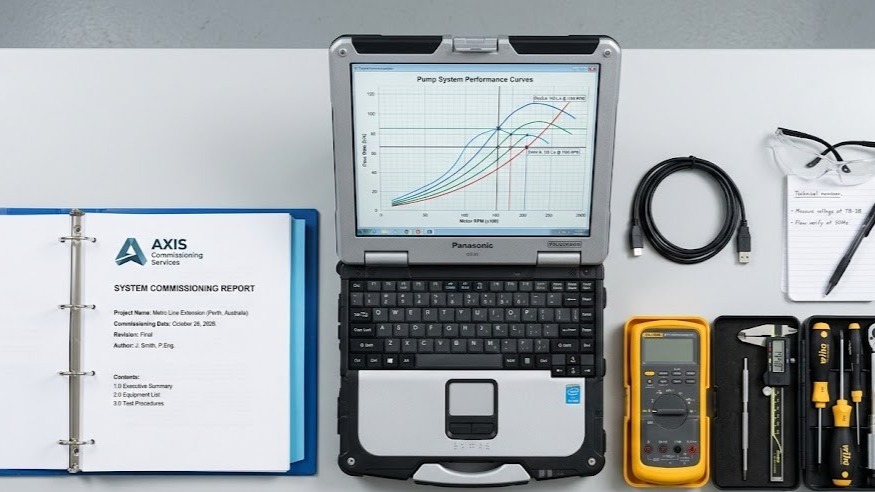
The commissioning report establishes the performance baseline against which all future measurements compare. This document must include:
- Complete pump identification (manufacturer, model, serial number)
- Installation date and commissioning engineer details
- Full system specifications (volume, pipe sizing, heat output)
- Initial performance readings (flow, pressure, power, temperature)
- Photographs of installation, gauge positions, and control settings
- Electrical certification and wiring details
- Initial system water quality analysis
Commissioning reports for DHW pumps require additional documentation of legionella control measures, temperature maintenance requirements, and circulation schedules.
Maintenance Logs
Maintenance logs record every interaction with the pump system. Digital maintenance management systems (CMMS) provide searchable records, but paper logs remain acceptable if consistently maintained. Each entry should document:
- Date and time of inspection or intervention
- Name and qualifications of attending engineer
- Specific measurements taken (flow, pressure, temperature, vibration)
- Any adjustments made to controls or settings
- Parts replaced with supplier and part numbers
- Observations of unusual conditions or developing issues
- Time spent and any costs incurred
Maintenance frequency depends on system criticality and operating environment. Commercial heating systems typically require monthly inspections during heating season, quarterly during summer. Critical applications like hospital heating need weekly monitoring.
Performance Trend Charts
Tabulated data reveals patterns that individual measurements might obscure. Plot key metrics over time to visualise performance trends:
- Flow rate vs time (identifies gradual pump wear or system blockages)
- Power consumption vs time (reveals efficiency degradation)
- Pressure differential vs time (shows developing system resistance)
- Temperature differential vs outdoor temperature (indicates system balance)
Spreadsheet software creates adequate trend charts for smaller installations. Building management systems (BMS) in commercial properties should integrate pump performance monitoring with automated trending and alert generation.
Digital Documentation Tools and Technologies
Modern documentation systems eliminate manual data entry whilst improving accuracy and accessibility. Smart monitoring technology has become cost-effective even for modest commercial installations.
Building Management Systems Integration
BMS platforms monitor pump performance continuously, recording data at intervals from seconds to hours depending on system requirements. Integration with Grundfos or Wilo smart pumps provides direct access to internal diagnostics: operating hours, starts per day, power consumption, and fault codes.
Configure BMS alarm thresholds based on commissioning baselines. A 10% flow reduction might trigger a monitoring alert, whilst a 25% reduction generates an urgent maintenance notification. Automated alarming prevents problems escalating unnoticed between manual inspections.
Standalone Data Loggers
For systems without comprehensive BMS coverage, standalone data loggers provide cost-effective performance monitoring. Install loggers on pressure gauges, temperature sensors, and power circuits to create automatic records without manual readings.
Modern wireless loggers transmit data to cloud platforms accessible from any internet-connected device. This remote accessibility proves invaluable for multi-site facilities management or when specialist engineers need performance data for remote diagnostics.
Mobile Documentation Apps
Smartphone applications designed for mechanical services documentation streamline on-site data collection. Engineers photograph gauge readings, record measurements, and add notes directly into structured forms. GPS tagging and timestamps create verifiable audit trails.
Cloud synchronisation ensures documentation reaches facilities managers and maintenance coordinators immediately. This real-time visibility enables faster decision-making when performance issues emerge.
Interpreting Performance Data for Predictive Maintenance
Documentation delivers value only when someone analyses the data and acts on emerging trends. Establish review protocols that translate measurements into maintenance decisions.
Establishing Alert Thresholds
Define specific performance deviations that trigger investigation:
- Flow rate reduction exceeding 10% of baseline
- Pressure differential change beyond ±0.2 bar
- Power consumption increases above 15% of baseline
- Vibration levels exceeding 4.5 mm/s
- Temperature differentials varying more than 3°C from design
These thresholds prevent both excessive false alarms and dangerous complacency. Adjust values based on system criticality and operational experience.
Seasonal Performance Comparisons
Compare current performance against the same period in previous years rather than against absolute commissioning baselines. A heating system naturally shows different characteristics in October versus February due to varying heat loads and operating temperatures.
Year-on-year comparisons at equivalent outdoor temperatures reveal genuine performance degradation whilst filtering out normal seasonal variations.
Correlation Analysis
Examine relationships between different performance metrics. Flow rate declining whilst power consumption increases suggests mechanical wear. Flow and power both declining together indicate electrical supply issues or control problems rather than pump degradation.
This correlation analysis often identifies root causes that single-parameter monitoring would miss.
Regulatory Compliance and Documentation Requirements
Multiple regulatory frameworks mandate pump performance documentation for commercial heating systems. Compliance failures carry financial penalties and potential liability exposure.
Energy Performance Regulations
Building Regulations Part L2 requires evidence that heating systems operate at design efficiency. Annual energy performance reviews must reference documented baseline data and demonstrate ongoing optimisation efforts.
The Energy Savings Opportunity Scheme (ESOS) for large organisations specifically requires evidence of energy-using equipment monitoring and performance tracking. Pump system documentation directly supports ESOS compliance.
Health and Safety Requirements
The Health and Safety at Work Act 1974 places duties on employers to maintain equipment in a safe operating condition. Documentation proving regular inspection and appropriate maintenance demonstrates compliance with these duties.
For systems containing expansion vessels or operating above atmospheric pressure, the Pressure Systems Safety Regulations 2000 mandate written schemes of examination and records of all inspections.
Insurance and Warranty Considerations
Equipment warranties typically require proof of proper maintenance and operation within manufacturer specifications. Without documentation, warranty claims fail regardless of actual maintenance quality.
Property insurance policies increasingly include conditions requiring preventive maintenance programmes for critical building services. Documentation proves compliance with these policy requirements when claims arise.
Long-Term Documentation Storage and Accessibility
Performance records deliver value across decades, not months. Storage systems must ensure documentation remains accessible, legible, and secure throughout equipment lifecycles spanning 15-20 years.
Physical Document Retention
Paper commissioning reports and maintenance logs require protection from water damage, degradation, and loss. Store originals in fire-resistant cabinets within plant rooms or facilities management offices. Create duplicate copies stored off-site or digitally scanned as backup.
Laminate frequently referenced documents like system schematics and quick-reference specification sheets. These working copies withstand plant room conditions whilst protecting original documents.
Digital Archive Management
Digital documentation demands systematic file organisation and backup protocols. Establish folder structures by building, system, and equipment type. Use consistent file naming conventions that include dates and document types.
Cloud storage with automated backup provides resilience against hardware failures and site disasters. Ensure service agreements include long-term data retention guarantees matching or exceeding equipment lifecycles.
Documentation Handover Protocols
When facilities management changes hands or contractors rotate, formal documentation handover prevents knowledge loss. Create comprehensive handover packages including:
- Complete commissioning documentation
- Full maintenance history
- Current performance baselines and trend data
- Known issues and planned remedial works
- Contact details for specialist contractors and suppliers
- Spare parts specifications and supplier information
Schedule handover meetings where outgoing and incoming engineers review documentation together, clarifying any ambiguities before knowledge transfer becomes impossible.
Conclusion
Systematic pump performance documentation transforms heating system management from reactive crisis response into proactive reliability optimisation. The investment in establishing documentation protocols - typically 2-4 hours during commissioning plus 30 minutes per monthly inspection - returns substantial dividends through extended equipment life, reduced emergency repairs, and demonstrated regulatory compliance.
Facilities lacking performance documentation face diagnostic delays, warranty disputes, and compliance vulnerabilities that comprehensive records prevent. When engineers document pump system performance systematically, modern digital monitoring tools eliminate much of the manual effort traditionally associated with documentation, whilst improving data quality and accessibility.
For heating engineers and facilities managers seeking to implement robust documentation systems, contact us for guidance on monitoring equipment selection, BMS integration, and documentation protocols tailored to specific system requirements.