

How Variable Speed Drives (VSDs) Reduce Pump Energy Consumption by up to 50%
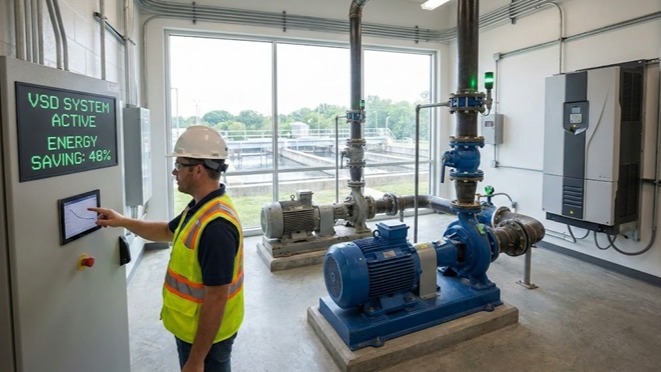
Pumps account for nearly 20% of global electricity consumption, yet most still run at fixed speeds regardless of actual system demand. This mismatch between supply and delivery burns through energy budgets and accelerates equipment wear. A variable speed drive pump installation changes this dynamic entirely - matching motor speed precisely to real-time load requirements and delivering VSD energy savings of 30-50% in typical commercial applications.
The mathematics behind these savings follows the affinity laws: halving pump speed reduces power consumption to just 12.5% of full-load operation. For a 15kW heating circulator running 8,760 hours annually at £0.25/kWh, dropping average speed by 30% saves approximately £8,200 per year. These figures explain why variable speed technology now dominates new commercial pump specifications and retrofit programmes across the UK.
Understanding Variable Speed Drive Technology
A variable speed drive (VSD) - also called a variable frequency drive or inverter - controls AC motor speed by adjusting the frequency and voltage of electrical supply. Standard UK mains electricity delivers 50Hz at 230V single-phase or 400V three-phase. The VSD converts this fixed-frequency AC to DC, then back to AC at variable frequency between 0-50Hz, allowing precise motor speed control from 0-100% of rated capacity.
This frequency modulation directly controls motor speed. A Grundfos pump rated at 2,900 RPM running at 25Hz operates at approximately 1,450 RPM - exactly half speed. The energy implications follow cubic relationships: half speed means one-eighth power consumption.
Modern VSDs incorporate microprocessors that continuously monitor system parameters - differential pressure, flow rate, temperature - and adjust motor speed accordingly. The control loop operates at millisecond intervals, maintaining setpoint conditions whilst minimising energy input. This differs fundamentally from throttle valves or bypass loops, which maintain full motor speed whilst wasting energy through restriction.
The Physics of Pump Energy Savings
The affinity laws govern centrifugal pump performance and reveal why VSD energy savings prove so dramatic:
Flow relationship: Flow rate changes proportionally with speed. Reducing speed by 20% cuts flow by 20%.
Pressure relationship: Head pressure changes with the square of speed. Reducing speed by 20% cuts pressure by 36%.
Power relationship: Power consumption changes with the cube of speed. Reducing speed by 20% cuts power by 49%.
This cubic relationship explains variable speed drive pump savings of 50% or more. A heating system requiring 60% flow during mild weather needs a central heating pump running at just 60% speed. Power consumption drops to 0.6³ = 21.6% of full-load operation - a 78.4% reduction during those operating hours.
Annual Savings Profiles
Annual savings depend on load profiles. Commercial buildings rarely demand full heating capacity. A typical profile might show: 10% of hours at 90-100% load, 30% at 70-90% load, 40% at 40-70% load, and 20% at below 40% load. Weighted average power consumption with fixed-speed operation approximates 75% of maximum. With VSD control matching actual demand, this drops to approximately 35% - a 53% reduction.
The relationship holds across pump types. DHW pumps serving domestic hot water systems, chilled water circulators in cooling systems, and condenser water pumps all follow identical physics. The affinity laws apply universally to centrifugal pump operation.
Real-World Application Scenarios
Commercial Heating Systems
A 30kW commercial heating system serving a 2,000m² office building typically uses a 3kW circulator running continuously during the heating season (October-April, approximately 5,040 hours). Fixed-speed operation consumes 15,120 kWh annually. With VSD control responding to building heat load and outdoor temperature compensation, average speed drops to approximately 65%. Annual consumption falls to 4,400 kWh - saving 10,720 kWh worth £2,680 at current commercial electricity rates.
The Wilo Stratos range demonstrates this principle in practice. These pumps incorporate automatic differential pressure control, adjusting speed to maintain constant pressure differential regardless of flow demand. When thermostatic radiator valves close in zones reaching temperature, system resistance increases. The VSD responds by reducing speed, maintaining pressure setpoint whilst cutting power consumption proportionally, resulting in substantial variable speed drive pump savings.
Chilled Water Systems
Air conditioning systems show even greater savings potential. Cooling loads vary dramatically with occupancy, solar gain, and outdoor temperature. A 150kW chiller serving a retail space might operate at full capacity only during peak summer afternoons - perhaps 200 hours annually. The remaining 3,000 operating hours demand 40-80% capacity.
Fixed-speed pump operation maintains full flow continuously, using bypass valves or three-way mixing to control capacity. A 7.5kW chilled water pump running 3,200 hours annually at fixed speed consumes 24,000 kWh. VSD control matching actual chiller load reduces average speed to 60%, cutting consumption to 7,770 kWh - saving 16,230 kWh worth approximately £4,060 annually.
Pressure Boosting Applications
Multi-storey buildings requiring boosted water pressure traditionally used multiple fixed-speed pumps with cascade control. This approach maintains pressure through pump staging - energising additional pumps as demand increases. Minimum running load equals one full-speed pump, even when actual demand requires only 20% capacity.
Variable speed booster sets from manufacturers like DAB replace this inefficient staging with continuous modulation. The lead pump runs at variable speed matching instantaneous demand, with additional pumps staging only when the lead unit reaches maximum speed. A four-pump booster set serving a 10-storey residential building might previously run one 4kW pump continuously (35,040 kWh annually). VSD control reduces average load to 1.2kW during occupied hours and 0.3kW overnight, cutting annual consumption to approximately 14,000 kWh - delivering VSD energy savings of 21,040 kWh worth £5,260.
Installation and Commissioning Considerations
Electrical Requirements
VSDs require appropriate electrical infrastructure. Units above 5.5kW typically need three-phase supply. The drive itself adds minimal load - efficiency exceeds 97% at rated capacity - but proper cable sizing remains essential. VSD output cables should use screened or armoured construction to prevent electromagnetic interference affecting building management systems or telecommunications equipment.
Electrical noise represents the primary installation challenge. VSDs generate high-frequency harmonics that can interfere with sensitive electronics. Proper earthing, cable screening, and physical separation from control cables prevents issues. British Standard BS 7671 provides specific guidance on VSD installation requirements, including minimum separation distances and cable routing specifications.
Control Integration
Modern VSDs accept multiple control inputs: 0-10V analogue, 4-20mA current loop, or digital protocols including Modbus RTU, BACnet, and LonWorks. Differential pressure sensors typically provide the control signal for heating and cooling applications, maintaining constant pressure differential across the system regardless of flow demand.
Commissioning requires establishing appropriate setpoints. Heating systems typically target 0.2-0.5 bar differential pressure at the index circuit - the hydraulically most distant point. Setting pressure too high wastes energy; too low causes inadequate flow to remote circuits. Proper system balancing before VSD commissioning ensures optimal performance.
System Protection
VSDs provide sophisticated motor protection exceeding conventional starter capabilities. Electronic thermal protection monitors actual motor current and calculates winding temperature, preventing damage from overload conditions. Adjustable acceleration and deceleration ramps eliminate mechanical shock during starting and stopping, extending bearing and seal life.
Additional protection features include: undervoltage and overvoltage protection, phase loss detection, earth fault monitoring, and dry-running prevention. These functions protect both motor and pump, reducing maintenance requirements and extending equipment life. The protection capabilities alone justify VSD investment in critical applications, independent of energy savings.
Economic Analysis and Payback
Capital Cost Considerations
Retrofit VSD installation costs £800-2,500 depending on pump power rating and installation complexity. A 4kW heating pump VSD retrofit typically costs £1,200 including drive, sensors, installation labour, and commissioning. Against annual variable speed drive pump savings of £2,000-3,000, payback periods run 6-18 months.
New installations show even better economics. The incremental cost of VSD-equipped pumps versus fixed-speed equivalents ranges from £300-800 for typical commercial applications. When specifying new plant, VSD technology represents standard practice rather than optional enhancement.
Larger installations benefit from economies of scale. A plantroom serving a 10,000m² commercial building might include six pumps totalling 45kW. Comprehensive VSD retrofit costing £12,000 delivers annual savings approaching £18,000, achieving payback within nine months.
Operational Cost Benefits
Energy savings represent the primary economic driver, but additional benefits compound the business case:
Reduced maintenance: Soft-starting eliminates mechanical shock, extending bearing life by 40-60%. Seal life increases similarly. Annual maintenance costs typically drop 20-30%.
Extended equipment life: Reduced operating speeds and eliminated starting stress extend pump life expectancy from 15 years to 20+ years, deferring capital replacement costs.
Improved comfort: Precise flow control eliminates temperature swings and noise from oversised fixed-speed operation. Complaint reduction and improved building performance have quantifiable value in commercial and residential applications.
Enhanced monitoring: Built-in diagnostics and performance monitoring enable predictive maintenance strategies, catching developing problems before failure occurs.
Carbon Reduction Value
Beyond direct cost savings, VSD energy savings deliver carbon benefits increasingly valued in corporate sustainability programmes. A 20,000 kWh annual saving prevents approximately 4.2 tonnes CO₂ emissions using current UK grid carbon intensity. Organisations with net-zero commitments or carbon pricing mechanisms realise additional value from VSD-enabled consumption reduction.
Enhanced Energy Performance Certificate (EPC) ratings provide another benefit. Building Regulations Part L increasingly emphasises efficient circulation pumps. VSD-equipped systems contribute toward compliance and improved ratings, affecting property values and rental premiums in commercial real estate.
Selecting Appropriate VSD Technology
Integrated Versus Separate Drives
Manufacturers offer two approaches: pumps with integrated VSDs (like Grundfos Magna3 or Wilo Stratos) or separate drives retrofitted to existing pumps. Integrated solutions provide compact installation, factory-optimised control algorithms, and simplified commissioning. They suit new installations and replacement projects where complete pump renewal makes sense.
Separate drives excel in retrofit applications where existing pumps remain serviceable. A Lowara pump installed 10 years ago with 15 years remaining service life benefits from VSD retrofit without requiring complete replacement. Separate drives also suit unusual applications requiring custom control strategies.
Control Strategy Options
Different applications demand different control approaches:
Constant differential pressure: Maintains fixed pressure differential regardless of flow, ideal for heating and cooling systems with variable flow demand.
Proportional pressure: Reduces pressure setpoint as flow decreases, following system resistance curve and maximising variable speed drive pump savings in complex distribution networks.
Constant flow: Maintains fixed flow rate regardless of system resistance, used in process applications requiring specific flow rates.
Temperature control: Directly controls temperature by varying flow rate, eliminating separate control valves in simple systems.
Selecting appropriate control strategy during commissioning significantly impacts both performance and savings. Heating systems typically achieve optimal results with proportional pressure control, whilst chilled water systems often benefit from constant differential pressure approaches.
Future-Proofing Considerations
Specifying VSDs with communication capabilities enables integration with building management systems. Remote monitoring, performance trending, and predictive maintenance become possible. As buildings become smarter and more connected, communication-capable VSDs integrate seamlessly whilst basic units require replacement or supplementary monitoring hardware.
Oversising drive capacity by 10-20% accommodates future system modifications without drive replacement. A 5.5kW pump might use a 7.5kW drive, allowing pump replacement with a larger unit if building modifications increase heating demand. The marginal cost difference (£150-200) provides valuable flexibility.
Conclusion
Variable speed drive technology transforms pump energy economics through precise matching of motor speed to actual system demand. The physics underlying these savings - the cubic relationship between speed and power - delivers VSD energy savings of 30-50% in typical commercial applications, with payback periods measured in months rather than years.
The technology has matured beyond early reliability concerns. Modern VSDs provide 100,000+ hour service lives with minimal maintenance, whilst simultaneously protecting motors and pumps from damaging starting transients. The protection features alone justify investment in critical applications, with energy savings providing additional benefit rather than sole justification.
For new installations, VSD-equipped pumps represent standard specification rather than optional enhancement. Building Regulations Part L increasingly expects variable speed control, and the marginal capital cost disappears within months of operation. Retrofit applications show even more dramatic economics, with existing serviceable pumps gaining decades of efficient operation through relatively modest drive additions.
National Pumps and Boilers supplies VSD-equipped pumps from leading manufacturers including Grundfos, Wilo, DAB, and Lowara, alongside standalone drives for retrofit applications. The technical team provides system analysis, drive specification, and commissioning support to ensure optimal performance and maximum savings. For guidance on VSD technology for specific applications, contact us for expert technical advice tailored to individual system requirements.