

Industrial Maintenance Choices That Protect Heating Performance
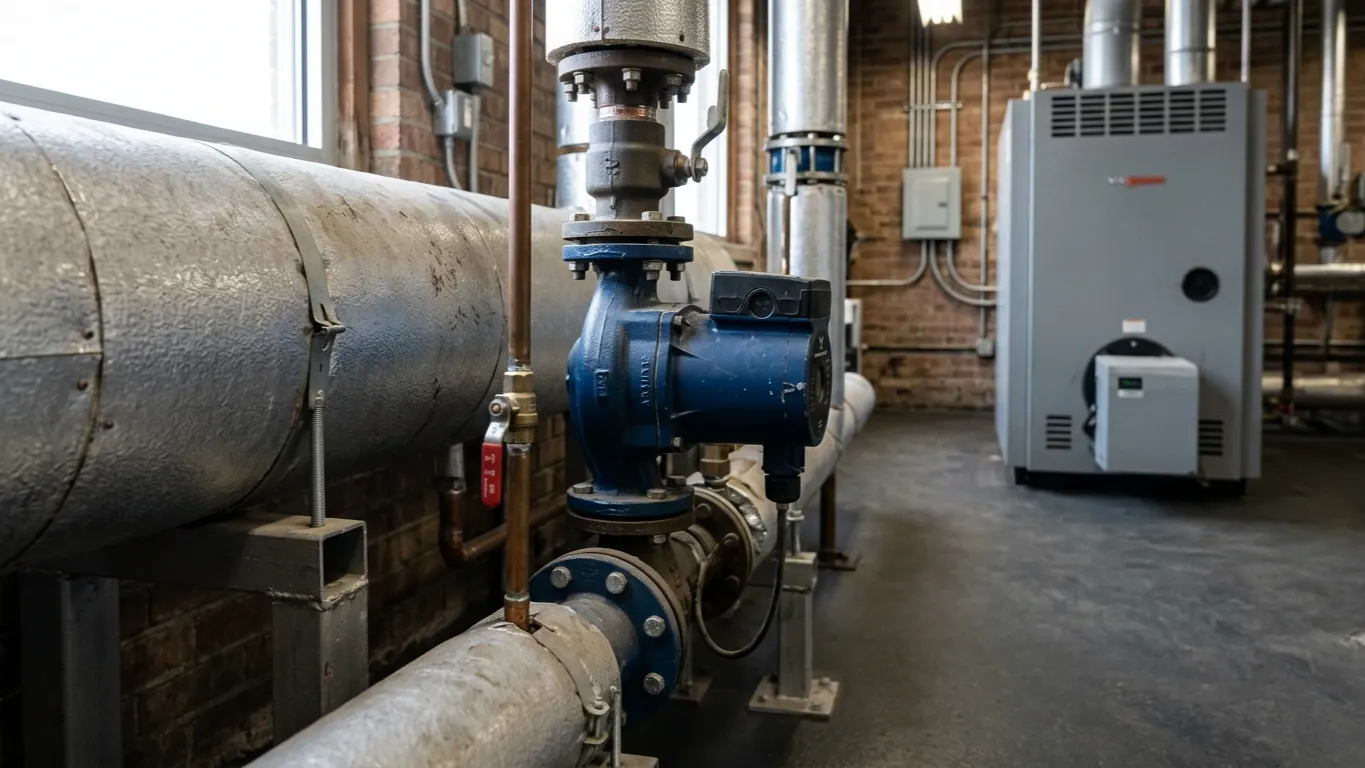
A useful plant maintenance strategy chooses the least disruptive action that can safely address the evidence: continue justified preventive work, investigate deterioration, correct controls, repair a confirmed defect or renew unsuitable equipment. Heating can remain available while earlier starts, longer runs and repeated resets conceal declining performance. Those changes deserve assessment, but they do not prove that a pump or boiler needs replacing. The decision rests on what has changed, what service is at risk and what improvement can reasonably be checked afterwards.
Start with the service you need to preserve. An occupied wing, hot water service and frost protection may depend on the same plant but tolerate different interruptions. A short adjustment may be preferable to replacement when equipment remains suitable; a repair may be poor value when it leaves an established capacity problem unresolved. Equally, postponing intrusive work can be sensible only where competent assessment supports continued operation. Neither a warm building nor an available maintenance slot establishes that the proposed choice is safe.
Establish What Has Changed
Record normal start time, recovery time, flow and return temperatures, pump settings, boiler cycling, schedules, resets, alarms, overrides, complaints and run hours. Flow is water leaving the heat source; return is water coming back. Identify affected areas and compare similar weather and occupancy before treating longer operation as equipment deterioration.
That record is not a diagnosis. An established cold-weather start differs from progressively earlier starts; one reset after unrelated work differs from a weekly reset accepted as routine. Keep temporary settings visible. Otherwise, a pump left running faster after a complaint can become the misleading baseline for judging future performance.
HSE maintenance guidance requires work equipment to be maintained in efficient order and good repair, with maintenance performed safely by competent people. Facilities staff can record observations through normal safe access. Opening equipment, testing protective functions or deciding whether a fault permits continued operation belongs with the responsible competent maintainer.
Choose Between Planned Work and Investigation
Preventive maintenance addresses expected deterioration through tasks triggered by time or operating hours. Follow the installed equipment's instructions and applicable inspection requirements, rather than copying a universal service interval. Stable operation supports continuing justified tasks; it does not make safety checks unnecessary or justify dismantling sound equipment without a reason.
Condition-based work responds to measured or observed deterioration rather than waiting for the next scheduled task. Choose investigation when recovery slows repeatedly, intervention increases or performance changes under comparable demand. This can avoid unnecessary replacement, but needs reliable observations and someone able to interpret them and act on the findings.
Boiler performance depends on heat-transfer surfaces, maintenance, controls and appropriate equipment selection. Clean heat-transfer surfaces and appropriate boiler loading matter, so investigate those conditions before assuming a newer appliance is the answer. A competent assessment can distinguish a maintenance task from an operating adjustment or a genuinely justified renewal project.
For circulation complaints, preserve the distinction between pump condition and resistance elsewhere in the circuit. Valves, strainers, air, water condition and changed demand can affect delivery. Replacing the pump before assessing those possibilities risks paying for equipment while leaving the restriction or operating requirement that prompted the complaint largely unchanged.
When Monitoring Is a Defensible Choice
Monitoring is useful when the maintainer considers continued operation acceptable and another observation can resolve a specific uncertainty. For example, compare recovery during the next comparable demand period if the previous complaint coincided with unusual occupancy.
Set a review point and an escalation condition with the maintainer. Worsening recovery, recurring alarms or increasing manual intervention may justify bringing assessment forward, not extending observation indefinitely. Where there is a safety concern, follow site escalation arrangements immediately. Do not keep faulty equipment operating merely to complete a comparison.
The plant maintenance strategy should also account for the consequence of an unsuccessful trial. A nonessential area with agreed cover offers different options from a service without dependable backup. Reducing exposure or arranging temporary provision may make investigation possible, but neither substitutes for technical authorisation or removes the underlying defect.
Correct Controls Without Concealing Defects
Choose a controls review when schedules no longer match occupancy or authorised temporary settings have remained in place. Record the original setting and intended result before adjustment. Earlier starts, permanent overrides and altered boiler sequencing may preserve comfort, but they can also conceal a problem that needs repair rather than compensation.
Within the agreed limits, test an explanation rather than chasing warmth at any cost. Changing several settings together makes the result harder to interpret. Agree permitted changes and restoration arrangements with the competent person. Never bypass protective controls or use repeated resets as an alternative to assessment.
Boiler sequencing means deciding which boilers run and when they contribute heat. Its suitability depends on demand and the installed equipment. Review sequencing before condemning a boiler that cycles frequently, but leave firing and combustion adjustments to qualified personnel. A schedule change cannot correct an incompatible accessory or damaged component.
Judge the adjustment against service and effort together. Shorter running hours are not an improvement if occupied rooms recover too late. Conversely, comfortable rooms do not prove success if the same override remains necessary. Any retained workaround needs explicit technical acceptance and a reason, rather than quietly becoming normal operation.
Protect the Circuit and the Work Window
For closed-loop heating upkeep, distinguish the heating-water circuit from potable domestic-hot-water distribution. The heating-water circuit recirculates water through the heat source and emitters rather than supplying taps. DOE's boiler guidance distinguishes recirculating hot-water systems from steam systems; steam make-up and blowdown practices should not become routine instructions for sealed heating.
Repeated make-up water, meaning water added to replace losses, warrants investigation rather than acceptance as ordinary upkeep. Record additions where measurement is available. Closed-loop heating upkeep still needs appropriate water-condition checks: agree testing and treatment with the responsible specialist and equipment instructions, especially after opening, draining or refilling the circuit.
Before intrusive work, the competent team must establish safe isolation, including electrical supplies, pressurised fluids, stored energy and cooling where needed. A control switched off is not sufficient isolation. Protect time for preparation and return checks; awkward access, uncertain lifting space or missing parts can make a short shutdown unworkable.
For a compact window record, capture:
- the affected service and the load it protects;
- the current performance state and the evidence behind it;
- safe access, isolation, permit, lifting and delivery constraints;
- the competent person or contractor responsible for technical inspection or work;
- product facts already confirmed and assumptions still open;
- the after-state evidence expected once the plant is running again.
Use that record to compare waiting, bringing work forward and stopping earlier. A shrinking acceptable outage or deteriorating service margin may change the preferred option before the component fails. Contractor availability matters, but cannot make unsafe operation acceptable. Include restoration time so the next occupied period does not become the test.
Repair or Renew on Confirmed Findings
Repair is worth comparing when a confirmed defect can be corrected and the remaining equipment suits the required duty. Renewal becomes more persuasive when that duty has changed, repair cannot restore dependable service or replacement offers a justified operating benefit. Compare the complete intervention, including disruption, interfaces and commissioning, not purchase price alone.
For commercial circulators, the duty includes the required flow and pressure rise, not simply the old pump's connection size. Retain confirmed fluid, temperature, pressure, electrical and control requirements when comparing replacements. A different control capability only helps if the installed system can use it and the intended operation is established.
For boiler renewal, confirm heat output against demand alongside fuel, flue, water-side connections, controls and accessories. The responsible technical parties must establish site suitability and commissioning requirements. Reusing the old output rating without reviewing demand can carry an earlier mismatch into the replacement, even when the new appliance fits physically.
Specify the expected benefit before ordering: restored recovery, dependable capacity, fewer resets or reduced manual intervention. If repair and renewal promise the same service result, compare their disruption and remaining uncertainties. Where future access is difficult, include maintainability in that comparison rather than selecting solely for the easiest immediate installation.
Verify the Choice Under Comparable Demand
After authorised return to service, compare recovery, temperatures, resets and manual attention under conditions resembling the original problem. Separate immediate functional checks from later performance checks. A successful start proves less than satisfactory recovery during the normal demand period, and mild weather can conceal a weakness that appeared during colder operation.
Record what improved and what remains unresolved. If several actions were necessary together, avoid claiming which one delivered the benefit without supporting evidence. Retain confirmed asset information and acceptance results for later comparisons. Where the expected improvement is absent, return to assessment rather than declaring success because new equipment is installed.
The best plant maintenance strategy preserves heating service without treating every complaint as a replacement request. Continue justified preventive tasks, investigate recurring deterioration, adjust only within agreed limits and repair or renew against confirmed findings. Protect the work window and the water circuit throughout. Then compare the result with the service and operating effort recorded beforehand. If slow recovery, repeated resets or an unexplained override remain, the maintenance choice needs further assessment, not an administrative declaration that the job is finished.