

Industrial Maintenance Signals That Point to Wider System Issues
A single trip, warm casing or short pressure dip is an observation, not a diagnosis. Industrial maintenance signals become more informative when changes in alarms, noise, flow, controls and standby operation form a repeatable pattern. The question is whether that pattern stays with one component or follows conditions shared by several assets.
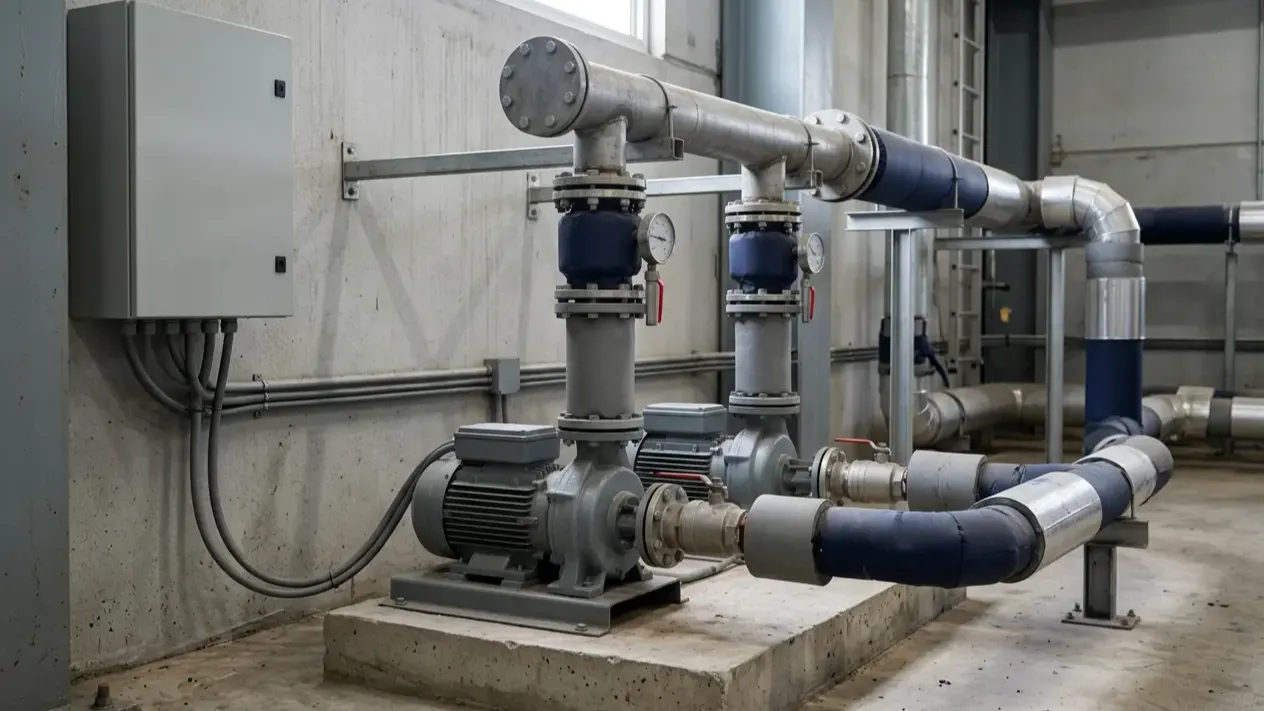
In a heating plantroom, a pump can react to a restriction elsewhere in its circuit. Several pumps can also respond to the same control instruction or electrical interruption. Compare the timing, operating conditions and connections between affected equipment before treating separate symptoms as separate failures, or assuming they have one common cause.
Operator notes and alarm histories provide condition evidence. Predictive maintenance goes further by analysing measurements for developing deterioration, using techniques such as vibration analysis or oil analysis where the equipment permits it. A collection of reset notes alone cannot establish the fault or predict how much working life remains.
Compare Events Under Equivalent Conditions
Start with what normal operation means for the affected service. Compare similar demand, pump speed, control mode and seasonal conditions. A pressure dip during changeover is different from one during steady running. Longer operating hours during colder weather need a different interpretation from longer hours under unchanged demand and schedules.
Use timestamp alignment to distinguish shared events from loose resemblance. Record whether pressure moved before a pump alarm, whether another asset changed afterwards, and whether an operator intervened between them. Reliable timestamp alignment depends on agreement between clocks. Events recorded minutes apart cannot confidently establish their order if controller clocks disagree.
Keep observation within safe access and reporting arrangements. HSE's maintenance guidance calls for competent people, suitable instructions and safe systems of work, and warns against using faulty or damaged equipment. Don't open panels, touch hot casings or bypass controls to collect evidence. Stable neighbouring equipment does not establish that continued operation is safe.
Also check readings for measurement method changes. A newly installed sensor, a different measuring position or more frequent inspections can make an existing condition appear new. Keep the previous method and measurement location with the reading. Without that context, an apparent deterioration may partly reflect measurement method changes, not just changes in equipment condition.
Read Physical and Hydraulic Changes Together
Noise, vibration, heat and leakage can reveal different aspects of the same operating change. Their combination helps frame an investigation, but none identifies a cause automatically. A changed sound accompanied by altered flow deserves a different enquiry from a sound change with unchanged hydraulic readings and a recently altered mounting arrangement.
The US Department of Energy's pumping systems sourcebook explains how operating conditions can affect pumps, joints and pipe supports together. Cavitation, where vapour bubbles form and collapse as pressure changes, can produce noise, reduce pump performance and induce vibration. Those effects justify checking hydraulic conditions; a rattling sound alone does not prove cavitation. Low flow can also create damaging recirculation at the suction or discharge regions of an impeller, the spinning part that transfers energy to the liquid. These disturbed flow patterns can cause cavitation-like damage, rather than damage being explained by vapour bubbles alone. This links possible pump damage to how much liquid passes through it, not just the component's physical condition.
Vibration can travel through connected structures, so the loudest location need not identify the originating component. Leakage likewise needs its location and timing recorded rather than an assumed source. Note whether staining is old or fresh, whether water returns after attention, and whether pressure or nearby equipment behaviour changes at the same time.
Temperature observations need load and ambient context too. A warmer reading under heavier duty isn't equivalent to a temperature rise under comparable conditions. Record any repeated topping-up alongside pressure movement, rather than treating restored pressure as proof that the underlying concern has disappeared. These observations help connect events without specifying a repair.
Pressure Differences and Shared Flow Paths
Differential pressure means the pressure difference between two identified points. Its meaning depends on where those points are: across a pump, a strainer or a branch. A single gauge reading is not interchangeable with that difference. Keep the measuring locations attached to the values so comparisons concern the same part of the circuit. Across a pipe reduction, water speeds up as the passage narrows, and static pressure can fall as energy shifts into motion. This pressure and velocity relationship means gauges on opposite sides can differ without that difference representing friction alone. Pipe diameter and measuring position therefore matter before interpreting pressure differences as developing deterioration.
In centrifugal pumping systems, flow depends on both pump performance and circuit resistance. Valve movement, fouling or a changed bypass path can therefore alter the operating point without a new pump defect. Hunting means repeated variation as the system seeks a stable operating condition; it calls for investigation, not an automatic conclusion that the controller is faulty.
Map the affected assets to their actual connections. Pumps on one shared header have a hydraulic relationship that pumps in separate circuits may not. Separate circuits might still share an electrical supply or control schedule. Physical proximity alone is weak evidence: two adjacent pumps can serve unrelated duties, while distant equipment can depend on one common service.
For example, if several branches lose flow when one control sequence changes, that timing supports examining their shared controls and hydraulic path. It does not prove which component is responsible. Conversely, one noisy pump with stable neighbours can still be responding to a restriction confined to its branch rather than an internal pump fault.
Separate Control Messages From Measured Behaviour
A building management system, or BMS, can bring alarms and operating records together. First establish what each entry represents. A start command records an instruction; a measured flow records a hydraulic result. They answer different questions. A command to run does not itself establish that the pump started or delivered the required flow.
Repeated messages alone do not establish signal independence. A pump fault shown locally, repeated at a control panel and forwarded to a BMS is not three independent observations. Independent pressure or flow measurements add different evidence. For industrial maintenance signals, signal independence matters more than message counts; check their origins and whether timing agrees.
An installed interface is not necessarily a recorded history. A fault relay can indicate a fault state, while a digital start/stop input receives a command. Neither function alone establishes that values are logged, retained or available for comparison. Check what the installed arrangement actually records before relying on a trend that may not exist.
Repeated resets, forced running and disabled schedules can obscure the sequence. Record when an intervention occurred, why it was made and what changed afterwards. A pressure recovery following an override describes a response, not proof of the original cause. Preserve the earlier alarm state where safe and available rather than relying only on the recovered display.
What Duty and Standby Records Can Reveal
The duty pump serves the operating requirement; a standby pump is held available for the intended reserve role. Two installed pumps do not prove that reserve is usable. A fault, isolation, unavailable supply or control problem can prevent the expected response. Read changeover records against the arrangement's intended operation, not simply its asset count.
A run-hour imbalance needs interpretation rather than an automatic fault label. A fixed standby role may legitimately produce very different totals. Where alternation is intended, a growing run-hour imbalance can justify checking whether the sequence occurred. Recent maintenance, deliberate isolation and counter resets can also affect the comparison, so preserve details alongside the totals.
If both units show similar behaviour under comparable conditions, shared pipework, controls or supply deserve attention. If only one does, the difference helps narrow the investigation but doesn't settle the cause. Any functional testing belongs with competent personnel following the equipment instructions and site arrangements; observations are not instructions to force a changeover.
Keep a Record That Supports Comparison
Combine the observations into one record that another shift can interpret. Keep observed facts separate from suspected explanations, and retain the relevant equipment instructions used by maintenance personnel. The useful minimum is:
- Asset, circuit, date, time, operating mode and duty or standby status.
- Alarm state, readings and measurement locations, including noise, vibration, temperature and leakage observations.
- Comparable normal demand, run hours, recent changes and interventions before and after the event.
- Related behaviour elsewhere and the shared circuit, control or supply connecting affected assets.
These records can support predictive maintenance, but their immediate value is deciding where further assessment belongs. Missing readings should remain missing, not become evidence of normal operation. Equally, a newly noticed symptom should not be called worsening unless comparable earlier observations show a change.
Conclusion
Industrial maintenance signals justify widening an investigation when their timing, comparable operating conditions and shared dependencies fit together. Simultaneous symptoms alone are insufficient. The result should be a clearer technical question about the component, its branch or the shared system, not a premature replacement decision.
If assessment establishes a replacement requirement, compare commercial circulators against the confirmed duty, connections, electrical supply, controls and installation constraints. We supply equipment and product information; the technical assessment remains with the responsible competent people. Keep any unresolved system issue separate from the product being ordered.