

Plantroom Downtime Warning Signs That Deserve Early Attention
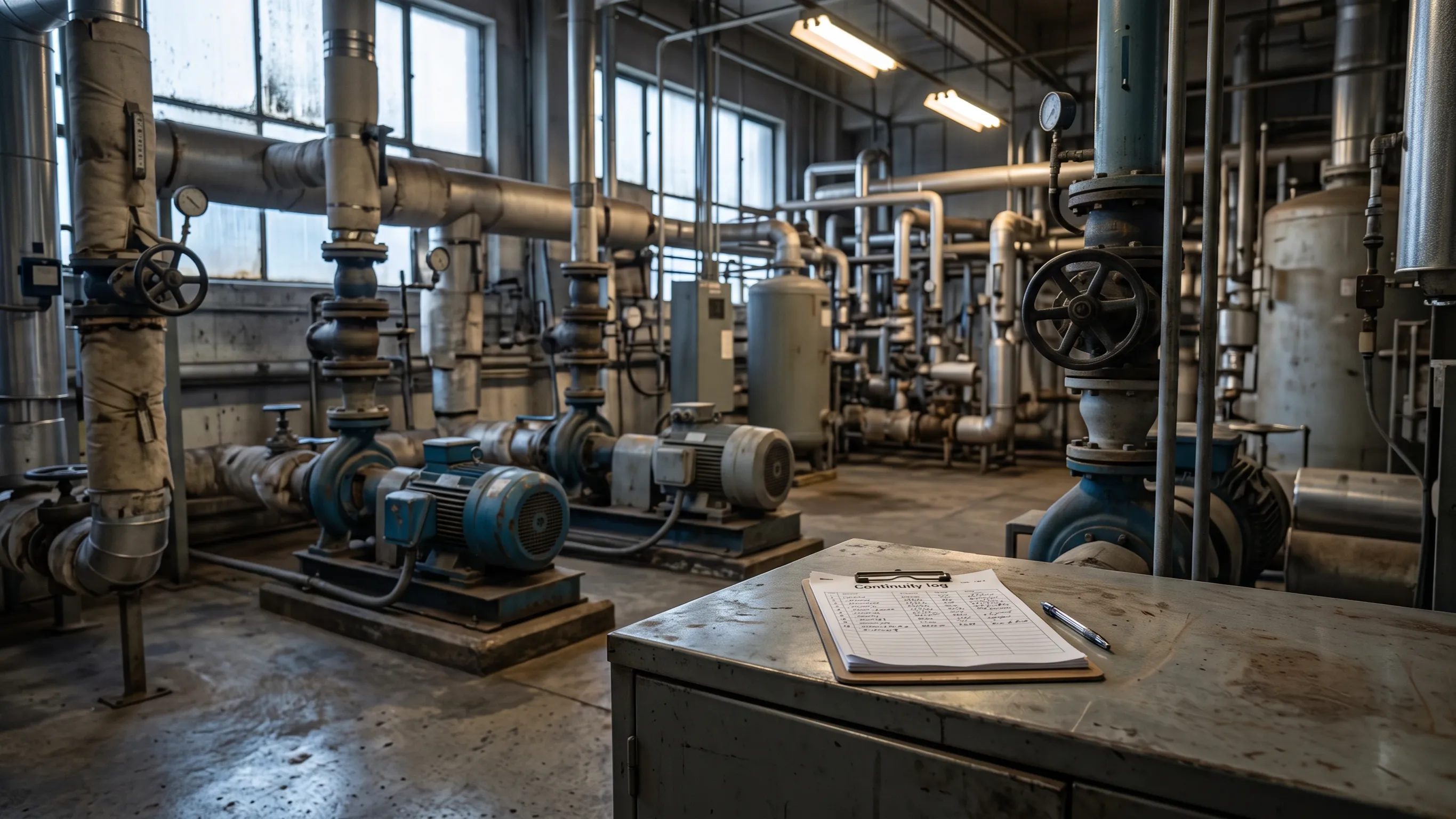
Plantroom downtime is not defined only by a stopped pump, a failed boiler or a locked-out control panel. It begins to matter when an interruption, slow recovery or narrowing operating margin starts to threaten the service the plantroom exists to protect. The warning may be visible before the cause is known: heating takes longer to recover, hot water availability becomes fragile, a duty/standby arrangement no longer feels dependable, or a short disruption has consequences that were previously manageable.
Early attention should therefore be governed by continuity, not guesswork. The organisation needs clear response levels, named ownership, enough recovery margin to avoid rushed decisions, replacement readiness based on confirmed requirements and careful preservation of event information. That approach keeps pump failure warning signs in proportion: they are clues that may justify competent assessment, not proof of a particular fault or a reason to specify replacement equipment without a technical brief.
Plantroom downtime is an operational threshold
Plantroom downtime deserves early attention when service consequence is starting to matter before a named part has failed. The first continuity question is not “which component is defective?” It is “how close is this service to losing continuity, and how much room is left to recover if conditions change?”
The warning is often operational rather than forensic. A system may still run, yet take longer to recover after normal demand. A short interruption that was once tolerable may now threaten heating, hot water, process availability or tenant comfort. Repeat events, increasing intervention and shrinking recovery margin justify attention without turning a possible pump issue into a premature diagnosis.
Define response levels before pressure rises
Response levels should be agreed before pressure is on the operator, duty manager or person trying to keep the building open. The threshold should be set by safety, repeatability, service consequence and remaining operating margin, rather than by a loose list of noises, temperatures, pressure readings, alarms or resets.
Planned review: use this level where the service remains stable, the event has not repeated, safety is unaffected and there is enough operating margin to wait for a scheduled technical review. Capture the concern while there is time to compare normal and observed recovery, confirm access needs and decide whether further assessment is justified.
Same-day continuity action: use this level where the issue has repeated, recovery is slower than normal, operator intervention is increasing, or the affected service has a direct business, occupancy or welfare consequence. Decide who attends, what service must be protected and what temporary constraints are acceptable before a complete outage.
Immediate safety escalation and isolation: use this level where continued operation may be unsafe or equipment is faulty or damaged in a way that could create risk. Prevent harm, follow the site's safe isolation procedures and escalate to a competent person with the authority and access needed to decide the next step.
These levels keep the decision practical. They do not require an operator to diagnose pump failure, boiler failure or controls behaviour. They ask whether the service remains tolerable, whether the risk is repeating, whether recovery is still credible and whether continued operation is safe. A reduction in operating capacity or continuity margin does not, by itself, establish that equipment is unsafe or that it must be isolated. That decision depends on the actual condition and risk.
These are practical planning categories, not regulatory classifications. They help organisations decide when to review, protect continuity or escalate a safety concern without treating every abnormal observation as a crisis.
Give the warning an owner and a deadline
A warning without an owner becomes background noise. Once a service consequence is visible, the organisation should know who records the event, who assesses the technical meaning, who protects continuity and who checks replacement options if a confirmed requirement emerges.
The operator records decision-critical facts: affected service, time, visible model details, normal versus observed recovery, intervention, alarms and whether alternative capacity was available. A competent technical person investigates the equipment and system context. Facilities or estates owns continuity, access and the acceptable interruption window. Procurement enters only when a confirmed brief allows product availability, price, lead time and published specification to be checked.
The decision deadline is as important as the owner. “Watch it” is rarely enough if the same service is becoming harder to recover. A deadline might be the next occupied period, the next production run, the next planned shutdown window or the next expected peak demand. The deadline turns a warning into a managed continuity decision.
Pump failure warning signs need context
Pump failure warning signs are useful when they are treated as service and equipment observations, not as final conclusions. Noise, vibration, repeated resets, loss of circulation, irregular pressure behaviour, overheating, leakage, tripping, slow recovery or a change in duty/standby behaviour may all deserve attention. The meaning depends on the system, controls, installation condition and operating duty.
The difference between a useful warning and a poor diagnosis is context. A noisy pump might be affected by bearing wear, cavitation, air, poor hydraulic conditions or another issue. A loss of flow might relate to the pump, valves, strainers, controls or wider system conditions. A repeated alarm may identify an electrical or control issue, but it still needs competent interpretation. Treating the symptom as a confirmed cause risks solving the wrong problem.
Useful pump observations should therefore preserve detail:
- What changed from normal operation.
- Whether the issue repeated, worsened or cleared.
- Which service was affected.
- Whether duty and standby equipment changed state as expected.
- Whether intervention was needed to restore service.
- Whether the next demand peak can still be met.
Those details help decide the response level. If symptoms are isolated and the service remains stable, planned review may be proportionate. If symptoms repeat and recovery margin is shrinking, same-day continuity action may be justified. If continued operation may be unsafe or damage is visible, safety escalation and isolation take priority.
Recovery margin shows fragility
Recovery margin is the spare operational room between an abnormal event and a lost service. It is not a hidden diagnostic code. It is the practical measure of whether the site can absorb predictable demand, recover from a short interruption and continue without depending on a fragile temporary condition.
A service with declining margin behaves differently. Recovery takes longer. Spare capacity feels narrower. A temporary setting or manual intervention becomes part of normal operation. The site becomes less able to absorb a predictable change in occupancy, weather, production load or usage pattern. These are non-diagnostic warnings, but they are still useful because they show that continuity is becoming more exposed.
Duty and standby resilience can be one source of lost margin. Alternating or paired arrangements support continuity only where the alternative capacity is available, suitable and able to meet the required duty. The DAB Evoplus D 40/220.32 M twin head circulator pump is one published twin-pump product example, although paired equipment alone does not prove resilience under site conditions.
Recovery margin also keeps the response proportionate. If the affected service has spare capacity and the event is isolated, a planned review may be enough. If the same issue leaves no room for the next demand peak, same-day continuity action is more appropriate. If continued operation is unsafe, isolation and escalation come first.
Preserve information before it disappears
Downtime decisions are weaker when the only record is a memory of “it happened again”. A short factual record protects the organisation from repeated uncertainty and helps competent assessment focus on the right area. It also supports replacement readiness if a product enquiry later becomes necessary.
The useful record is not complicated. Keep the affected service, date and time, visible model or serial details, operating mode, alarm or fault indication, intervention taken, recovery time and whether the service returned to normal. Where safe and permitted, photographs of nameplates, pump displays, control panels or obvious damage may help. Any such record should be factual and should not encourage untrained people to open equipment, bypass controls or continue unsafe operation.
Maintenance duties also need to be treated seriously. For workplaces in Great Britain, HSE guidance on the maintenance of work equipment explains that the Provision and Use of Work Equipment Regulations (PUWER) require work equipment to be maintained in an efficient state, in efficient working order and in good repair. Maintenance operations must also be planned and carried out safely. This does not turn every warning sign into an emergency, but it supports a disciplined approach to acting when equipment condition or operation may affect safety.
Keep replacement readiness separate from assessment
Replacement readiness is valuable, but it should remain separate from technical assessment. Investigation establishes the requirement. Procurement then works from confirmed facts rather than using catalogue pages to infer the cause of an outage.
A product page such as the Wilo Yonos MAXO 25/0,5-10 PN10 single pump may help compare availability, price and published specification once a circulator requirement is defined.
If the confirmed requirement is boiler-related, Remeha product ranges provide a separate product pathway. The range should be considered against a clear technical brief, not used to guess the cause of downtime.
For confirmed requirements, procurement can compare available pump and boiler products against the established technical brief, checking published specifications, pricing, availability and replacement options.
The competent technical person defines what is required. Facilities or estates decide the continuity position and access window. Procurement checks the market against confirmed data. The supplier provides product information and supply options within that confirmed brief.
Conclusion
Early attention preserves operational choice. An isolated event within tolerance may need a defined review point. Slower recovery, increasing intervention or insufficient margin for the next demand peak calls for competent assessment, with access and continuity responsibilities agreed. An unsafe equipment condition requires appropriate safety escalation and isolation.
Treating downtime as a continuity threshold keeps attention on consequence, operating margin, ownership and replacement readiness before a suspected component outcome narrows the choices available.