

Pump and Boiler Contingency Planning: Scenarios and Decision Thresholds
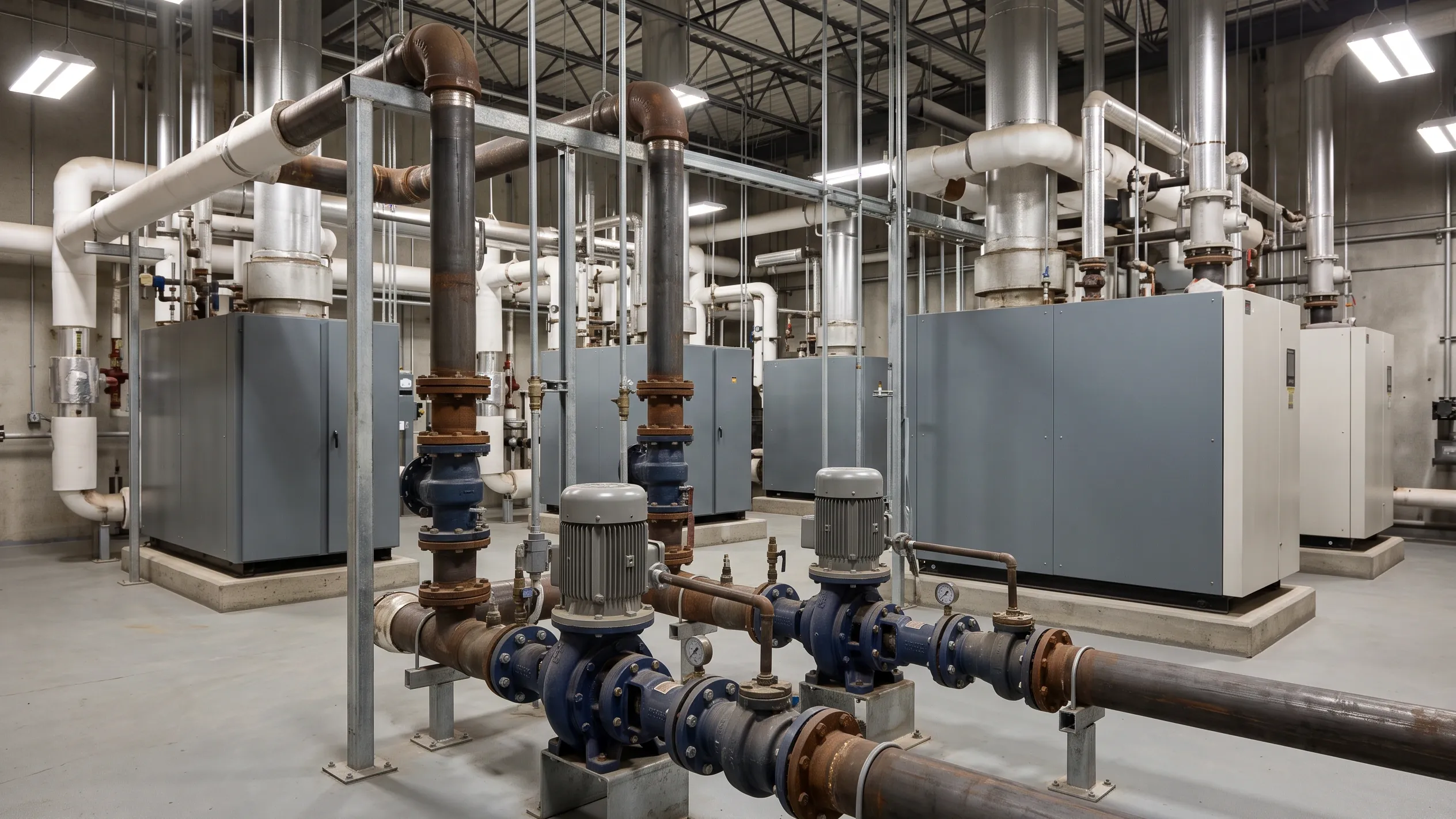
A heating system contingency plan earns its keep when the event does not follow the neat version. A duty pump is lost when the building is occupied. A boiler output problem appears during cold weather. A small missing component holds recovery after the main fault has already been understood. Each event can produce downtime, but each needs a different branch, fallback and decision threshold.
That is the practical meaning of pump and boiler resilience. It is not a promise that a site will continue without interruption. It is the ability to choose between safe isolation, reduced service, standby operation, delayed ordering, substitute capacity or a planned pause because the missing fact is too important to guess.
The plan should not design temporary services, diagnose faults or instruct anyone to work on live plant. HSE maintenance guidance is clear about competence, planning, safe isolation and risks around energy, pressure and access. A contingency record should respect those boundaries while giving facilities, estates, contractors and procurement teams a usable route through disruption.
Scenario One: The Main Heating Circulator Is Unavailable
The first scenario is loss of circulation. The boiler may still generate heat, but the served circuit cannot move it reliably. The branch starts by asking what service has been lost: whole-building heating, one riser, a landlord area, a tenant zone, frost protection, secondary hot water circulation or a process-related circuit.
The fallback options depend on that answer. If a standby head or parallel pump is installed, the plan should say whether changeover is automatic, manual, tested or assumed from the drawing. If there is no usable standby route, the branch may become reduced service, delayed occupation, frost-watch priority, temporary heat under a separate approved plan, or safe shutdown until competent assessment is complete.
The DAB Evoplus D 40/220.32 M twin-head circulator pump is one example of a twin-head option. That configuration alone does not establish standby capacity on an installed system. Check the required duty, valves, controls, isolation and tested changeover before relying on a second head to keep the served circuit operating.
Pre-agreed thresholds make this scenario manageable. A site might decide that one cold office area can wait for planned review if temperatures remain within its internal tolerance, while loss of circulation to a clinical, welfare, production or frost-exposed area triggers same-day escalation. A further threshold may say that if standby operation cannot be proved within a defined time, the plan moves from fallback to interruption management.
Scenario Two: Boiler Output Is Lost or Restricted
The second scenario is reduced or lost heat generation. One boiler may lock out, a cascade may lose a module, or older plant may no longer provide enough reliable output for the weather and occupancy condition. This branch should not treat every boiler symptom as an immediate buying task.
The first fallback question is capacity. Can remaining boilers hold the critical load at the current outside temperature? Can non-critical zones be reduced while welfare, frost protection, hot water or priority operational areas are protected? Is the issue likely to affect domestic hot water as well as space heating? Those decisions should be written before the site is under pressure.
If replacement is required after competent assessment, review the listed commercial boilers against the confirmed requirement and any relevant manufacturer-specific options. Carry the existing make, model, output, serial number, fuel, flue arrangement, controls, accessory references and photographs into that comparison. A lockout or slow recovery does not by itself establish that a new boiler is needed.
Decision thresholds should be expressed in operational terms: outside temperature, occupied hours, minimum service areas, hot-water demand period, number of boiler modules unavailable, acceptable recovery time and whether repeated resets or unsafe conditions are present. If a threshold is crossed, the branch changes. It may move from monitoring remaining capacity to calling competent attendance, from reduced service to full interruption, or from product information gathering to a postponed order because the safety or flue question is not settled.
This scenario also needs a communications fallback. If full output is unavailable, the plan should already say who is told, what service level can be promised and when the next update is due. Without that branch, technical uncertainty becomes operational confusion.
Scenario Three: The Missing Component Holds the Recovery
The third scenario is a delayed recovery caused by a missing component. The main failed item may be known, but the outage continues because a flue section, shunt pump, low-loss header, valve, gasket, bracket, control module or connection component is missing, wrong or incompatible.
This branch is different from the first two because the fallback may be a hold point. If the component affects flue safety, gas appliance suitability, pressure boundary, electrical interface or manufacturer compatibility, the plan should say that no substitute is accepted without competent confirmation. If the component is a non-critical connection item with a verified equivalent route, the plan may allow a pre-approved alternate sourcing path.
Remeha commercial boiler accessories include flue kits, shunt pumps, low-loss headers and cascade components for defined boiler ranges. A request for "a flue kit" or "a shunt pump" leaves compatibility unresolved. Record the appliance family, output, accessory reference, photographs and configuration, together with any alternative already approved by the responsible technical team.
Pump-side components need the same treatment. Connection, pressure rating, orientation, valve condition, port length and access affect whether recovery can proceed. A small missing item can stop the return of service because it controls fit, isolation or safety boundary.
The branch should therefore distinguish between recoverable delay and hard stop. Recoverable delay means the component is commercially unavailable but the requirement is confirmed and an approved alternative path exists. Hard stop means compatibility, safety or technical approval is unresolved. The plan should make that difference visible before someone tries to solve it with a fast order.
Branches That Keep Options Usable
A useful contingency plan contains branches rather than a single instruction. Each branch should tell the site what option remains valid when the preferred route fails.
The main fallback options are:
- Standby operation, where duty, valves, controls and changeover evidence have been tested.
- Reduced service, where priority areas and acceptable interruption have been agreed.
- Temporary provision, where the site already has a competent, approved method and access route.
- Product substitution, where equivalence rules and approval owners are defined before the event.
- Deferred ordering, where the requirement is known but the timing is commercially managed.
- Hard stop, where safety, duty, flue, pressure, control or compatibility evidence is missing.
The strength of the plan is not the number of options. It is whether each option has a threshold. "Use standby if available" is weak. "Use standby only if changeover has been tested, isolation valves are open, the control signal is present and the served circuit can hold priority areas" is a usable branch.
Apply the same thresholds when comparing commercial circulators. The buyer needs confirmed duty and interface requirements, plus an approved route for any alternative. If those details are missing, gather them before ordering rather than using a familiar model as a substitute for the assessment.
Pre-Agreed Decision Thresholds
Thresholds should be agreed when the building is calm. They should use conditions people can recognise during an outage: service lost, time to next occupied period, outside temperature, number of assets unavailable, hot-water demand window, safety status, confirmed access, product lead time and whether critical evidence is missing.
A practical threshold set might include:
- If safe isolation is not confirmed, stop the branch and escalate to the competent party.
- If the next occupied period cannot be protected by remaining plant, activate reduced-service communication.
- If standby operation is untested, treat it as uncertain capacity until proven.
- If product identity is incomplete, gather photographs and records before requesting price or delivery.
- If a flue, gas, pressure or controls component is uncertain, do not substitute without competent approval.
- If lead time exceeds the agreed service tolerance, move to the reduced-service or temporary-provision branch.
These thresholds prevent the plan from becoming a document of good intentions. They also make commercial decisions cleaner. A buyer can see whether the site is asking for product information, an approved alternate, a delivery check or a deliberate hold.
Tabletop Test the Plan Before Downtime
The best way to expose hidden dependencies is a tabletop test. Choose one pump scenario, one boiler-output scenario and one missing-component scenario. Walk each one from first alarm or complaint to the next stable state, using the actual asset records.
The test should ask awkward questions. Who can access the plant room out of hours? Which valves are labelled and known to isolate? Where are the latest duty figures? Which boiler serial numbers are current? Who can approve reduced service? Which areas get heat first? What product references are already photographed? Which suppliers can only answer a product-information question once the technical requirement is confirmed?
During the test, avoid filling gaps verbally. If the evidence is not in the record, mark it missing. If standby is assumed but untested, mark it uncertain. If an accessory has no approved alternate, mark it as a hard stop. If the decision threshold depends on one person, mark that dependency and create a fallback contact route.
We supply twin-head circulators, commercial boilers and model-specific boiler accessories. Once a contingency branch identifies a replacement requirement, bring the confirmed equipment and accessory references into the product enquiry. Check availability and delivery against the site's agreed interruption limit before committing to an order.
The Usable End State
A heating system contingency plan is usable when each scenario ends in a clear decision: run the confirmed fallback, operate reduced service, request a defined product, wait for competent confirmation, or stop because the risk is unresolved. Each decision needs an owner and a trigger that the next person can recognise.
The final check is simple. Hand the plan to someone who did not write it and ask them to run the three disruption scenarios. If they can see the thresholds, fallback options, evidence gaps and hard stops without asking for plant-room folklore, the plan is ready. If they cannot, the tabletop test has done its job before downtime does it for real.