

Pump Performance Degradation: How Efficiency Changes Over Time
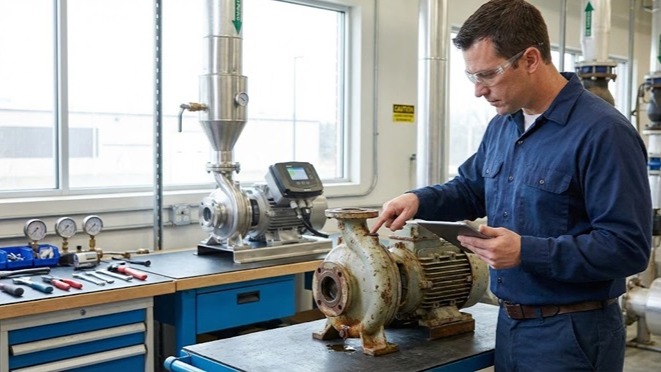
Circulating pumps don't fail overnight - they decline gradually, losing efficiency month by month until energy costs spiral and system performance collapses. A Grundfos UPS 25-60 that once delivered 3,500 litres per hour at 6 metres head might struggle to achieve 2,800 litres after five years of continuous operation. This isn't theoretical deterioration - it's measurable pump performance degradation that affects every commercial heating system, DHW installation, and industrial process loop in operation today.
The financial impact proves substantial. A 15% pump efficiency decline on a 1.5kW circulator running 6,000 hours annually adds £180 to operating costs at current electricity rates. Multiply that across a commercial building with twelve pumps, and degradation costs £2,160 per year - before accounting for reduced heat distribution, comfort complaints, or premature component failure elsewhere in the system.
Understanding how and why pump efficiency decline occurs allows heating engineers, facilities managers, and building services contractors to predict maintenance requirements, budget for replacements, and identify failing equipment before catastrophic breakdowns occur. National Pumps and Boilers supplies replacement circulators and commercial pumps to thousands of UK installations, and the patterns of pump performance degradation follow remarkably consistent trajectories across brands and applications.
The Physics Behind Pump Performance Degradation
Centrifugal pumps convert mechanical energy into fluid movement through rotating impellers. Efficiency depends on maintaining precise clearances between impeller vanes and pump housing, smooth internal surfaces that minimise friction, and bearing assemblies that support the shaft with minimal resistance. Each of these elements deteriorates through normal operation.
Bearing Wear and Shaft Misalignment
Pump bearings - whether sleeve bearings in smaller circulators or ball bearings in commercial units - experience constant radial and axial loads. A typical heating circulator shaft rotates 2,880 times per minute at full speed. Over one heating season (200 days of operation), that represents 82.8 million rotations. Even premium ceramic bearings from Grundfos pumps or Wilo pumps show measurable bearing wear after this duty cycle.
As bearings degrade, the shaft position shifts microscopically within the pump housing. This creates uneven clearances between the impeller and volute, generating turbulence that reduces hydraulic efficiency. Simultaneously, bearing friction increases, raising motor current draw and heat generation. Field measurements show bearing-related efficiency losses of 3-8% over typical five-year service intervals.
Impeller Surface Degradation
Impeller vanes achieve optimal performance with smooth surfaces that allow laminar flow. System water contains dissolved minerals, suspended particles, and corrosion products that gradually erode impeller surfaces. This erosion proves particularly severe in systems with inadequate filtration or improper water treatment.
Pitting and surface roughness disrupt flow patterns, creating turbulence that converts hydraulic energy into heat rather than pressure. A DHW pump handling hard water with 300ppm calcium carbonate shows measurably rougher impeller surfaces after 18 months compared to installations with softened water. This surface degradation accounts for 5-12% efficiency loss in hard water areas.
Seal and Gasket Deterioration
Modern circulators use mechanical seals or magnetic drive couplings to prevent leakage between the rotating shaft and pump housing. These seals incorporate elastomer components that harden and lose flexibility over time, particularly in high-temperature applications. A combi boiler circulator operating at 75°C experiences more rapid mechanical seal degradation than a low-temperature underfloor heating pump running at 45°C.
As seals deteriorate, internal recirculation increases - fluid bypasses the impeller rather than moving through the system. This internal leakage reduces the delivered flow rate without a corresponding reduction in power consumption, directly degrading efficiency. Seal-related losses typically contribute 2-5% efficiency reduction over standard service life.
Measuring Efficiency Loss in Operating Systems
Quantifying pump efficiency decline requires baseline measurements and periodic reassessment using a consistent methodology. Facilities managers and heating engineers can implement straightforward monitoring protocols without specialised equipment.
Flow Rate Assessment
Flow rate measurement provides the most direct indicator of pump performance degradation. Ultrasonic flow metres offer non-invasive measurement, but simpler approaches work for routine monitoring. The temperature drop method calculates flow by measuring heat output and temperature differential across a heat emitter.
For a radiator circuit: Flow rate (l/h) = Heat output (kW) × 860 / Temperature drop (°C)
A 2kW radiator with 10°C drop indicates 172 litres per hour. If that same radiator shows 12°C drop at full output after two years, flow has decreased to 143 litres per hour - a 17% reduction indicating significant pump performance degradation.
Power Consumption Monitoring
Motor current draw reveals efficiency changes even when flow measurement proves impractical. A clamp metre measures operating current, which should remain stable if pump performance maintains specification. Rising current with stable system demand indicates declining efficiency - the motor works harder to achieve the same hydraulic output.
Baseline current measurements during commissioning provide comparison points. A Lowara pump drawing 1.8A at commissioning that now requires 2.1A at identical system conditions has lost approximately 15% efficiency, assuming voltage remains constant.
Pressure Differential Testing
Measuring pressure across the pump reveals head performance independent of system variables. Pressure gauges installed on pump inlet and outlet ports show delivered head at operating flow rate. Comparing current readings against manufacturer's pump curve identifies performance degradation.
A circulator specified to deliver 4 metres head at 2,000 litres per hour should maintain that performance throughout its service life. If pressure differential drops to 3.2 metres at the same flow rate, the pump has lost 20% of its head capacity - clear evidence of internal wear requiring attention.
Degradation Patterns Across Pump Types
Different pump configurations and applications experience characteristic degradation patterns based on operating conditions, duty cycles, and mechanical design.
Fixed-Speed Circulators
Traditional single-speed heating circulators show linear degradation over their service life. Performance typically declines 2-3% annually during the first five years, accelerating to 4-5% annually thereafter. A seven-year-old fixed-speed pump commonly operates at 70-75% of its original efficiency.
These pumps prove particularly vulnerable to bearing wear because they run continuously at full speed throughout the heating season. Constant operation at 2,880 RPM generates more bearing stress than variable-speed alternatives that modulate output to match demand.
Variable-Speed ECM Circulators
Electronically commutated motor (ECM) pumps from manufacturers like Grundfos and Wilo range demonstrate superior longevity because they adjust speed to match system requirements. Lower average operating speeds reduce bearing wear and mechanical stress.
These pumps typically maintain 90% or greater efficiency for seven to ten years under normal conditions. However, control electronics prove more vulnerable than mechanical components. Circuit board failures often end service life before mechanical wear significantly degrades performance.
Commercial End-Suction Pumps
Larger end-suction pumps serving commercial heating systems, process cooling, or industrial applications show different degradation characteristics. These pumps use replaceable mechanical seals and serviceable bearings, allowing maintenance to restore performance without complete replacement.
Without proactive maintenance, commercial pumps lose 3-5% efficiency annually. However, scheduled mechanical seal replacement at three-year intervals and bearing service at five years maintains efficiency above 85% for fifteen years or longer. This makes commercial pump maintenance economically advantageous compared to residential circulator replacement strategies.
Environmental Factors Accelerating Degradation
Operating environment significantly influences the rate of pump efficiency decline. Systems operating under ideal conditions maintain efficiency far longer than installations subjected to contamination, temperature extremes, or poor system water quality.
System Water Quality
Water chemistry proves the single most influential factor in pump longevity. Systems filled with softened water and proper inhibitor concentrations show minimal internal corrosion and scale formation. Pumps in these systems commonly achieve twelve to fifteen years of service with gradual efficiency decline.
Conversely, systems with hard water (above 200ppm calcium carbonate) and no water treatment develop scale deposits on impeller surfaces and within pump housings. This scale roughens surfaces, restricts clearances, and creates imbalance that accelerates bearing wear. Pump performance degradation accelerates to 5-8% annually in untreated hard water systems.
Operating Temperature
High-temperature applications stress pump components more severely than low-temperature installations. A circulator serving an 82°C flow temperature in a commercial heating system experiences more rapid seal degradation and bearing wear than an identical pump handling 50°C underfloor heating circuits.
Temperature cycling proves equally damaging. Systems that operate intermittently with frequent temperature swings subject pump components to thermal expansion and contraction that fatigues materials and loosens precision fits. Continuous operation at stable temperature preserves efficiency better than cycling duty.
Installation Position and Pipework Configuration
Pumps installed with improper pipework configuration experience accelerated degradation. Inadequate straight pipe runs before and after the pump create turbulent flow that reduces efficiency and increases mechanical stress. Systems with air separation problems allow microbubbles through the pump, causing cavitation damage to impeller surfaces.
Vertical installation with downward flow proves particularly problematic for circulators with sleeve bearings, as gravity compounds bearing loads. Horizontal installation preserves bearing life and maintains efficiency longer in most circulator designs.
Economic Impact of Declining Efficiency
Quantifying the cost of pump efficiency decline reveals when replacement becomes more economical than continued operation of deteriorated equipment.
Energy Cost Calculations
A 1.1kW circulator operating 5,000 hours annually consumes 5,500 kWh at full efficiency. At £0.32 per kWh (current commercial electricity rates), annual energy cost totals £1,760. After five years of typical degradation reducing efficiency by 15%, that same pump now draws 1.27kW to achieve equivalent hydraulic output, increasing annual consumption to 6,350 kWh and costs to £2,032.
The efficiency loss costs £272 annually - money spent achieving the same heating distribution that the pump originally provided at lower energy consumption. Over the remaining expected service life (typically three additional years), degradation costs £816 compared to replacement with a new high-efficiency circulator.
System Performance Consequences
Beyond direct energy costs, pump performance degradation impacts overall system operation. Reduced flow rates cause uneven heat distribution, comfort complaints, and increased boiler cycling. These secondary effects prove difficult to quantify but substantially impact building operation and occupant satisfaction.
Commercial buildings commonly experience increased service calls and tenant complaints as pump efficiency declines. A 20% reduction in circulator performance creates noticeable temperature variations between floors or zones, prompting facilities management intervention even before complete pump failure occurs.
Predictive Maintenance and Replacement Strategies
Understanding typical degradation patterns allows proactive replacement before efficiency losses become economically significant or catastrophic failures disrupt building operation.
Replacement Interval Guidelines
Fixed-speed circulators warrant replacement at seven to eight years of service, when cumulative efficiency losses typically exceed 25-30%. The energy savings from new high-efficiency pumps recover replacement costs within two to three years through reduced electricity consumption.
Variable-speed ECM pumps justify longer service intervals - ten to twelve years for residential applications, eight to ten years for commercial installations with higher duty cycles. These pumps maintain efficiency longer but cost more to replace, shifting the economic breakpoint later in service life.
Commercial end-suction pumps benefit from component-level maintenance rather than complete replacement. Mechanical seal replacement at three-year intervals costs £180-£320 depending on pump size, whilst bearing service at five years adds £250-£450. These maintenance investments preserve 90% or greater efficiency for fifteen years, far exceeding the economics of premature replacement.
Performance Monitoring Protocols
Implementing simple monitoring procedures identifies declining pumps before failure. Annual current draw measurements flag efficiency losses, whilst five-year flow rate verification confirms hydraulic performance. These assessments require minimal time investment but provide objective data for replacement decisions.
Building management systems with pump current monitoring enable automated performance tracking. Setting alerts for 15% current increase above baseline values provides early warning of significant degradation, allowing planned replacement during scheduled maintenance rather than emergency response to failures.
Maximising Pump Service Life
Whilst all mechanical equipment eventually degrades, proper installation and maintenance practices significantly extend the period of high-efficiency operation.
Water Treatment Fundamentals
Closed heating systems require proper inhibitor concentrations to prevent internal corrosion and scale formation. British Standard BS 7593 specifies treatment requirements for different system types and water qualities. Systems maintained within these parameters show 40-60% slower pump performance degradation compared to untreated installations.
Annual water testing verifies inhibitor concentration and identifies contamination requiring attention. Facilities managers should budget £120-£180 annually for professional water testing and treatment adjustment - an investment that extends pump life by three to five years.
Filtration and Dirt Separation
Magnetic filters and dirt separators remove suspended particles before they reach pump internals. These devices prove particularly valuable in older systems with legacy pipework that continuously generates corrosion products. A quality magnetic filter (£180-£280 installed) captures debris that would otherwise erode impeller surfaces and damage seals.
Filter maintenance matters as much as installation. Filters should be cleaned every six months in the first year after installation, then annually thereafter. Neglected filters become saturated and allow particle bypass, negating their protective benefit.
Proper System Design
Pump longevity begins with correct specification and installation. Oversised pumps running continuously at low speed or throttled with system valves experience more rapid seal degradation than properly sized equipment operating near design conditions. Similarly, undersised pumps running continuously at maximum output suffer accelerated bearing wear.
System design should include adequate expansion vessel capacity to maintain stable pressure, preventing cavitation that damages pump internals. Pressure fluctuations prove particularly destructive to mechanical seals and can reduce service life by 30-40% in poorly designed systems.
Conclusion
Pump performance degradation follows predictable patterns determined by mechanical wear, operating conditions, and maintenance quality. Understanding these patterns allows heating engineers and facilities managers to implement monitoring protocols, schedule proactive replacements, and maximise equipment service life whilst controlling energy costs.
The economic case for addressing pump efficiency decline proves compelling. A typical commercial heating circulator losing 20% efficiency over five years wastes £1,000-£1,500 in excess energy costs - money that could fund replacement with modern high-efficiency equipment. Residential installations show proportionally similar waste, with degraded circulators costing homeowners £60-£120 annually in unnecessary electricity consumption.
Proactive maintenance - particularly water treatment, filtration, and periodic performance assessment - extends high-efficiency operation by three to five years compared to neglected installations. These practices require modest investment but deliver substantial returns through extended equipment life and reduced energy consumption.
For technical guidance on pump selection, performance monitoring, or replacement specifications suited to specific applications, contact us for expert advice on maintaining system efficiency and identifying when replacement delivers better value than continued operation of degraded equipment.