

Replacement Planning Mistakes That Create Compatibility Problems
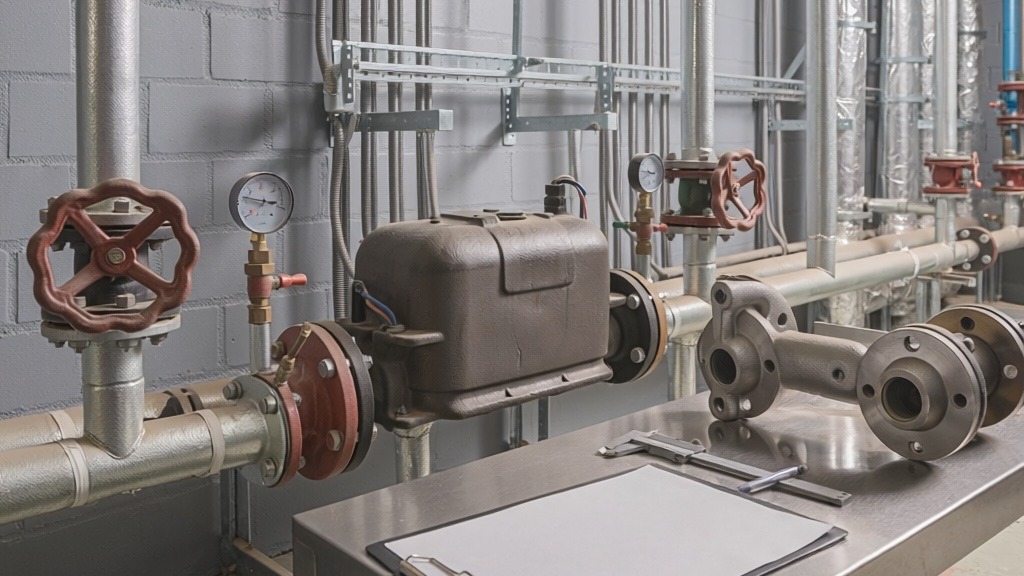
Compatibility problems often begin with a replacement that looks reassuringly familiar. The old pump has a nameplate, the pipe centres appear close, the surrounding valves are already in place and a current model seems to answer the enquiry. The mistake is assuming that familiar appearance has already proved compatibility.
A pump compatibility assessment has a narrower job than a full pump specification. It does not need to rebuild every design input in public. It needs to catch the replacement traps that usually appear after the product has been ordered: connection differences, access that disappears when the new body is fitted, valves that will not isolate, control signals that the pump or panel cannot use, pressure ratings copied from habit and resilience assumptions that were never agreed.
The Compatibility Gate Should Test the Awkward Details
For replacement pump selection, a useful compatibility gate asks whether the proposed replacement can be installed, isolated, controlled, removed and supported in the real plant room that will receive it. The old model can be a clue, and DAB pump-selection guidance supports using flow, head, liquid and operating conditions as core selection inputs, but those inputs do not remove the need for a practical replacement check.
The gate should be deliberately sceptical. It should ask:
- Does the replacement physically land where the old pump leaves the pipework?
- Can the existing valves, strainers and unions actually be used during the work?
- Will the control panel, BMS signal and alarm route recognise the new control arrangement?
- Is the pressure rating being confirmed for this circuit rather than copied from memory?
- Can the pump be accessed, insulated, wired, isolated and removed after installation?
- Has the site decided whether it needs single, twin or duty-standby resilience?
Those questions keep the article in compatibility territory. They are not a complete design schedule. They are the familiar-looking replacement traps that turn a tidy order into extra work, delay or later disagreement.
Trap One: Port-to-Port Similarity Is Not the Whole Fit
Port-to-port length is one of the most common places where a replacement looks simple until the old pump is out. A replacement can have the right general product family and still create work if its face-to-face dimension, connection arrangement, orientation or control-box position differs from the existing installation.
The compatibility note should record the measured port-to-port length, connection type, connection size, flange or threaded arrangement, pump orientation, wiring side, insulation clearance and lifting or removal space. If the site needs the replacement to fit without pipework alteration, that is a constraint to write down before the order. If alteration is acceptable, it should be treated as a separate programme and competent-work decision, not hidden inside the product choice.
The same point applies after the new pump is in place. A body that fits between the pipes can still block access to a strainer, prevent insulation reinstatement, leave no room for the terminal cover, crowd a pressure gauge or make later removal harder. Compatibility includes future access, not only the first installation.
Trap Two: Seized Valves Change the Replacement Job
A like-for-like replacement can depend on parts of the plant room that nobody checks during procurement. Isolation valves may be seized, passing, badly labelled, inaccessible or too corroded to trust. Unions may be damaged. Strainers may be overdue for attention. A drain-down route may depend on valves outside the immediate pump bay.
That does not make the selected pump wrong, but it changes the risk around the replacement. If isolation cannot be relied on, the site may need a wider shutdown, a different work window, additional components or a competent review of the surrounding arrangement before the order should be treated as safe to proceed.
The compatibility record should therefore include valve condition, isolation confidence, drain point position, access for tools, surrounding component condition and any obvious obstruction. A product enquiry that says only “replace existing pump” leaves those risks invisible. A good compatibility gate makes them visible before delivery pressure starts.
Trap Three: The Controls May Recognise the Old Pump, Not the New One
Control compatibility is not just voltage. A replacement pump may have local settings, integrated control modes, external enable, fault relay output, digital start or stop, alarm indication or communication options. Those features are only useful if the existing panel, BMS logic, wiring and maintenance records can support them.
The trap is assuming that a modern control function will automatically improve the system. It might not. The old pump could have used a simple enable signal, while the new product expects different wiring or different settings. The BMS may need a clean run signal, a fault indication, a volt-free contact or a particular control behaviour. The site may also need the competent party to record settings after installation so future fault-finding does not start from guesswork.
A compatibility assessment should write down the supply, phase, local isolation, protection, control signal, alarm requirement, panel limitation and who owns any settings or controls evidence. We do not programme, commission or diagnose the control system. Product information can show what a pump publishes. The site team decides whether the controls arrangement can use it.
Trap Four: Pressure Rating Assumptions Can Be Too Casual
Pressure rating often receives less attention than duty or connection size because the old installation has been working for years. That is a risky shortcut. Component pressure rating, system static pressure, expansion provision and circulating head are different matters. In a closed heating circuit, pump head normally concerns circuit resistance at the required flow, while pressure rating concerns the component boundary the product must safely sit within.
The compatibility gate should confirm the required product pressure rating against the circuit condition and current product data. It should also check temperature range, liquid or treatment assumption and material expectations where those are relevant. A pump can appear mechanically close yet still carry the wrong rating or operating boundary for the replacement context.
This section should stay practical rather than pretending to approve the design. The buying decision needs to know whether the proposed product data contradicts the known circuit requirement. If that line is missing or assumed, the order should pause until the competent technical owner confirms it.
Trap Five: Single, Twin and Standby Are Not Interchangeable
Resilience errors are another familiar-looking replacement trap. A site may have a single pump and assume a single replacement is enough. Another site may see a twin-head product and assume resilience has been solved. Neither assumption is safe without a clear operating decision.
The compatibility question is not only what is installed now. It is what continuity the service requires, how interruption will be managed, whether changeover behaviour is expected, how isolation will work and how the asset will be supported later. A twin-head product may support a different resilience approach from a single pump, but the result depends on the product, controls, isolation, pipework and site requirement.
The record should therefore state whether the replacement is expected to remain single, become twin, support duty-standby operation or simply restore an existing arrangement. It should also state the shutdown window and any lead-time risk. Without that decision, resilience can become a product label rather than an agreed operational requirement.
Use Product Information to Check Traps, Not to Skip Them
Once the replacement traps have been written down, product information becomes much more useful. The Grundfos MAGNA1 25-60 listing includes fields such as product number, pipe connection, pressure rating, installation length, voltage and integrated control. Those fields help test known compatibility points. They do not prove that an unknown site is suitable.
A broader category such as commercial circulators can help procurement compare current product routes after the compatibility record has defined the replacement trap lines. Used too early, the category can make the job look like catalogue matching. Used after the record is written, it helps the team ask cleaner product-information questions.
A single circulator such as the Wilo Yonos MAXO 25/0,5-10 PN10 Single Pump should be checked against the confirmed connection, pressure rating, electrical supply, control expectation, access and resilience decision. It should not be treated as a resilience answer merely because it is a current commercial heating pump option.
The DAB Evoplus D 40/220.32 M Twin Head Circulator Pump shows why twin configuration must be treated as its own compatibility choice. The site still needs to confirm isolation, control behaviour, access, expected operation and supportability before a twin route is treated as the correct replacement answer.
The Approval Note Should Name the Trap, Not Bury It
Replacement planning often fails because the open risk is buried inside a purchasing note. The approval record should be short enough to use and specific enough to stop false certainty. It should name the old product reference if available, the measured physical constraints, the surrounding valves, the control interface, the pressure-rating evidence, the access concern and the resilience decision.
It should also name unresolved items plainly. “Port length assumed”, “BMS signal not confirmed”, “isolation valves untested” or “twin operation not agreed” are not admin details. They are compatibility risks. Once they are visible, the order approver can decide whether the decision should proceed, pause or return to the competent party for confirmation.
When the record is clear, we can support the supplier side with published specification, availability, price, ordering and delivery questions. That supplier route is strongest when the enquiry contains a bounded replacement-product question rather than a request to assess the site.
Stop the Order When the Familiar Match Is Still Unproven
The compatibility decision is allowed to stop. If port-to-port length is guessed, stop. If the isolating valves are seized or untested, stop. If the control signal is not understood, stop. If the pressure rating is assumed, stop. If the new pump will block future access, stop. If single, twin or standby resilience has not been agreed, stop.
That stopping rule is what separates a pump compatibility assessment from a broad selection article. It protects the site from ordering a familiar-looking product that creates an unfamiliar problem. Record the open trap, name the owner and close that point before the replacement becomes a purchase commitment.