

Replacing Pressurisation Units, Pumps and Boiler Ancillaries
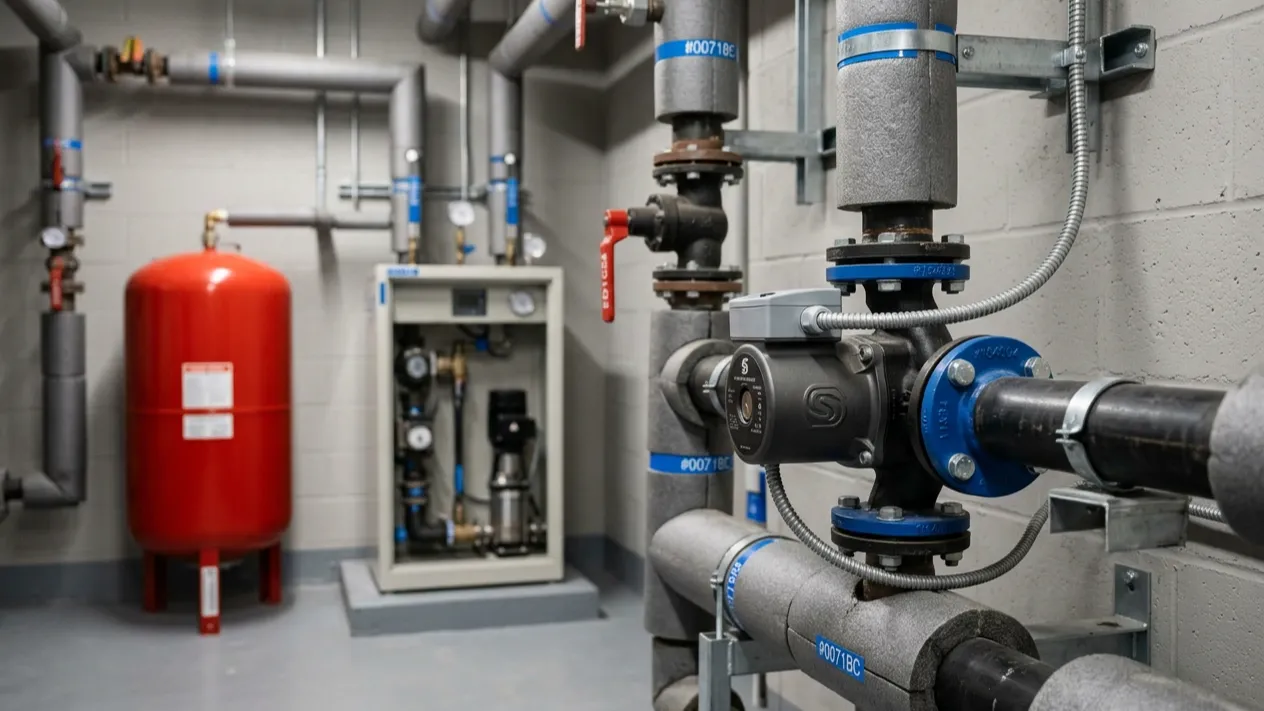
A heating pressurisation unit maintains the fill pressure in a sealed water circuit; a circulator is the pump that moves water around it. Boiler ancillaries are supporting parts, such as pumps and flue fittings, that must suit the appliance and its connected system. Replacement requirements differ accordingly. For the pressurisation unit, check pressure and replacement water use. For the pump, check flow, the amount of water moved, and head, the pressure it can provide to overcome resistance. For an ancillary, check the appliance identity and the water-pipework or exhaust-flue arrangement. A matching casing, pipe diameter or brand name cannot establish all three.
Expansion vessel matching belongs alongside pressurisation selection because the two components do different jobs. The vessel accommodates changes in water volume as the system heats and cools; the filling unit replaces water when pressure falls. More frequent filling is not a substitute for adequate expansion provision. Understanding that distinction helps separate a faulty unit from a problem elsewhere in the sealed system before choosing a replacement.
Pressure Behaviour Before Pressurisation Replacement
Pressurisation replacement starts with the sealed system, not the product casing. The pressure required when the system is cold, known as cold-fill pressure, and its normal operating pressure range describe the conditions the replacement must serve. The expansion arrangement, make-up water pattern (water added to replace losses), alarm history and leakage history help explain how it has been behaving. Whether the unit serves heating, cooling or both also matters: a record of pressure without the system's operating conditions gives only part of the picture.
Available water-supply pressure is a separate selection input from the pressure required in the heating circuit. The Mikrofill 3 PRO is a direct-fill unit using the incoming mains or boosted supply; it is not itself a booster pump. Dynamic inlet pressure is the supply pressure available while water is flowing, rather than the sealed circuit's cold-fill target. A unit with the right system-pressure range still needs an adequate incoming supply. A small discharge follows each fill, so suitable drainage is also part of the replacement's space and connection requirements. A compact casing does not resolve either interface.
The Mikrofill 3 PRO shows cumulative top-up volume alongside an operation count and filling time. Separately, its history log stores the last 100 faults or parameter changes with time and date stamps. Those records are useful evidence when assessing repeated top-ups; they do not identify the cause of water loss by themselves.
Expansion vessel matching also depends on where the vessel sits relative to the pressurisation unit. For the Mikrofill 3 PRO arrangement, a difference in height calls for manufacturer advice on the vessel's air pre-charge, the initial pressure on its gas side. The old vessel capacity is therefore only part of the pairing: capacity describes its size, while charge and location affect the pressure relationship. Access to the air-charge valve and diaphragm, the flexible membrane separating water and gas, plus space for its connecting pipework to be removed for servicing, also matter. A vessel can fit the available footprint yet leave those maintenance provisions unresolved.
Normal filling and abnormal make-up are different replacement problems. A pressurisation unit that keeps adding water may be revealing leakage, relief valve discharge, expansion failure or other system behaviour. Replacing the unit alone does not correct those causes. In the Mikrofill example, the unit is intended to compensate for intermittent pressure losses, not continuously refill a system suffering significant, sudden water loss. Its filling capability should not be mistaken for a remedy for that loss.
Event history is especially useful because pressure problems can be intermittent. A single normal gauge reading during a site walk does not show what happened after a weekend shutdown, during peak heat-up or after a known leak was topped up. Where the existing unit stores alarms or usage records, those records should be preserved by the responsible maintainer before replacement choices narrow.
A useful pressurisation replacement record brings the operating evidence together with the physical constraints. For controls, BMS means building management system, which monitors or controls building equipment; MODBUS is a protocol for exchanging data between devices. Record:
- existing unit make, model and photographs;
- system type, heating or cooling, and approximate served area;
- confirmed pressure requirements from the responsible technical party;
- expansion vessel matching: size, pre-charge and location;
- alarm, event history or make-up water pattern;
- BMS or MODBUS requirements confirmed for the project;
- access, electrical supply and connection constraints confirmed on site.
Pump Duty and Control Interface
DAB's Evoplus circulators illustrate why the operating method matters as well as the physical fit. These wet-rotor electronic circulators, with the motor's rotating part in the pumped water, serve commercial heating and conditioning systems with variable-speed control and selectable operating modes. The pump's required duty is the flow and head it must deliver; that and its control arrangement must be established before choosing the exact unit.
In commercial heating, chilled-water or domestic-hot-water circuits, the old pump nameplate can narrow the search but cannot prove the current duty. Buildings change. Controls change. Valves, strainers, treatment condition and occupancy patterns change. A pump that once matched the system may now be oversized, undersized or poorly controlled for the present system.
When comparing commercial circulators, flow and head establish the pump's duty, while liquid, operating temperature and pressure rating define the conditions the pump must tolerate. Physical connections, port arrangement, available space and electrical supply determine whether the candidate fits the installation. These are separate checks: matching the bolted pipe connections, or flanges, does not demonstrate the required flow at the required head, and matching the duty does not establish electrical or control compatibility.
The exact version matters as much as the range name. In the new DAB EVOPLUS range, SAN identifies the version suitable for potable-water service, meaning water intended for drinking or food preparation; that suitability does not extend to every EVOPLUS circulator. For heating or cooling, the water or water/glycol antifreeze mixture must fall within the proposed model's permitted liquids. DAB model designations also distinguish centre distance and the nominal diameter of flanged ports. Those dimensions answer different fit questions: the distance between connections and the size of the connection itself. The complete designation is therefore more useful than the diameter alone.
A single pump and a twin pump describe one-pump and two-pump equipment. Duty/standby describes the operating arrangement: one pump runs while the other is available to take over. The control interface is a separate requirement again: local control, an external start/stop command, a fault relay used to signal a problem and a building management system signal do not all perform the same function. The required arrangement needs to describe both normal operation and the intended response to a failure.
Variable speed alone does not describe how a pump should respond to the circuit. Differential pressure is the pressure difference between the pump's outlet and inlet. In the new EVOPLUS range, proportional differential-pressure control reduces the pressure target as demand falls, whereas constant differential-pressure control maintains its target. Constant-curve operation instead uses a selected rotational speed. These are different responses even where the pump body and electrical supply are identical. An external setpoint is a target supplied by the building's controls rather than selected locally on the pump. The required mode and setpoint source must therefore match the intended system behaviour.
A start command, a demand signal and a fault indication are separate controls functions. In the new EVOPLUS range, external start/stop, analogue or PWM control, and outputs for status or alarm indication serve distinct functions. Analogue control uses a varying voltage; PWM, or pulse-width modulation, varies how long electrical pulses stay on to convey the demand. A pump being enabled to run is not the same as receiving a demand signal, and neither provides fault feedback by itself. For twin arrangements in this range, the modes are alternating operation, where pumps take turns, main/reserve operation, where one is kept ready to take over, and simultaneous operation, where both run together. Simultaneous running can serve a flow that one pump cannot deliver. Two fitted pumps therefore do not automatically provide full-duty standby capacity when one becomes unavailable. That requires either pump to meet the required duty alone.
Boiler Ancillary Compatibility
Boiler ancillaries are often where a simple replacement enquiry becomes a compatibility problem. Flue kits, elbows, mounting brackets and boiler-circuit pumps are tied to boiler range, output band and installed arrangement. The same applies to parts joining several boilers together or connecting a heat exchanger between water circuits. The wrong accessory can delay the work even when the main boiler decision is understood.
For Vaillant, selecting boiler accessories depends on the exact appliance generation, not just the brand. For the ecoTEC plus VU GB 806/5-5, 1006/5-5 and 1206/5-5, the boiler pump group is used with a plate heat exchanger. This transfers heat between the boiler's water circuit and the building's heating circuit while keeping their water separate. The exchanger selection depends on appliance output and whether the arrangement is a cascade, meaning several boilers working together, with its resistance to water flow matched to the offered pump groups. The boiler-side pump and exchanger form a matched combination; the pump is not simply interchangeable with the building's circulation pump. A replacement must preserve that relationship, rather than matching only the old pump's connection size.
For those same ecoTEC plus models, the pump group also provides connections for an expansion vessel and an expansion relief valve, which releases water if pressure becomes too high. When replacing only one ancillary, it matters what is included in the assembly: the complete group, its pump and a separately connected component are different supply requirements. A connection for a vessel does not mean that the vessel is included in the assembly. The part reference and assembly description define that scope, while photographs help establish what is present. Distinguishing the boiler circuit from the building's heating circuit on the arrangement drawing also identifies which vessel or exchanger connection is involved.
The appliance's full model, output and serial number where available identify the relevant instructions; its position within any group of boilers, the water-circuit arrangement and existing accessory reference identify its use within the installation. Clear photographs can support those records but cannot show every compatibility condition. For flue and gas appliance questions, a competent Gas Safe registered professional must confirm the safety and compliance context before procurement.
Flue compatibility needs the same precision at the appliance interface. For these commercial ecoTEC plus models, the concentric 110/160 flue options include vertical roof, horizontal wall or roof, and other supported arrangements. Here, concentric means the flue-gas pipe runs inside the surrounding air pipe. Their permitted lengths differ by appliance model and route, and additional bends affect the allowance. A matching diameter alone therefore cannot settle which replacement kit or elbow is suitable. The relevant comparison is the complete route, including its bends, against the instructions for that exact model, not the dimensions of the isolated component. The confirmed route and component references keep replacement procurement tied to the professional's flue assessment.
From Confirmed Requirements to Supply
A sound replacement preserves the required function, not merely the appearance of the old component. For pressurisation, the decisive relationship is between filling behaviour, circuit pressure and expansion provision. For a circulator, it is the required duty together with its control response; for a boiler ancillary, it is the matched appliance and assembly. Where those relationships remain uncertain, a like-for-like order is premature. Once the component requirement is established, contact us with the model or part reference to discuss product supply. System assessment, installation and commissioning, the final set-up and operational checks, remain with the responsible technical parties.