

Signs Your Strainer Needs Cleaning or Replacement
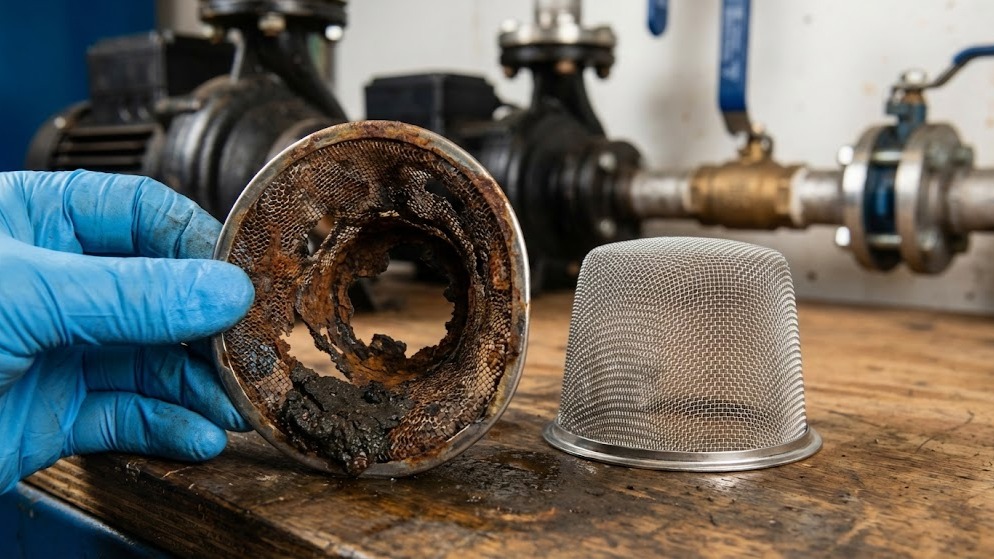
Strainers protect pumps, boilers, and heating systems from debris that can damage internal components, reduce efficiency, and cause costly breakdowns. These simple mesh or perforated filters sit upstream of critical equipment, capturing sediment, scale, metal particles, and other contaminants before they reach sensitive parts like pump impellers, valve seats, and heat exchangers.
Yet strainers only work when properly maintained. A clogged or damaged strainer creates more problems than it solves, restricting flow, increasing pressure drop, and allowing debris to bypass protection entirely. Recognising strainer replacement signs prevents system failures and extends equipment life. Knowing when to service pump filters ensures continuous protection for heating system components.
Reduced Flow Rate and System Performance
The most obvious sign of strainer trouble appears as diminished flow throughout the system. When debris accumulates in the strainer mesh, it creates resistance that restricts water movement. This manifests in several ways.
Heating systems struggle to reach target temperatures despite the boiler firing correctly. Radiators at the end of circuits remain lukewarm whilst those nearest the pump achieve full heat. Domestic hot water takes longer to reach taps, or arrives at reduced pressure.
Pump performance drops noticeably. A circulator that previously handled system demands now runs constantly without achieving desired flow rates. The pump motor works harder, drawing more current whilst delivering less output, a clear indication something upstream blocks the flow path.
For systems with flow meters or pressure gauges, the data tells the story directly. Flow readings drop 20-30% below normal whilst differential pressure across the strainer increases significantly. This pressure differential, the difference between inlet and outlet pressure, provides the most reliable indicator of strainer blockage. Most manufacturers specify maximum acceptable pressure drops; exceeding these values signals immediate cleaning requirements. These warning indicators warrant prompt attention.
Unusual Noises From Pumps and Equipment
Clean, properly functioning strainers operate silently. When problems develop, pumps and downstream equipment generate distinctive sounds that indicate flow restriction or cavitation.
Cavitation produces a characteristic rattling or grinding noise, like gravel passing through the pump. This occurs when restricted flow through a blocked strainer creates low-pressure zones where water vapour bubbles form and collapse violently. These implosions erode pump impellers, wear valve seats, and damage seals. Left unchecked, cavitation destroys pumps within months.
Whistling or hissing sounds indicate high-velocity flow through partially blocked strainer openings. As debris narrows the effective flow area, water accelerates through remaining gaps, creating turbulent flow and noise. This high-velocity flow also causes erosion damage to the strainer itself and downstream piping.
Pump motor noise changes when strainers clog. The motor may labour audibly, running louder than normal as it works against increased resistance. Alternatively, the pump may run quieter than expected, a sign of severely restricted flow that prevents the pump from moving sufficient water volume.
Visible Debris and Contamination
Physical inspection reveals strainer condition directly. Most pump valves and strainer assemblies include sight glasses, removable covers, or blow-down ports that allow visual checks without complete disassembly.
Significant debris accumulation appears as dark material coating the strainer mesh, typically a combination of rust particles, scale deposits, solder flux, hemp fibres from threaded joints, and general sediment. New installations accumulate construction debris: metal filings, sand, welding slag, and pipe dope. Older systems shed corrosion products, particularly in systems with steel pipework or radiators.
The nature of debris indicates its source. Black magnetic particles suggest steel corrosion within the system. White or grey crystalline deposits indicate hard water scale or limescale formation. Green or blue staining points to copper corrosion, often from incompatible metals in contact or aggressive water chemistry. Orange-brown material typically represents general iron oxide rust.
Debris colour and consistency also reveal whether contamination is ongoing or historical. Fresh, loose particles indicate active corrosion or recent system work. Compacted, hardened deposits suggest long-term accumulation without maintenance. Recognising these indicators helps determine appropriate action.
Pressure Fluctuations and System Instability
Partially blocked strainers cause erratic system behaviour as debris shifts within the mesh, alternately blocking and partially clearing flow paths. This creates several symptoms.
System pressure swings unexpectedly. Gauge readings fluctuate without corresponding changes in system temperature or fill pressure. Expansion vessels cycle more frequently as the system struggles to maintain stable pressure.
Pump cycling increases. The circulator switches on and off more frequently than normal, responding to pressure changes created by variable flow restriction. This short-cycling reduces pump life and increases energy consumption.
Temperature inconsistency appears throughout the system. Some radiators or zones achieve full heat whilst others remain cold, with the pattern changing unpredictably as debris shifts within the strainer. Boiler lockouts may occur if flow restriction prevents adequate circulation through the heat exchanger.
These symptoms worsen over time as debris accumulation progresses. What begins as occasional fluctuation becomes persistent instability that prevents proper system operation.
Increased Energy Consumption
Blocked strainers force pumps to work harder, directly increasing electricity consumption. A strainer that creates excessive pressure drop requires the pump to operate at higher speeds or run longer to achieve necessary flow rates.
For variable-speed pumps like Grundfos Alpha or Wilo Stratos models, this appears as increased average operating speed. The pump's adaptive control system compensates for flow restriction by running faster, consuming more power. Monitoring pump speed through the control interface reveals this trend; speeds consistently 20-30% higher than normal indicate downstream restriction, often at the strainer.
Fixed-speed pumps show increased current draw. Measuring motor amperage reveals whether the pump works against abnormal resistance. Comparing current readings to nameplate specifications or baseline measurements identifies developing problems before complete blockage occurs.
Boiler efficiency also suffers. Restricted flow through a dirty strainer prevents adequate circulation through the heat exchanger, causing the boiler to cycle more frequently or run longer to satisfy heat demand. This increases fuel consumption and reduces seasonal efficiency. Technicians should service pump filters when energy consumption increases unexpectedly.
Corrosion and Physical Damage to the Strainer
Strainers themselves deteriorate over time, particularly in aggressive water conditions. Several forms of damage indicate replacement rather than simple cleaning.
Mesh perforation or tearing creates gaps that allow debris to bypass the strainer entirely. This defeats the strainer's protective function and sends contaminants directly into pumps and valves. Perforation typically occurs at stress points, where the mesh attaches to the frame, or at the centre where flow velocity peaks.
Corrosion weakens strainer bodies and meshes. Pitting corrosion creates small holes that expand over time. General corrosion thins mesh wires until they break under flow forces. Stainless steel strainers resist corrosion better than brass or bronze, but even stainless fails in particularly aggressive conditions.
Scale buildup sometimes becomes impossible to remove without damaging the mesh. Thick limescale deposits cement themselves into mesh openings, and aggressive cleaning methods required for removal distort or tear the mesh. In these cases, replacement proves more practical than restoration.
Gasket deterioration allows bypass flow around the strainer rather than through it. Compressed fibre gaskets harden and crack with age. Rubber O-rings lose elasticity. This bypass flow carries unfiltered water directly to downstream equipment, rendering the strainer ineffective even if the mesh remains clean. These damage indicators require immediate attention.
Frequent System Problems and Component Failures
A failing strainer reveals itself through increased problems elsewhere in the system. When the strainer no longer protects equipment effectively, debris causes damage throughout the installation.
Pump failures increase in frequency. Impellers wear rapidly, showing erosion damage or broken vanes. Mechanical seals leak prematurely. Bearings fail due to contamination or imbalanced impellers. These pump problems often trace back to inadequate strainer protection.
Valve operation becomes problematic. Balancing valves and zone valves stick or fail to close completely as debris lodges in valve seats. Thermostatic radiator valves (TRVs) jam in partially open positions. Motorised valves burn out as debris prevents smooth operation, forcing actuators to work against mechanical resistance.
Heat exchanger efficiency drops as debris accumulates on heat transfer surfaces. Plate heat exchangers prove particularly vulnerable, as narrow flow channels block easily when strainers fail to capture fine particles. This reduces heat transfer efficiency and may cause complete blockage requiring professional cleaning.
Boiler lockouts increase. Modern boilers include flow sensors and overheat protection that trigger shutdowns when circulation becomes inadequate. Whilst these lockouts protect the boiler from damage, they indicate underlying flow problems, often caused by strainer blockage restricting circulation.
When to Clean Versus Replace
Not every strainer problem requires replacement. Understanding the difference between cleaning and replacement situations saves money whilst maintaining system protection.
Clean the strainer when:
- Debris accumulation appears loose and removable
- The mesh shows no physical damage or perforation
- The strainer body remains structurally sound without corrosion
- Gaskets and seals maintain good condition
- The system recently underwent work that introduced temporary contamination
- Pressure drop returns to normal after cleaning
Replace the strainer when:
- The mesh shows tears, holes, or significant corrosion
- Scale or debris has cemented into the mesh and resists cleaning
- The strainer body shows corrosion, cracks, or structural weakness
- Gaskets cannot seal properly even after replacement
- Repeated cleanings provide only temporary improvement
- The strainer design proves inadequate for system conditions
For new installations, strainers require frequent cleaning during the first months of operation as the system sheds construction debris. National Pumps and Boilers recommends checking strainers weekly for the first month, then monthly for three months, before moving to quarterly inspection intervals.
Established systems benefit from annual strainer inspection as part of routine maintenance. Systems with known water quality issues, including hard water, high iron content, or aggressive chemistry, require more frequent attention, typically every six months. Regular schedules to service pump filters prevent unexpected failures.
Proper Strainer Maintenance Procedures
Effective strainer maintenance requires systematic approach and proper technique.
Isolation and pressure relief come first. Close isolation valves on both sides of the strainer. Open the blow-down valve or drain point to relieve pressure completely before loosening any connections. Never attempt to service a pressurised strainer, as even low system pressures can spray hot water and cause injury.
Disassembly varies by strainer type. Y-strainers typically use a threaded cap or bolted cover that removes to access the mesh basket. Basket strainers feature a hinged or removable cover. Note the mesh orientation during removal to ensure correct reinstallation.
Cleaning requires gentle technique to avoid mesh damage. Rinse the strainer basket under running water, brushing gently to remove loose debris. For stubborn deposits, soak in appropriate cleaning solution: diluted citric acid for limescale, proprietary system cleaners for corrosion products. Avoid aggressive wire brushing that damages mesh.
Inspection after cleaning identifies damage requiring replacement. Hold the mesh to light and look for holes, tears, or thinned areas. Check the mesh-to-frame attachment for separation or damage. Examine gasket seating surfaces for scoring or corrosion.
Reassembly demands attention to detail. Replace gaskets and seals even if they appear serviceable, as they are inexpensive insurance against leaks. Ensure the mesh basket seats properly in its housing. Tighten covers to manufacturer specifications; overtightening damages gaskets and threads, whilst undertightening causes leaks.
System refilling requires care to avoid introducing air. Open isolation valves slowly, venting air from high points in the system. Check for leaks around the strainer assembly, tightening connections if necessary. Monitor system pressure and top up as needed.
Choosing Replacement Strainers
When replacement becomes necessary, selecting appropriate specifications ensures long-term performance.
Mesh size determines what the strainer captures. Common sizes range from 20 mesh (0.85mm openings) to 100 mesh (0.15mm openings). Finer mesh provides better protection but requires more frequent cleaning. For central heating applications, 40-60 mesh typically balances protection with maintenance requirements.
Material selection affects corrosion resistance and longevity. Stainless steel offers superior corrosion resistance for aggressive water conditions. Brass and bronze suit most domestic applications. Cast iron strainers serve low-pressure, non-corrosive applications economically.
Body style influences maintenance convenience. Y-strainers provide compact installation but require more effort to service. Basket strainers offer easier maintenance with larger debris capacity. Automatic self-cleaning strainers eliminate manual maintenance entirely for critical applications, though at significantly higher cost.
Pressure and temperature ratings must match system requirements. Domestic heating systems typically operate at 1-3 bar and up to 80°C, well within standard strainer ratings. Commercial systems may require higher-rated components.
Conclusion
Strainer maintenance represents one of the simplest yet most important tasks in heating system care. Recognising the strainer replacement signs, including reduced flow, unusual noises, visible debris, pressure fluctuations, increased energy use, physical damage, and frequent component failures, prevents costly equipment damage and system downtime.
Regular inspection and timely cleaning extend strainer life whilst protecting downstream equipment. When cleaning no longer restores performance, or when physical damage becomes apparent, replacement ensures continued system protection. Selecting appropriate replacement specifications based on system requirements and water conditions provides long-term reliability.
For guidance on strainer selection, maintenance schedules, or troubleshooting persistent system problems, contact the team at National Pumps and Boilers for expert technical support.