

The Benefits of Thermal Storage in Reducing Peak Energy Demand
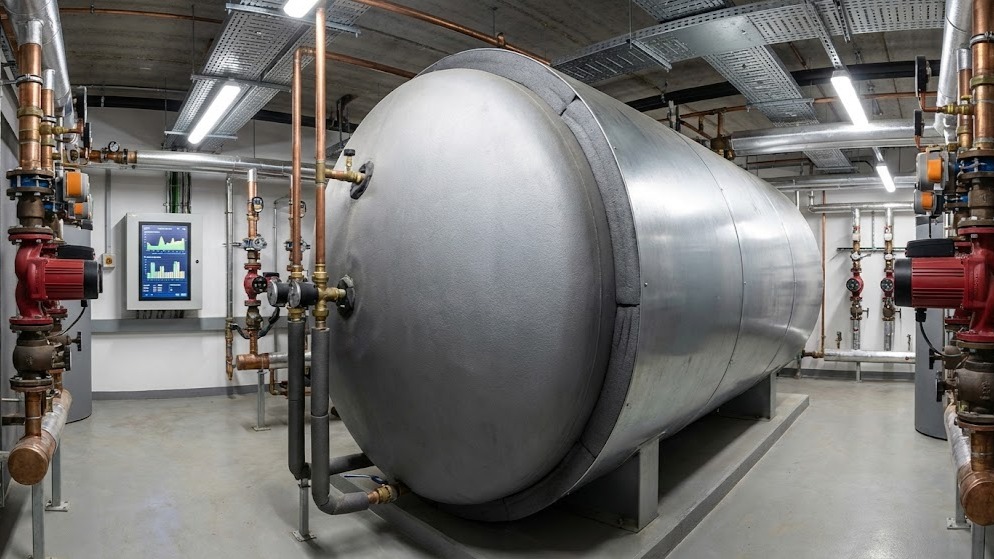
Commercial buildings face increasing pressure to manage energy costs and reduce environmental impact. Peak electricity demand creates particular challenges because tariff structures impose significant charges for maximum consumption regardless of average usage levels. Thermal storage provides an effective strategy for addressing thermal storage peak demand by shifting energy-intensive heating and hot water processes away from expensive peak periods.
Understanding how thermal storage reduces peak demand helps building owners and facilities managers evaluate investment opportunities. The financial benefits often prove substantial, with demand charge reductions and time-of-use savings delivering returns that justify storage system investment within reasonable payback periods.
Understanding Peak Energy Demand
Peak demand refers to the maximum rate of electricity consumption a building draws from the grid at any moment. This instantaneous maximum matters because electricity infrastructure must accommodate the highest demand any connected consumer might require, even if that demand occurs only briefly.
The principle of thermal storage peak demand reduction involves using stored heat to meet building requirements during periods when electricity costs are highest. Rather than running electric boilers, heat pumps, or other heating equipment during expensive peak hours, systems draw on heat accumulated during cheaper off-peak periods.
Load shifting heat storage strategies time energy consumption to minimise costs whilst maintaining building comfort and services. Heat stored in buffer tanks, hot water cylinders, or other thermal mass during overnight or midday low-tariff periods provides the energy needed during morning and evening peaks.
The effectiveness of demand reduction depends on storage capacity relative to peak period requirements. Systems must store sufficient heat to meet demand throughout peak tariff periods without requiring additional generation. Adequate sizing ensures that load shifting heat storage delivers its full potential benefit.
How Peak Demand Affects Energy Costs
Understanding the cost mechanisms that thermal storage addresses helps quantify potential savings and justify investment.
Demand Charges and Tariff Structures
Commercial electricity tariffs typically include demand charges based on maximum consumption during billing periods. These charges may represent thirty to fifty percent of total electricity costs, making demand management a significant savings opportunity.
Maximum demand measurement captures the highest average consumption during any half-hour or fifteen-minute period within the billing month. A single high-demand event can establish the charge level for the entire month, making peak management particularly important.
Time-of-use tariffs add temporal variation to energy costs. Consumption during designated peak periods costs significantly more than off-peak usage. The differential between peak and off-peak rates determines the potential value of load shifting heat storage implementation.
Buildings with electric heating face particularly high demand charges because heating loads often coincide with system-wide peaks during cold winter mornings. Managing these coincident peaks provides substantial cost reduction opportunities.
Grid Capacity and Infrastructure Costs
Peak demand affects not only ongoing tariff charges but also infrastructure capacity requirements. New connections and capacity increases involve costs that reflect the peak demand the supply must accommodate.
Connection charges for new commercial buildings often include capacity elements based on agreed maximum demand. Demonstrating demand management capability through thermal storage may enable reduced connection capacity and lower associated costs.
Future grid constraints make demand management increasingly valuable. As electrical systems accommodate growing loads from heat pumps and electric vehicles, peak management becomes essential for grid stability and cost control.
Quality heating equipment from National Pumps and Boilers integrates effectively with demand management strategies, enabling systems that deliver both efficiency and peak reduction benefits.
Thermal Storage as a Peak Demand Solution
Thermal storage provides practical mechanisms for shifting heating-related electricity consumption away from peak periods. Various storage approaches suit different applications and demand management objectives.
The Load Shifting Principle
Load shifting heat storage fundamentally involves consuming electricity when it costs least to accumulate heat for use when electricity costs most. The thermal mass within storage vessels retains heat for hours, bridging the gap between cheap generation periods and expensive consumption periods.
The timing of heat generation shifts from demand-driven to price-optimised scheduling. Rather than heating in response to immediate requirements, systems accumulate heat during designated charging periods and draw from storage during discharge periods.
Storage capacity determines how much demand can be shifted. Larger capacity enables longer discharge periods or higher demand rates during discharge. The relationship between capacity and shifting potential guides sizing decisions for demand management applications.
Thermal storage peak demand benefits compound with heating system efficiency improvements. Heat pumps operating during mild daytime temperatures achieve better coefficients of performance than during cold morning peaks. Storage enables exploitation of these efficiency variations.
Types of Thermal Storage for Demand Management
Buffer tanks provide immediate demand management capability within heating systems. Heat accumulated in buffer vessels during off-peak periods supplements or replaces real-time generation during peak hours.
Hot water storage cylinders similarly enable demand shifting for domestic hot water loads. Calorifiers charged overnight provide hot water throughout the day without requiring peak-period heating.
Ice storage and phase change materials provide enhanced storage density for applications requiring substantial capacity within limited space. These technologies suit large commercial and industrial applications with demanding peak reduction requirements.
System selection considers storage density, discharge characteristics, and integration requirements. Buffer tanks suit heating applications whilst ice storage may better address cooling-dominated demand profiles.
Benefits of Peak Demand Reduction
Thermal storage delivers multiple benefit categories that combine to justify investment.
Direct Cost Savings
Demand charge reductions provide the most immediately quantifiable benefit of thermal storage peak demand management. Eliminating heating-related peaks during high-tariff periods can reduce monthly demand charges by twenty to forty percent in buildings with significant electric heating loads.
Time-of-use arbitrage captures the differential between off-peak charging costs and avoided peak-period consumption. Where tariff differentials exceed standing loss costs, every kilowatt-hour shifted delivers net savings.
Avoided infrastructure costs may provide substantial one-time benefits. Connection capacity reductions enabled by demonstrated demand management reduce initial project costs and ongoing availability charges.
Payback calculations typically show thermal storage investment recovering within three to seven years through combined demand and energy savings. Buildings with particularly unfavourable tariff structures or high electric heating loads achieve faster returns.
Operational Benefits
Equipment efficiency improves when generators operate steadily during optimal conditions rather than cycling in response to variable demands. Heat pumps achieve better seasonal performance when able to run during favourable ambient conditions.
Maintenance requirements reduce when equipment operates more steadily. The cycling that causes ignition system wear, thermal stress, and control component fatigue diminishes with thermal storage integration.
The relationship between load shifting heat storage and equipment life extends to all system components. Pumps, valves, and controls all benefit from the more stable operating conditions that storage enables.
Control simplification through storage integration reduces the complexity of demand management. Rather than sophisticated real-time demand limiting, systems can follow simple schedules that charge storage during designated periods.
Circulation equipment from Grundfos and Wilo provides reliable operation across the charging and discharging cycles that demand management requires.
Environmental Benefits
Carbon reduction from efficient operation compounds the financial benefits of demand management. Equipment operating at optimal efficiency generates less carbon per unit of useful heat delivered.
Grid support benefits during peak periods contribute to system-wide carbon reduction. Reducing demand during peaks decreases reliance on peaking generation plants that typically have higher carbon intensities than baseload generation.
Renewable energy integration improves when thermal storage enables consumption timing flexibility. Systems can preferentially consume during high-renewable periods and avoid consumption when fossil generation predominates.
Sustainability reporting increasingly values demonstrable demand management as evidence of responsible energy consumption. Thermal storage provides measurable, verifiable demand reduction supporting corporate sustainability claims.
Implementation Strategies
Effective demand management through thermal storage requires careful attention to system design and control integration.
Sizing for Demand Management
Storage capacity requirements for demand management derive from peak period duration and heat demand during those periods. Systems must store sufficient heat to meet requirements throughout the peak tariff window without supplementary generation.
The relationship between shift duration and volume follows directly from heat demand rates. Four-hour morning peaks require twice the storage of two-hour peaks at equivalent demand rates. Sizing calculations multiply demand rate by duration to establish minimum useful capacity.
Multiple storage elements may combine to address different demand management objectives. Buffer tanks for space heating and separate cylinders for domestic hot water enable independent optimisation of each service.
Systems incorporating expansion vessels must accommodate the additional volume that demand management storage introduces. Expansion provision requires reassessment when significant storage capacity is added.
Control System Requirements
Intelligent controls maximise demand management benefit by optimising charging timing and managing discharge to maintain building comfort whilst avoiding peak-period generation.
Predictive algorithms anticipate heating requirements based on weather forecasts, occupancy schedules, and historical demand patterns. Accurate prediction ensures adequate heat accumulation without wasteful over-provision.
Building management system integration enables coordination between thermal storage and other demand management strategies. Lighting, ventilation, and other loads may all contribute to peak demand management programmes.
Monitoring and verification confirm that demand management performs as intended. Submetering heating circuits and tracking demand profiles enables ongoing optimisation and benefits verification.
Conclusion
Thermal storage provides effective mechanisms for addressing thermal storage peak demand challenges that increase commercial building energy costs. The financial benefits from demand charge reduction and time-of-use optimisation often justify storage investment within reasonable payback periods.
Load shifting heat storage strategies require appropriate sizing, effective controls, and integration with building energy management systems. Professional design ensures that storage capacity and control sophistication match demand management objectives.
Building owners and facilities managers facing significant demand charges should evaluate thermal storage as a demand management option. The combination of direct cost savings, operational benefits, and environmental advantages makes storage increasingly attractive as electricity costs rise and grid constraints tighten.
For guidance on thermal storage for demand management and quality heating equipment, contact the National Pumps and Boilers team for expert technical support.