

The Impact of Fluid Viscosity on Pump Performance (When Water Properties Matter)
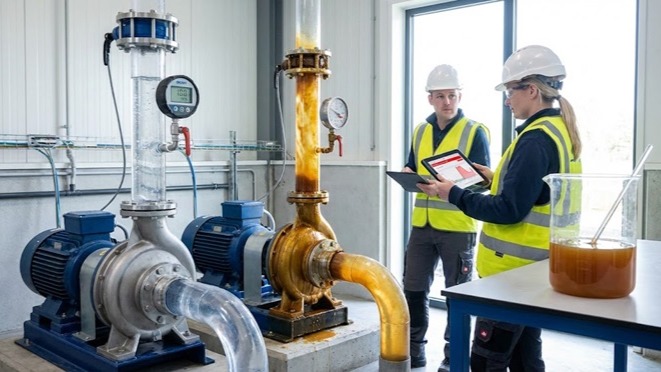
Heating engineers rarely consider water viscosity when specifying circulator pumps - until a system fails to perform as expected. A pump rated for 6 metres head and 2,500 litres per hour should deliver those figures, yet systems with glycol antifreeze or elevated temperatures often fall short. The difference lies in fluid properties that manufacturers' standard curves don't account for.
National Pumps and Boilers handles enquiries weekly from contractors puzzled by underperforming systems. The root cause frequently traces back to fluid viscosity pump performance variations that alter pump hydraulics in ways standard selection charts ignore. Understanding when water properties matter - and when they don't - separates competent system design from costly remedial work.
What Fluid Viscosity Actually Means for Pump Operation
Viscosity measures a fluid's resistance to flow. Water at 20°C has a dynamic viscosity of approximately 1.0 centipoise (cP). This baseline assumption underpins every manufacturer's pump curve. Heating engineers work with this figure daily without realising it - every flow rate, head pressure, and power consumption chart assumes water at standard conditions.
The challenge emerges when real-world systems deviate from this baseline. Glycol antifreeze solutions, commonly specified for systems exposed to freezing conditions, can double or triple fluid viscosity. A 50% propylene glycol mixture exhibits viscosity around 3.5 cP at 20°C - a 250% increase that fundamentally alters how fluid moves through pump impellers and system pipework.
Temperature compounds these effects. Water viscosity drops as temperature rises: from 1.0 cP at 20°C to approximately 0.3 cP at 80°C. This sevenfold reduction changes pump performance characteristics across the operating range. A central heating pump selected for cold-fill conditions will behave differently once the system reaches working temperature.
How Viscosity Changes Pump Performance Characteristics
Increased fluid viscosity affects three critical pump parameters: flow rate, head pressure, and power consumption. These changes don't occur uniformly - the impact varies with pump speed, impeller design, and operating point on the pump curve.
Flow Rate Reduction
Higher viscosity fluids require more energy to move through pump passages and impeller channels. The same rotational speed that moves 2,500 L/h of water might only achieve 2,200 L/h with a 40% glycol solution. This 12% flow reduction can leave radiators undersized and heat output insufficient, particularly in systems designed with minimal safety margins.
The effect intensifies at higher flow rates. Pumps operating near their maximum capacity experience proportionally greater flow reduction than those running at mid-curve. A Grundfos pump specified at 80% of maximum flow might see 15% reduction with glycol, whilst one running at 50% capacity experiences only 8% reduction.
Head Pressure Changes
Viscosity impacts head pressure in counterintuitive ways. At low flow rates, viscous fluids can actually increase head slightly due to improved impeller sealing. At higher flows, however, head drops significantly as friction losses within the pump overwhelm any sealing benefits.
This creates a flattened pump curve - reduced maximum flow and diminished shut-off head. The practical consequence: systems with high static head (tall buildings, complex pipework configurations) may struggle to overcome resistance, particularly during commissioning when fluid temperatures remain low and viscosity peaks.
Power Consumption Increases
Viscous fluids demand more shaft power to achieve equivalent hydraulic work. A pump drawing 85 watts with water might require 110 watts with glycol - a 29% increase that affects motor selection, electrical loading, and running costs. Undersized motors can overheat or trip on thermal overload, whilst correctly specified motors face higher energy consumption throughout system life.
Wilo pumps with electronically commutated motors (ECMs) handle viscosity variations better than fixed-speed alternatives, adjusting power input to maintain target differential pressure. Even these adaptive systems, however, consume additional energy when fluid viscosity pump performance deviates from design conditions.
Glycol Concentration and System Protection
Antifreeze protection drives most viscosity-related pump challenges in UK heating systems. Glycol solutions prevent freeze damage in exposed pipework, buffer vessels, and ground-source heat pump ground loops. The protection comes at a hydraulic cost that system designers must account for.
Propylene vs Ethylene Glycol
Propylene glycol, preferred for potable water applications and systems where toxicity matters, exhibits higher viscosity than ethylene glycol at equivalent concentrations. A 40% propylene glycol solution has roughly 20% higher viscosity than 40% ethylene glycol. This difference becomes significant in systems with marginal pump capacity or complex pipework arrangements.
Ethylene glycol, whilst more hydraulically efficient, poses toxicity risks that limit its application in domestic heating and DHW pumps systems. Building Regulations and water supply regulations restrict its use near potable water, making propylene glycol the default choice despite its viscosity penalty.
Concentration Selection
Many installers default to 50% glycol concentration, providing freeze protection to approximately -35°C. This exceeds requirements for most UK applications, where protection to -15°C (achievable with 30-35% concentration) suffices. The additional 15-20% glycol increases viscosity by roughly 40% whilst providing unnecessary protection.
Optimising glycol concentration balances freeze protection against hydraulic performance. A system in southern England rarely needs protection below -10°C, allowing 25-30% concentration that minimises viscosity impact whilst maintaining adequate safety margin. Systems in Scottish Highlands or exposed locations justify higher concentrations despite the performance penalty.
Temperature Effects on Fluid Viscosity Pump Performance
System operating temperature creates dynamic viscosity changes that affect pump behaviour throughout the heating cycle. Understanding these variations helps explain performance differences between cold commissioning and steady-state operation.
Cold Start Conditions
Initial system fill occurs at ambient temperature, often 10-15°C in UK winter conditions. Water viscosity at 10°C reaches approximately 1.3 cP - 30% higher than the 20°C baseline. Glycol systems face compounded effects: 40% propylene glycol at 10°C exhibits viscosity around 6.5 cP, six times higher than warm water.
This creates commissioning challenges. Pumps struggle to overcome system resistance, flow rates fall below design values, and balancing becomes difficult. Contractors unfamiliar with viscosity effects may oversize pumps or increase speed settings, creating noise and efficiency problems once the system reaches working temperature.
Operating Temperature Range
Central heating systems typically operate between 60-80°C flow temperature, where water viscosity drops to 0.4-0.3 cP. This 70% viscosity reduction compared to cold conditions dramatically improves pump performance. The same pump that struggled to achieve 2,000 L/h during cold commissioning might deliver 2,400 L/h at operating temperature.
Glycol systems show similar patterns but retain higher absolute viscosity. 40% propylene glycol at 70°C has viscosity around 1.2 cP - still 20% higher than cold water, but 80% lower than the same solution at 10°C. This temperature sensitivity explains why glycol systems often perform acceptably once warmed up despite poor cold-start behaviour.
Viscosity Pump Selection Corrections for Viscous Fluids
Manufacturers provide correction factors that adjust standard pump curves for viscous fluids. These corrections account for flow reduction, head loss, and power increase, allowing accurate viscosity pump selection when fluid properties deviate from water baseline.
Hydraulic Institute Standards
The Hydraulic Institute publishes viscosity correction charts applicable to centrifugal pumps across industries. These charts plot correction factors (Cq for flow, Ch for head, Cη for efficiency) against fluid viscosity and pump capacity. Lowara pumps documentation references these standards, as do most commercial pump manufacturers.
Applying corrections involves three steps: determine fluid viscosity at operating temperature, identify pump operating point on manufacturer's curve, and apply correction factors to adjust performance. A pump rated for 3,000 L/h at 8m head with water might correct to 2,700 L/h at 7.2m head with 40% glycol - requiring the next larger pump size to achieve design flow.
Practical Application Limits
Correction factors work reliably for viscosities up to approximately 20 cP - covering most heating applications. Beyond 20 cP, corrections become less accurate and manufacturers recommend direct testing or specialist pump designs. Heating systems rarely exceed this threshold unless using heavy oils or unconventional heat transfer fluids.
Small circulators (under 100 watts) show greater performance sensitivity than larger pumps. The tight clearances and compact impellers that enable efficient operation with water become liabilities with viscous fluids. Expansion vessels and system components also experience higher pressure drops, compounding the viscosity pump selection challenge.
System Design Considerations Beyond Pump Selection
Addressing fluid viscosity pump performance requires system-level thinking beyond pump specification. Pipe sizing, valve selection, and control strategies all interact with fluid properties to determine overall system behaviour.
Pipe Sizing and Pressure Drop
Viscous fluids increase pipe friction losses proportionally to viscosity increase. A system designed for 1.5 m/s water velocity with 40 kPa pressure drop might experience 55 kPa drop with 40% glycol - a 38% increase. This additional resistance loads the pump, reducing available head for overcoming height differences and component pressure drops.
Increasing pipe diameter one size reduces velocity and friction loss, partially offsetting viscosity effects. A system with 28mm pipework designed for water might benefit from 35mm pipe when using glycol, maintaining similar pressure drop characteristics. The additional pipe cost often proves less expensive than oversized pumps and increased energy consumption.
Control Valve Authority
Viscous fluids affect control valve performance through two mechanisms: increased pressure drop across the valve at a given flow, and altered flow characteristics that affect control stability. A pump valve with 0.5 authority (valve pressure drop equals 50% of system pressure drop) in a water system might see authority drop to 0.35 with glycol as system pressure drop increases disproportionately.
Maintaining adequate valve authority with viscous fluids requires either larger valve sizes (reducing valve pressure drop) or higher differential pressure (increasing valve pressure drop relative to system). The latter approach increases pump power consumption and system noise, making valve upsizing the preferred solution where practical.
Variable Speed Control
Constant pressure differential control, common in modern heating systems, adapts naturally to viscosity variations. The pump adjusts speed to maintain setpoint pressure regardless of fluid properties. This automatic compensation makes variable speed pumps more forgiving of glycol addition or temperature changes than fixed-speed alternatives.
Energy consumption still increases with viscosity - the pump runs faster to overcome additional resistance - but system performance remains stable. DAB pumps with pressure differential sensors provide this adaptive behaviour across their product range, from small domestic circulators to commercial booster sets.
When Water Properties Don't Matter
Many heating applications operate sufficiently close to standard water conditions that viscosity corrections prove unnecessary. Recognising these situations prevents over-engineering whilst maintaining reliable performance.
Pure Water Systems
Sealed heating systems in frost-protected buildings require no antifreeze. Water viscosity variations with temperature remain modest - the 70% change between 10°C and 80°C affects pump performance less than 10% across the operating range. Standard pump selection using manufacturer curves provides adequate accuracy.
Low Glycol Concentrations
Systems requiring only -5°C protection (achievable with 15-20% glycol) experience minimal viscosity impact. The 30-40% viscosity increase compared to pure water falls within typical pump performance tolerances and safety factors. Applying correction factors provides marginal benefit that doesn't justify the additional calculation effort.
Oversized Pumps
Systems with substantial safety margins - pumps operating at 40-50% of maximum capacity - tolerate viscosity increases without performance degradation. The available head and flow capacity exceeds system requirements by enough margin to absorb glycol-related losses. This accidental over-specification, whilst inefficient from an energy perspective, provides immunity to fluid property variations.
Practical Troubleshooting for Viscosity-Related Problems
Existing systems exhibiting poor performance may suffer from unrecognised viscosity effects. Systematic diagnosis identifies whether fluid properties contribute to operational issues.
Symptom Recognition
Systems with viscosity problems typically show: inadequate flow to remote radiators or zones, pump running at maximum speed continuously, higher-than-expected electricity consumption, and poor performance during cold weather that improves as temperature rises. These symptoms overlap with other common issues (air locks, incorrect balancing, undersized pumps), requiring methodical investigation.
Testing fluid temperature at the pump inlet during operation provides immediate insight. If the system operates below 40°C when the design temperature exceeds 60°C, viscosity remains elevated and pump performance suffers. Confirming glycol concentration through refractometer testing or specific gravity measurement identifies whether antifreeze exceeds requirements.
Remedial Options
Reducing glycol concentration to the minimum required levels often restores adequate performance. Draining 20-30% of system volume and refilling with water can reduce 50% glycol to 35-40%, cutting viscosity by 40% whilst maintaining sufficient freeze protection. This simple intervention costs less than pump replacement and improves energy efficiency.
Increasing pump speed or installing a higher-capacity model addresses severe viscosity impacts that concentration reduction can't resolve. Modern variable speed pumps with oversized motors provide an adjustment range that accommodates viscous fluids without hardware changes. Where existing pumps lack capacity, specifying the next size up with appropriate correction factors ensures reliable operation.
Making Informed Viscosity Pump Selection Decisions
Fluid viscosity pump performance matters most when glycol antifreeze concentrations exceed 30%, operating temperatures remain below 40°C, or systems operate near maximum pump capacity. These conditions combine in ground-source heat pump installations, exposed pipework systems, and applications requiring low-temperature operation - precisely where performance margins matter most.
Heating engineers who understand viscosity effects avoid undersized pumps, excessive energy consumption, and customer complaints about inadequate heat output. The solution isn't complex: apply manufacturer correction factors for glycol systems, optimise antifreeze concentration to actual protection requirements, and select pumps with adequate capacity margin to accommodate fluid property variations.
Standard water-based systems in frost-protected buildings need no special consideration. Systems with modest glycol concentrations (under 25%) or substantial capacity margins tolerate viscosity increases without correction. Between these extremes lies a grey area where engineering judgement determines whether detailed viscosity analysis justifies the effort.
For technical guidance on viscosity pump selection for glycol systems or assistance specifying equipment for challenging applications, contact us at National Pumps and Boilers. Accurate pump specification prevents costly remedial work and ensures systems deliver design performance across all operating conditions.