

The Role of Flexible Connectors in Reducing Pump Vibration and Noise
Pump vibration transfers through rigid pipework at amplitudes that can damage equipment, fracture connections, and generate noise levels exceeding 85dB - enough to breach workplace regulations and compromise system longevity. In commercial HVAC installations, mechanical services engineers face a predictable problem: circulation pumps operating at 2,850 RPM create vibration frequencies that resonate through steel pipework, radiating noise through building structures, and accelerating wear on bearings, seals, and mechanical components.
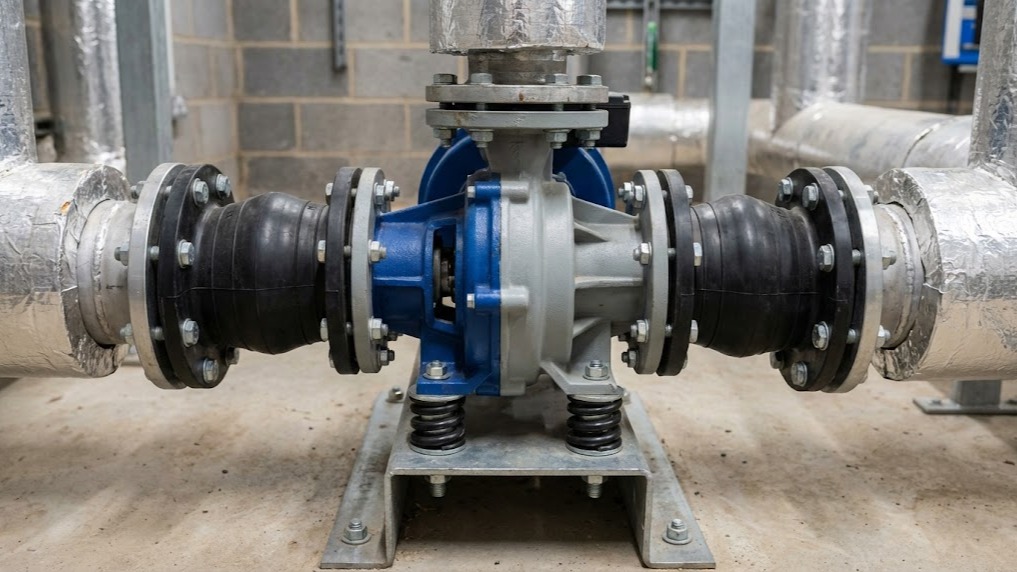
Flexible pump connectors interrupt this vibration transmission path. When installed correctly between pump flanges and system pipework, these engineered components absorb mechanical oscillations before they propagate through the installation. The result: measurable reductions in both structure-borne vibration (typically 15-30dB attenuation) and airborne noise (10-20dB reduction), alongside extended service intervals and reduced maintenance costs.
National Pumps and Boilers supplies flexible connector solutions across commercial heating, DHW circulation, and pressurisation systems where vibration control determines system performance and compliance with Building Regulations Approved Document E (acoustic performance). This technical analysis examines how flexible pump connectors function, where they deliver measurable benefits, and how to specify them correctly for different pump applications.
Understanding Pump Vibration: Sources and Transmission Paths
Centrifugal pumps generate vibration through three primary mechanisms. Hydraulic imbalance occurs when impeller vanes pass the volute cutwater, creating pressure pulsations at blade-pass frequency - for a six-vane impeller at 2,850 RPM, this produces a dominant vibration frequency of 285Hz. Mechanical imbalance results from rotor mass distribution irregularities, generating vibration at shaft rotational frequency (47.5Hz at 2,850 RPM). Bearing wear introduces additional high-frequency components as rolling elements pass over race defects.
Vibration Transmission Through Pipework
These vibrations transfer through pump casings into pipework via rigid flange connections. Steel pipework acts as an efficient vibration conductor - a 100mm steel pipe can transmit vibration with less than 3dB attenuation per metre. Once vibration enters the pipework, it radiates as airborne noise and excites building structures through pipe supports, wall penetrations, and equipment mountings.
The consequences extend beyond nuisance noise. Sustained vibration accelerates fatigue in threaded connections, causes fretting corrosion at flange faces, and reduces seal life by 40-60% compared to properly isolated installations. In variable-speed pump systems, vibration characteristics change across the operating envelope - a pump running smoothly at 50% speed may generate excessive vibration at 85% due to resonance with system natural frequencies.
How Flexible Connectors Interrupt Vibration Transmission
Flexible pump connectors function as mechanical filters, introducing compliance between rigid components. The basic construction comprises a flexible element (typically EPDM or NBR rubber) reinforced with textile or wire braiding, terminated with metal flanges or threaded ends. This assembly provides two critical properties: axial flexibility (allowing compression and extension along the pipe axis) and angular deflection (accommodating misalignment between pump and pipework).
The Vibration Isolation Mechanism
The pump vibration isolation mechanism relies on impedance mismatch. Vibration energy travelling through steel pipework encounters the flexible element's dramatically different mechanical properties, where steel has a Young's modulus of 200 GPa, EPDM rubber measures approximately 0.01 GPa. This 20,000:1 stiffness ratio causes vibration energy to reflect back toward the source rather than transmit through the connector.
Effective isolation requires matching connector stiffness to system characteristics. Isolation efficiency increases as the ratio between system operating frequency and connector natural frequency rises - optimal performance occurs when operating frequency exceeds connector natural frequency by a factor of 3 or greater. For a pump operating at 2,850 RPM (47.5Hz fundamental frequency), the connector natural frequency should remain below 15Hz.
Material Selection for Different Applications
Material selection determines performance across different applications. EPDM compounds handle temperatures to 110°C and resist ozone degradation, making them suitable for standard heating circuits. NBR variants offer superior oil resistance for lubricated pump applications. PTFE-lined flexible connectors accommodate aggressive fluids in chemical dosing or water treatment systems. The reinforcement architecture - typically polyester fabric or stainless steel wire - determines pressure rating and fatigue life.
Installation Positions and Configuration Requirements
Connector placement relative to the pump determines isolation effectiveness. The standard configuration positions one flexible connector on each pump flange - suction and discharge - with the connectors oriented to absorb vibration before it enters the distribution system. This arrangement also accommodates thermal expansion, installation misalignment, and maintenance access requirements.
Distance and Orientation Considerations
The distance between the pump flange and first rigid support affects pump vibration isolation performance. Minimum separation should equal 5 pipe diameters - for a 100mm connection, position the first rigid pipe clip at least 500mm from the pump flange. This prevents short-circuiting the vibration isolation path through rigid supports positioned too close to the flexible element.
Orientation matters for systems with significant static pressure or thermal movement. In vertical pump installations, flexible connectors must support fluid weight without excessive compression - specify connectors rated for the combined static and dynamic loads. For systems operating above 80°C, allow for thermal expansion by positioning connectors to accommodate axial growth - typically 1-2mm per metre of pipework per 10°C temperature rise.
Common Installation Errors
Common installation errors compromise performance. Over-compression during installation pre-loads the flexible element, reducing available travel and increasing effective stiffness. The correct approach: bring flanges to light contact, then tighten bolts progressively in a star pattern to compress the flexible element by 5-10mm. Misalignment exceeding manufacturer specifications (typically 15° angular, 10mm lateral) induces stress concentrations that accelerate fatigue. Always align pipework before installing flexible pump connectors - never use connectors to force misaligned components into position.
Noise Reduction Performance Across Different Pump Types
Circulator Pumps in Heating Systems
Circulator pumps in domestic and light commercial heating systems generate noise primarily through motor operation and hydraulic flow. Installing Grundfos pumps with flexible connectors typically achieves 12-18dB noise reduction compared to rigid installations - enough to reduce a 65dB pump installation to 47-53dB, well below the 40dB threshold for noise-sensitive spaces. The benefit increases in properties with lightweight construction where structure-borne sound transmission dominates.
Commercial circulators in plantrooms require different consideration. A Wilo pump rated at 7.5kW generates vibration amplitudes that can exceed 5mm/s at the pump feet - sufficient to cause perceptible floor vibration in upper storeys. Flexible connectors combined with inertia bases reduce transmitted vibration by 25-30dB, preventing structure-borne noise transmission through building frames.
DHW and Pressurisation Systems
DHW circulation systems present specific challenges. Pumps handling water at 60-65°C experience thermal cycling that affects flexible connector performance. The solution: specify EPDM connectors rated to 110°C with reinforcement designed for cyclic loading. Testing shows properly specified DHW pumps with flexible connectors maintain isolation performance through 100,000+ thermal cycles - equivalent to 15+ years of typical operation.
Booster sets and pressurisation systems generate higher vibration amplitudes due to increased power ratings and variable-speed operation. Multi-pump installations require individual flexible connectors on each pump - shared manifolds without isolation allow vibration cross-talk between pumps. In these applications, combining flexible connectors with anti-vibration mountings provides optimal results: connectors address fluid-borne vibration while mountings isolate structure-borne transmission through pump feet.
Specification Criteria for Different System Types
Pressure and Temperature Ratings
Pressure rating must exceed maximum system pressure, including transient conditions. For sealed heating systems operating at 3 bar with an expansion vessel pre-charge, specify connectors rated to 10 bar minimum - this provides an adequate safety margin for pressure surges during pump start-up or valve closure. Undersized connectors risk rupture; oversized units incorporate thicker reinforcement that reduces flexibility and compromises isolation.
The temperature rating should exceed normal operating temperature by 20°C. A heating system designed for 80°C flow temperature requires connectors rated to 100°C+. This margin accommodates fault conditions (failed thermostats, circulation pump failure) without connector degradation. EPDM compounds maintain properties to 110°C; higher temperatures require PTFE-lined or metal bellows designs.
Dimensional Compatibility and Movement Capacity
Dimensional compatibility extends beyond nominal bore. Flange drilling must match system pipework - PN10, PN16, or PN25 patterns according to system pressure. Threaded connectors require verification of thread type (BSP parallel vs tapered) and orientation (male/female) to match existing connections. Face-to-face dimension determines required pipework modification - standard lengths range from 150mm to 300mm, depending on bore size.
Movement capability must accommodate installation tolerances and operational displacement. Specify axial compression/extension capacity (typically ±10mm for DN50-DN100 sizes), angular deflection (15° standard, 30° for special designs), and lateral offset (5-10mm). Systems with significant thermal expansion or seismic requirements need enhanced movement capacity.
Integration With System Components and Controls
Flexible connectors interact with other system components in ways that affect performance. Check valves positioned immediately adjacent to flexible connectors can generate water hammer - the rapid closure creates pressure spikes that stress the flexible element. Best practice: position check valves at least 1 metre downstream from flexible connectors, with adequate straight pipe to dissipate turbulence.
Valve and Sensor Positioning
Isolation valves allow pump removal without system drainage, but valve weight must not load the flexible connector. Support valves independently using pipe clamps or brackets - never allow valve weight to compress or extend the flexible element beyond specified limits. For large bore installations (DN100+), this typically requires a dedicated support bracket within 300mm of the valve.
Variable-speed drives alter pump vibration characteristics across the operating range. A pump running at 30Hz (1,800 RPM) generates different vibration frequencies than the same unit at 50Hz (3,000 RPM). Specify flexible connectors with broadband isolation characteristics - effective across the full speed range rather than optimised for a single frequency. This prevents resonance conditions where the connector's natural frequency coincides with the pump's operating frequency.
Pressure sensors and temperature probes require careful positioning. Mounting sensors directly on flexible connectors introduces measurement errors as the flexible element deflects under pressure variations. Position sensors on rigid pipework at least 500mm from flexible connectors to ensure stable readings. For systems requiring pressure measurement near the pump, install sensor bosses on the rigid pipe section between the flexible connector and first support.
Maintenance Requirements and Service Life Expectations
Properly specified flexible connectors in heating and DHW systems typically achieve 10-15 year service life before requiring replacement. Degradation mechanisms include ozone attack on rubber compounds, fatigue from cyclic loading, and chemical degradation from system water chemistry. Visual inspection during annual boiler service identifies developing problems: surface cracking, bulging, or weeping from the flexible element indicates approaching end-of-life.
Inspection Protocol and Replacement Intervals
Inspection protocol should verify: no visible cracks or cuts in the flexible element, no fluid seepage at flange interfaces, no excessive compression or extension from the original installation position, and no corrosion on metal flanges or reinforcement. Document flexible connector condition annually - progressive deterioration indicates accelerated replacement requirements.
Replacement intervals depend on operating conditions. Systems running continuously at elevated temperatures (DHW circulation at 60°C+) experience accelerated ageing - expect 8-10 year life rather than 15 years. Installations with poor water quality (high chloride, low pH) attack rubber compounds and metal components, reducing service life by 30-40%. Conversely, sealed systems with inhibited water and moderate operating temperatures can exceed 15 years before replacement becomes necessary.
When replacing flexible connectors, verify system alignment before installation. Misalignment that developed during the original service life will stress new connectors and reduce their service life. Check pipe support positions - supports that have settled or loosened allow excessive movement that loads flexible connectors beyond design limits. Address these issues during replacement to achieve full service life from new components.
Compliance With Building Regulations and British Standards
Building Regulations Approved Document E sets maximum noise levels for building services equipment. For residential properties, continuous noise from heating systems must not exceed 30dB LAeq,30min in bedrooms during night hours. Achieving this target in properties with circulation pumps often requires flexible connectors combined with acoustic enclosures or remote pump locations.
Standards and Regulatory Requirements
BS 6540 provides guidance for sound insulation in buildings, including recommendations for pump vibration isolation of mechanical services equipment. The standard specifies minimum separation distances between pumps and noise-sensitive spaces, and recommends flexible connections for all pumps exceeding 0.75kW motor rating. Compliance requires both flexible connectors and proper pipe support design to prevent vibration transmission through the building structure.
For commercial installations, the Noise at Work Regulations limit employee exposure to 85dB over 8 hours. Plantrooms with multiple pumps can exceed this threshold when pumps are rigidly connected to pipework. Installing flexible connectors on central heating equipment typically reduces plantroom noise by 8-12dB - often sufficient to achieve compliance without additional acoustic treatment.
Water Supply (Water Fittings) Regulations require that system components must not cause contamination or waste. Flexible connectors must carry appropriate approvals (WRAS, Kiwa) demonstrating material compatibility with potable water. For heating systems, this primarily affects DHW circuits and combination systems where heating components contact drinking water.
Strategic Considerations for Specification and Procurement
Cost-benefit analysis consistently favours flexible connector installation despite the additional component cost. A DN50 flexible connector adds £40-80 to installation cost but prevents noise complaints that can cost £500-2,000 to remediate after completion. The payback period for commercial installations is typically under 12 months when considering reduced maintenance costs and extended pump service life.
Procurement and Quality Considerations
Procurement timing affects project coordination. Flexible connectors should arrive with the pump equipment to verify dimensional compatibility before installation. Last-minute sourcing risks incorrect specification - particularly flange drilling patterns or thread types that don't match installed pipework. Include flexible connectors in initial equipment schedules rather than treating them as site-supplied accessories.
Quality variation between manufacturers affects long-term performance. Budget connectors using inferior rubber compounds or inadequate reinforcement may meet initial pressure tests but fail prematurely under cyclic loading. Specify products from established manufacturers with documented test data for fatigue life, pressure cycling, and temperature resistance. The incremental cost difference (typically 20-30%) provides substantial risk reduction.
For projects requiring multiple connectors, standardisation simplifies procurement and reduces inventory. Where possible, specify common sizes and ratings across the installation - this reduces the risk of incorrect installation and simplifies future maintenance when replacement components are required. The trade-off: slight over-specification on some connections versus operational simplicity and reduced error risk.
Conclusion
Flexible pump connectors deliver measurable vibration and noise reduction in commercial HVAC and building services installations. The engineering principle is straightforward: introducing compliance between pump flanges and rigid pipework interrupts vibration transmission paths before mechanical energy propagates through distribution systems. The practical benefit: 15-30dB vibration attenuation and 10-20dB noise reduction, alongside extended pump service life and reduced maintenance requirements.
Effective implementation requires matching connector specifications to system characteristics - pressure rating, temperature capability, movement capacity, and dimensional compatibility all affect performance and longevity. Installation quality determines whether theoretical isolation performance translates to real-world results: proper alignment, correct compression, and adequate separation from rigid supports are non-negotiable requirements.
For heating engineers and mechanical services contractors, flexible connectors represent a low-cost intervention with disproportionate benefits. The component cost - typically £40-150 per connector, depending on size - prevents noise complaints, reduces maintenance costs, and ensures compliance with Building Regulations acoustic performance requirements. In noise-sensitive installations (residential properties, hotels, healthcare facilities), flexible connectors often make the difference between compliant and non-compliant installations.
National Pumps and Boilers supplies flexible connectors compatible with major circulation pump brands across heating and DHW applications. Technical specifications, pressure ratings, and dimensional data support accurate specifications for new installations and retrofit applications. For guidance on flexible connector selection for specific pump models or system configurations, contact us for application-specific recommendations and availability.