

Understanding Cascade Control for Multi-Pump Commercial Systems
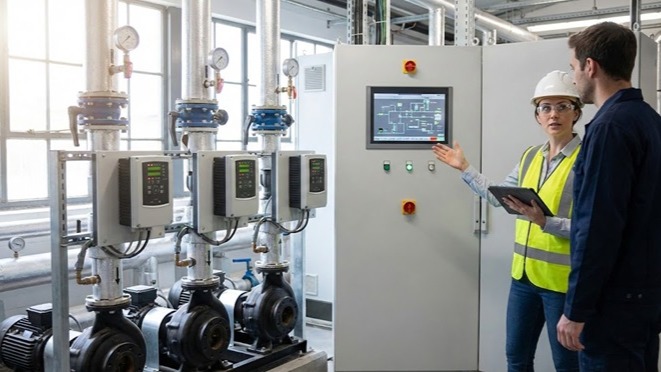
Large commercial buildings, industrial facilities, and district heating networks rarely rely on a single pump to move water through their systems. Instead, they deploy multiple pumps working in coordination - a configuration that demands intelligent control strategies to maintain efficiency, reliability, and cost-effectiveness. Pump cascade control represents the technical solution that determines when each pump operates, how they share the workload, and when to bring additional capacity online or offline.
For mechanical services contractors and facilities managers overseeing multi-pump installations, understanding pump cascade control isn't merely an academic exercise. Poor cascade configuration wastes energy, accelerates wear on equipment, and creates pressure instability that affects system performance. Properly implemented cascade control, by contrast, can reduce energy consumption by 30-40% whilst extending pump service life and maintaining consistent system pressure across varying demand conditions.
What Pump Cascade Control Actually Does
Pump cascade control manages multiple pumps serving a common system by coordinating their operation based on real-time demand. Rather than running all pumps continuously or cycling them randomly, cascade systems use feedback from pressure sensors, flow metres, or temperature measurements to determine optimal pump staging.
The fundamental principle involves matching pump output to system demand with minimal energy waste. When demand increases beyond a single pump's efficient operating range, the cascade controller brings a second pump online. As demand falls, it stages pumps off in sequence. This dynamic adjustment maintains system pressure within target parameters whilst keeping individual pumps operating near their best efficiency point.
Commercial Applications
Commercial applications include:
- Chilled water systems serving multiple air handling units across office buildings
- Heating circulation in multi-zone commercial properties
- Pressure boosting for high-rise buildings with variable occupancy
- Process cooling in manufacturing facilities with fluctuating thermal loads
- District heating networks supplying multiple buildings with varying demand profiles
The control strategy differs fundamentally from simple lead lag pump systems. Basic lead lag pump systems alternate which pump runs first but don't optimise staging based on actual system conditions. Cascade control, particularly when integrated with variable speed drives, continuously adjusts pump speed and staging to match precise demand requirements.
Core Control Strategies for Multi-Pump Systems
Several cascade control approaches exist, each suited to different system requirements and equipment configurations. Understanding these strategies helps specify appropriate control systems during design and troubleshoot performance issues in existing installations.
Fixed Speed Sequencing
The simplest cascade approach uses fixed-speed pumps with staged operation. The controller monitors system pressure and brings additional pumps online when pressure drops below setpoint. This method works for systems where demand changes relatively slowly and energy optimisation isn't the primary concern.
Limitations include step changes in capacity that can cause pressure spikes, inability to fine-tune output between staging points, and reduced efficiency when running multiple pumps at partial system load. Fixed speed sequencing remains common in older installations and applications where initial cost outweighs operational efficiency.
Variable Speed Lead with Fixed Speed Lag
This hybrid approach uses a variable speed drive on the lead pump with fixed-speed lag pumps. The VSD-controlled pump modulates speed to maintain pressure across most operating conditions. When the lead pump reaches maximum speed and pressure still falls below setpoint, the controller stages a fixed-speed lag pump and reduces the lead pump speed proportionally.
This configuration offers better efficiency than fully fixed-speed systems whilst limiting VSD investment to a single pump. The strategy works particularly well when base load represents 40-60% of maximum capacity, allowing the variable speed pump to handle most normal variation whilst fixed-speed pumps provide peak capacity. This represents one of the most common lead lag pump systems configurations in commercial applications.
Full Variable Speed Cascade
Premium installations equip all pumps with variable speed drives, enabling precise capacity modulation across the entire operating range. The controller adjusts pump speeds continuously and stages additional pumps only when the operating pumps reach a predetermined speed threshold (typically 80-90% of maximum).
Energy savings prove most significant in this configuration. Systems with high load variability - such as those serving mixed-use buildings or facilities with distinct occupied/unoccupied periods - can see energy reductions exceeding 40% compared to fixed-speed arrangements. National Pumps and Boilers supplies complete Grundfos pumps and Wilo pumps with integrated cascade control capabilities for precisely these applications.
Alternating Duty Cycles
Regardless of speed control method, proper cascade systems incorporate duty alternation to equalise runtime across all pumps. The controller rotates which pump serves as lead, distributing wear evenly and preventing situations where one pump accumulates significantly more operating hours than others.
Alternation intervals vary based on application. Heating systems might alternate daily or weekly, whilst critical applications may alternate on each start cycle to ensure all pumps remain operationally ready.
Pressure Control and Sensor Placement
Cascade effectiveness depends critically on accurate pressure sensing and appropriate control algorithms. The location of pressure sensors and the control logic processing their signals determine whether the system maintains stable conditions or experiences hunting, pressure fluctuations, and efficiency losses.
Sensor Location Considerations
Pressure sensors should monitor the point representing system demand most accurately. For closed-loop heating or chilled water systems, this typically means the return line near the furthest or highest point. Measuring too close to the pumps provides misleading feedback that doesn't reflect actual system conditions.
Multiple sensor configurations offer advantages in complex systems. Averaging signals from sensors at different locations prevents control decisions based on localised anomalies. Differential pressure measurement across the system provides direct indication of flow resistance and demand changes.
Temperature sensors complement pressure measurements in heating and cooling applications. A system showing adequate pressure but insufficient temperature differential indicates flow rates exceeding thermal demand - a condition where reducing pump output improves efficiency without compromising performance.
Proportional-Integral-Derivative Control
Most cascade controllers employ PID algorithms to process sensor feedback and adjust pump operation. Proper PID tuning prevents the oscillating behaviour that occurs when controllers react too aggressively or the sluggish response resulting from overly conservative settings.
Proportional gain determines how aggressively the controller responds to pressure deviations from setpoint. Integral action eliminates steady-state offset by adjusting output based on cumulative error over time. Derivative response anticipates future error based on the rate of change, providing damping that prevents overshoot.
Tuning requirements differ between fixed and variable speed systems. VSD-controlled pumps respond more quickly to control signals, requiring different PID parameters than staged fixed-speed arrangements. Many modern controllers offer auto-tuning functions that optimise parameters based on observed system response.
Staging Logic and Transition Management
The points at which pump cascade control systems stage pumps on and off significantly impact efficiency and equipment longevity. Poorly configured staging creates frequent cycling, pressure spikes during transitions, and operation outside optimal efficiency ranges.
Staging Thresholds
Controllers typically stage additional pumps when the operating pump(s) reach 80-90% of maximum capacity. This threshold provides reserve capacity to prevent pressure droop during the transition period whilst avoiding operation at the extreme end of the pump curve where efficiency deteriorates.
De-staging thresholds incorporate hysteresis - the lag pump doesn't shut down immediately when capacity drops below the staging-on point. Instead, the controller waits until combined output falls to perhaps 60-70% of the lead pump's capacity alone. This dead band prevents rapid cycling when demand hovers near staging thresholds.
Time delays further stabilise staging decisions. Rather than reacting to momentary demand spikes, controllers typically require conditions to persist for 30-60 seconds before staging changes occur. This filtering prevents unnecessary transitions caused by transient events like valve repositioning or temporary load changes.
Soft Starting and Ramping
Variable speed drives enable soft starting that gradually accelerates newly staged pumps rather than bringing them instantly to full speed. This approach minimises pressure surges, reduces mechanical stress on pump components, and prevents water hammer in piping systems.
When staging a pump on, the controller typically starts it at minimum speed and ramps up over 10-30 seconds whilst simultaneously reducing the speed of already-operating pumps. The coordinated transition maintains relatively constant total output whilst distributing load across multiple pumps.
De-staging follows a similar pattern. The controller gradually reduces the speed of the pump being taken offline whilst increasing speeds of remaining pumps, ensuring smooth transitions without pressure fluctuations that occupants might notice as performance changes.
Energy Optimisation Through Cascade Control
The primary justification for sophisticated pump cascade control lies in energy savings. Pumping represents one of the largest electrical loads in commercial buildings - optimising pump operation directly reduces both energy costs and carbon emissions.
Affinity Laws and Part-Load Efficiency
Pump power consumption follows the cube of speed ratio. Reducing pump speed by 20% (to 80% of maximum) cuts power consumption to approximately 51% of full-speed power. This cubic relationship means even modest speed reductions yield substantial energy savings.
Single pumps operating at reduced speed prove more efficient than multiple pumps sharing the load at higher individual speeds. However, this principle has limits - pumps operating below approximately 40% of design speed often encounter efficiency penalties and control stability issues. Effective cascade control balances these factors, using speed reduction where beneficial and staging additional pumps when demand justifies it.
Minimum Speed Considerations
Most variable speed pump installations establish minimum speed limits around 30-40% of maximum. Below these speeds, several problems emerge:
- Reduced flow through the pump motor can cause overheating in water-cooled designs
- Bearing lubrication may become inadequate at very low speeds
- Control stability deteriorates as small speed changes produce large flow variations
- Pump efficiency typically drops significantly below the design operating range
Cascade systems should stage down to fewer pumps rather than operating multiple pumps at very low speeds. A single pump at 60% speed typically consumes less energy and provides better control stability than two pumps at 35% speed each.
System Design Considerations for Cascade Applications
Effective lead lag pump systems require appropriate system design from the outset. Retrofitting cascade control to poorly designed pump arrays rarely achieves optimal results - the physical system must support the control strategy.
Pump Sizing and Selection
Multi-pump systems perform best when individual pumps are sized for 50-60% of maximum system demand. This configuration allows single-pump operation during typical conditions whilst providing sufficient capacity when multiple pumps operate together.
Oversized pumps force the system to operate at low speeds or stage multiple pumps even at moderate demand, reducing efficiency. Undersized pumps run continuously at high speed, eliminating the control flexibility that enables energy optimisation.
Identical pumps simplify cascade control and maintenance. Using the same model throughout the array means all pumps share the same performance characteristics, simplifying control algorithms and parts inventory. Mixed pump installations require more sophisticated control logic to account for different capacities and efficiencies.
Lowara pumps offer robust options for commercial cascade applications, whilst DAB pumps provide cost-effective solutions for smaller multi-pump installations.
Piping Configuration
Proper piping arrangements prevent hydraulic interactions that interfere with cascade control. Each pump should have isolation valves and check valves preventing backflow when offline. Common headers must be sized to avoid excessive pressure drop that varies with the number of operating pumps.
Inadequate header sizing creates a situation where pressure at the common discharge point changes significantly depending on how many pumps operate. This variation confuses pressure-based control algorithms and can cause instability. Headers should maintain velocities below 2-3 m/s to minimise this effect.
Suction conditions matter equally. Pumps sharing a common suction header must have adequate net positive suction head available under all operating scenarios. Staging additional pumps shouldn't create suction pressure drops that risk cavitation in any pump.
Common Cascade Control Problems and Solutions
Even properly designed systems encounter cascade control issues. Recognising common problems enables faster diagnosis and resolution.
Hunting and Rapid Cycling
When pumps stage on and off repeatedly within short timeframes, the usual culprits include insufficient hysteresis between staging thresholds, inadequate time delays, or sensor placement providing misleading feedback. Increasing the dead band between staging-on and staging-off points typically resolves hunting behaviour.
PID tuning may also contribute. Overly aggressive proportional gain causes the controller to overreact to small pressure deviations, whilst insufficient integral action fails to eliminate steady-state offset that triggers unnecessary staging changes.
Unequal Runtime Distribution
If duty alternation fails to equalise runtime across pumps, the alternation logic may be configured incorrectly or runtime counters may have been reset unevenly. Most controllers track cumulative runtime for each pump and automatically select the pump with lowest accumulated hours as the next lead.
Mechanical issues can also prevent equal distribution. If one pump consistently shows lower runtime, it may have performance problems causing the cascade controller to favour other pumps. Comparing pump curves and checking for wear or damage helps identify such situations.
Pressure Instability
Fluctuating system pressure despite active cascade control often indicates sensor problems, inadequate system volume, or air in the piping. Pressure sensors should be verified for accuracy and proper location. Systems with insufficient water volume relative to pump capacity respond too quickly to flow changes, making stable control difficult.
Expansion vessels sized appropriately for the system volume help dampen pressure fluctuations and improve cascade control stability. Air elimination devices prevent air pockets that cause erratic pressure readings and flow distribution.
Integration With Building Management Systems
Modern lead lag pump systems rarely operate in isolation. Integration with building management systems enables coordinated control strategies that optimise overall building performance rather than just pump operation.
Demand-Based Setpoint Adjustment
Rather than maintaining constant pressure regardless of demand, integrated systems can reset pressure setpoints based on actual requirements. During periods of low occupancy or reduced HVAC load, the BMS can lower pressure targets, allowing pumps to operate at reduced speeds and capacity.
This strategy proves particularly effective in heating systems where outdoor temperature correlates with heating demand. As outdoor temperature rises, the BMS progressively reduces system pressure, cutting pump energy whilst still meeting reduced thermal loads.
Predictive Control Strategies
Advanced integrations use occupancy schedules, weather forecasts, and historical demand patterns to anticipate system requirements. Rather than reacting to pressure changes, the control system proactively adjusts pump operation based on predicted demand.
Morning warm-up periods in commercial buildings provide a clear example. Rather than waiting for space temperatures to drop and pressure to fall before staging additional pumps, predictive control brings pumps online before occupancy based on the known thermal mass and heating capacity required.
Maintenance and Performance Monitoring
Cascade control systems require ongoing attention to maintain optimal performance. Monitoring key parameters identifies degradation before it causes failures or significant efficiency losses.
Performance Metrics to Track
Runtime distribution across pumps should remain relatively equal over extended periods. Significant imbalances indicate control problems or mechanical issues affecting individual pumps. Most controllers provide runtime reports showing cumulative hours for each pump.
Energy consumption relative to system load reveals whether cascade control maintains efficiency. Tracking kilowatt-hours per unit of heating or cooling delivered (or per square metre served) establishes baseline performance. Degradation in this metric suggests control tuning issues, mechanical wear, or fouling affecting pump efficiency.
Staging frequency provides another useful indicator. Excessive staging (more than 4-6 cycles per hour) suggests control instability or inappropriate staging thresholds. Too-infrequent staging may indicate the system isn't responding adequately to demand variations.
Preventive Maintenance Considerations
Cascade systems require maintenance on both the pumps themselves and the control components. Pressure sensors should be calibrated annually to ensure accurate feedback. Drift in sensor readings causes the controller to maintain incorrect setpoints, wasting energy and potentially compromising system performance.
Variable speed drives require periodic inspection of cooling fans, capacitor banks, and control boards. Drive failures can force systems into fixed-speed operation or cause unexpected shutdowns that cascade control logic may not handle gracefully.
Pump mechanical maintenance follows standard schedules, but cascade systems offer the advantage of built-in redundancy. Properly configured controllers can operate the system with one pump offline for maintenance without compromising building comfort - provided the maintenance occurs during periods when remaining pumps can handle the load.
For technical guidance on cascade control configuration or pump selection for multi-pump systems, facilities managers and contractors can contact us for application-specific recommendations.
Conclusion
Pump cascade control transforms multi-pump installations from simple redundancy arrangements into sophisticated systems that match capacity precisely to demand whilst optimising energy consumption and equipment longevity. The control strategies range from basic fixed-speed sequencing suitable for simple applications to fully variable speed configurations that deliver maximum efficiency in complex commercial systems.
Successful implementation requires more than just sophisticated controllers - proper pump sizing, appropriate piping design, accurate sensor placement, and thoughtful staging logic all contribute to system performance. The energy savings potential remains substantial, with well-designed cascade systems reducing pumping energy by 30-40% compared to conventional fixed-speed operation.
As commercial buildings face increasing pressure to reduce energy consumption and operating costs, pump cascade control represents a proven technology that delivers measurable results. For mechanical services professionals specifying or maintaining lead lag pump systems, understanding cascade control principles enables better design decisions, more effective troubleshooting, and optimised long-term performance. National Pumps and Boilers supplies the pumps, drives, and control components needed for professional cascade installations across commercial and industrial applications.