

Understanding Low-Loss Headers vs. Buffer Tanks: What's the Difference?
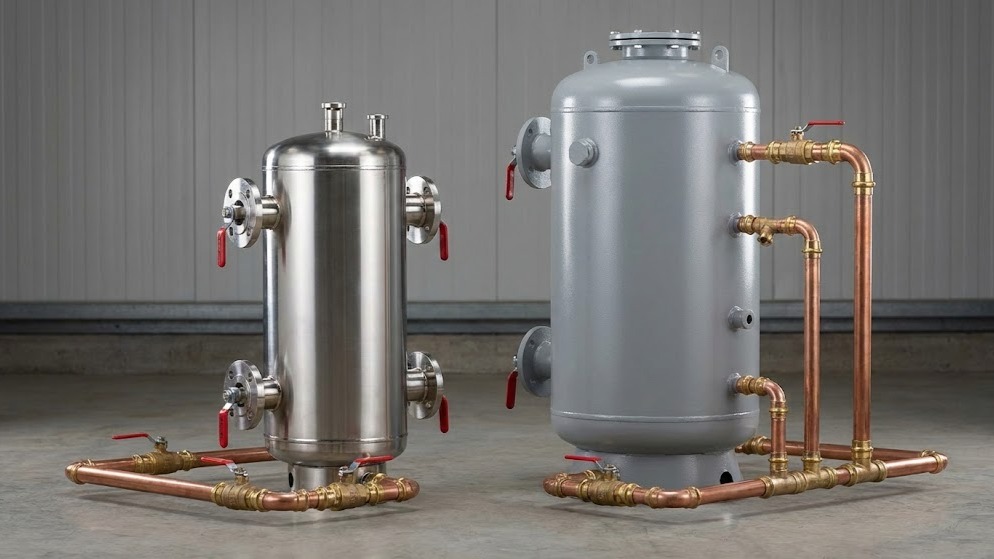
Commercial heating systems often require hydraulic separation between generation and distribution circuits, but the devices providing this separation serve different purposes. Low-loss headers and buffer tanks both appear in system designs, yet their functions differ fundamentally. Understanding the low loss header buffer distinction helps specify the correct solution for each application, avoiding the performance problems that result from inappropriate selection.
Confusion between these devices leads to specification errors that compromise system performance. Headers installed where buffers are needed fail to provide the thermal mass that enables efficient generator operation. Conversely, buffers specified where simple hydraulic separation would suffice add unnecessary cost and complexity. Clear understanding of the hydraulic separator difference from thermal storage guides appropriate selection.
The Need for Hydraulic Separation
Commercial heating systems typically operate with separate primary and secondary circuits that require hydraulic independence. The generation circuit containing boilers or heat pumps needs different flow characteristics than the distribution circuit serving building zones. Without separation, these circuits interfere with each other, causing control problems and inefficient operation.
Hydraulic separation allows primary and secondary circuits to operate with independent flow rates and temperatures. Generation equipment can circulate water at rates optimising heat transfer whilst distribution pumps deliver flow matching zone requirements. Neither circuit constrains the other when proper separation exists.
The low loss header buffer choice depends on whether thermal storage is needed alongside hydraulic separation. Headers provide separation with minimal thermal mass, whilst buffers combine separation with substantial heat storage capability. Understanding which function each application requires guides correct device specification.
Both device types create low-velocity zones where primary and secondary circuits connect. In these zones, pressure differences between circuits become negligible, allowing independent operation. The key distinction lies in what else each device provides beyond this basic separation function.
Understanding Low-Loss Headers
Low-loss headers provide hydraulic separation through carefully sized vessels that create low-velocity zones between connected circuits. Their design prioritises hydraulic function with minimal thermal influence on system operation.
Function and Operating Principles
Low-loss headers work by creating enlarged sections where flow velocity drops below the level required to develop significant pressure differential. Water entering from the primary circuit loses velocity in the enlarged header volume, allowing secondary circuits to draw flow without affecting primary circuit pressure.
The low-velocity zone within headers enables flow rates to differ between primary and secondary sides. Primary pumps can circulate more or less water than secondary pumps demand without either side affecting the other. This independence simplifies control and prevents the hydraulic interference that direct connection would cause.
The distinction between headers and buffers becomes clear when examining thermal behaviour. Headers contain minimal water volume relative to system flow rates, providing seconds rather than minutes of thermal storage. This limited capacity serves hydraulic purposes but cannot smooth generator cycling or absorb load variations as buffers do.
Temperature mixing within headers occurs rapidly because internal volume is small relative to flow. Water from primary and secondary circuits blends quickly, eliminating the temperature stratification that buffers maintain. This mixing proves acceptable for hydraulic separation but prevents headers serving thermal storage purposes.
Design Features and Sizing
Low-loss headers typically comprise cylindrical or rectangular vessels with connections positioned for optimal hydraulic performance. Primary connections often enter at top and bottom, whilst secondary connections tap from the centre where velocity is lowest.
Sizing methodology focuses on achieving adequately low velocity in the separation zone. Velocities below 0.1 metres per second typically ensure effective separation. Header diameter and length calculations derive from maximum anticipated flow rates and acceptable velocity limits.
Advanced header designs incorporate additional features including air separation vents, dirt collection chambers, and temperature sensor pockets. These features add value without significantly increasing size or cost, making combined-function headers attractive for many installations.
Quality headers from reputable manufacturers ensure reliable performance over system service life. Cheap alternatives may suffer corrosion, leakage, or inadequate separation that compromise system operation. Specification should prioritise quality for these critical components.
Appropriate Applications
Low-loss headers suit applications requiring hydraulic separation without significant thermal storage. Systems where generators closely match loads, where turndown capability handles part-load conditions, and where cycling prevention is not a concern can use headers rather than buffers.
Cascade boiler arrangements commonly employ headers to coordinate multiple generators. The header allows individual boilers to operate at their optimal flow rates whilst distribution pumps serve building loads independently. Sequencing controls manage boiler staging without hydraulic interference between units.
Zone pump systems benefit from header separation that prevents zones affecting each other. Opening or closing individual zones changes flow on the distribution side without influencing primary circulation. This independence enables responsive zone control without generator instability.
The hydraulic separator difference from buffers matters most when thermal storage would add unnecessary cost or space requirement. Applications needing only hydraulic independence can achieve it more economically through header selection.
Understanding Buffer Tanks
Buffer tanks combine hydraulic separation with substantial thermal storage capacity. This dual function addresses both hydraulic independence and the thermal mass requirements that enable efficient generator operation under variable load conditions.
Function and Operating Principles
Buffer tanks provide hydraulic separation through the same low-velocity zone principle that headers employ, but in vessels sized for thermal rather than purely hydraulic purposes. The enlarged volume that provides thermal storage simultaneously creates the conditions for hydraulic independence.
The thermal capacity distinction represents the fundamental difference between these devices. Buffers contain water volumes providing minutes or hours of thermal storage rather than the seconds that headers provide. This capacity enables buffers to smooth generator operation across load variations.
Temperature stratification within buffers maintains separation between hot water entering from generators and cooler water returning from distribution. Hot water rises to buffer tops whilst cool water settles at bottoms, preserving temperature quality for efficient heat delivery. Headers cannot maintain this stratification due to rapid mixing in their smaller volumes.
The dual function of buffers reduces total installed device count in many applications. Systems requiring both hydraulic separation and thermal storage can use single buffers rather than separate headers and thermal stores, simplifying installation and reducing cost.
Design Features and Sizing
Buffer tank construction prioritises thermal performance through heavy insulation that minimises standing heat losses. Typical commercial buffers feature fifty to one hundred millimetres of insulation achieving loss rates below one degree per hour.
Sizing methodology differs fundamentally from header sizing. Buffer calculations consider thermal requirements including generator capacity, minimum run times, and load variability. The resulting volumes typically exceed header sizing by factors of ten or more for equivalent flow applications.
Connection positioning in buffers supports stratification maintenance. Flow connections at tops and return connections at bottoms preserve temperature layering that mixing-prone centre connections would disrupt. Internal baffles may further protect stratification during flow events.
Proper buffer integration requires attention to both hydraulic and thermal requirements. Primary and secondary circuits must achieve hydraulic independence whilst flow patterns maintain the stratification essential for thermal storage effectiveness.
Appropriate Applications
Buffer tanks suit applications where thermal storage provides operational benefit beyond simple hydraulic separation. Generator cycling prevention, load smoothing, and defrost management all require the thermal capacity that only buffers provide.
Heat pump installations almost universally benefit from buffer storage. The sensitivity of heat pump efficiency to stable operating conditions makes thermal mass valuable regardless of hydraulic separation needs. The device selection clearly favours buffers for heat pump applications.
Variable load applications benefit from buffering that enables efficient generation despite fluctuating demand. Buildings with occupancy variations, assembly spaces, and facilities with intermittent processes all present load profiles that benefit from thermal storage.
Circulation equipment from National Pumps and Boilers supports effective buffer integration. Properly specified pumps ensure that installed thermal capacity delivers its intended benefits through adequate flow and temperature management.
Key Differences Explained
Understanding the specific differences between low-loss headers and buffer tanks helps specify the correct device for each application.
Thermal Storage Capacity
The fundamental hydraulic separator difference from buffers lies in thermal capacity. Headers provide essentially zero useful thermal storage, whilst buffers are sized specifically for their storage capability.
This capacity difference affects generator operation significantly. Generators serving headers must respond to every load change because no thermal mass absorbs variations. Generators serving buffers can operate more steadily because thermal storage handles short-term load fluctuations.
The low loss header buffer sizing difference reflects these thermal requirements. A header serving the same flow as a buffer might contain one-tenth the volume because its sizing addresses only hydraulic needs.
Physical Size and Installation
Headers occupy substantially less space than buffers for equivalent hydraulic duty. Their compact dimensions suit installations where space constraints limit equipment sizing. Retrofit applications with limited plant room space often favour headers for this reason.
Buffer installation requires space for larger vessels plus clearance for insulation and connections. Vertical buffers minimise floor space but require adequate height. Horizontal alternatives spread footprint but may fit where headroom is limited.
Installation complexity differs modestly between device types. Both require similar connection work, though buffer insulation and additional temperature sensors add some complexity. Neither presents unusual installation challenges for experienced heating engineers.
Cost Considerations
Capital costs favour headers over buffers for equivalent hydraulic capacity. The additional material, insulation, and size of buffers creates cost premiums that must be justified by operational benefits.
Operating cost comparison may reverse the capital cost advantage. Efficiency gains from buffer-enabled stable operation often exceed the additional capital cost within a few years. Systems where buffering reduces cycling or enables condensing operation typically favour buffer investment.
Whole-life cost analysis considers capital, operating, and maintenance costs across system service life. This comprehensive view often favours buffers for applications where thermal storage delivers operational benefits, despite higher initial cost.
Selection Guidance
Clear criteria help select the appropriate device for each application, avoiding both under-specification that compromises performance and over-specification that wastes resources.
When to Specify Low-Loss Headers
Headers suit applications where hydraulic separation suffices without thermal storage benefit. Characteristics suggesting header selection include closely matched generator and load sizing, generators with good turndown capability, and stable load profiles with limited variation.
Cascade boiler arrangements commonly use headers because each boiler has its own fire rate control responding to load. The header provides hydraulic independence between boilers and distribution without adding thermal mass that boiler controls do not require.
Zone pump systems often need only the hydraulic separation that headers provide. Zone valves modulate demand whilst headers prevent zones affecting each other. Generators modulate to match total demand without needing thermal buffering.
The hydraulic separator difference from buffers favours header selection when thermal mass would add cost without delivering proportionate benefit.
When to Specify Buffer Tanks
Buffers suit applications requiring thermal storage for efficient operation. Heat pumps, variable loads, and cycling-prone systems all benefit from the thermal mass that only buffers provide.
Heat pump applications almost always warrant buffer specification. The efficiency sensitivity and defrost requirements of heat pumps make thermal storage valuable regardless of other factors. The low loss header buffer decision strongly favours buffers for heat pump systems.
Systems exhibiting cycling despite adequate generator controls likely need the additional volume that buffers provide. The thermal mass extends run times sufficiently for efficient operation under conditions where headers would allow continued cycling.
Variable load applications benefit from thermal storage that enables rapid response to demand increases without requiring oversized generation. Buffer capacity charged during low-load periods provides the energy for quick warm-up when loads rise.
When to Use Both
Some installations benefit from both headers and buffers serving different functions. Complex systems with multiple generator types, diverse loads, or specific control requirements may need separate devices.
Hybrid systems combining heat pumps with backup boilers sometimes use buffers for heat pump support and headers for boiler cascade coordination. Each device serves its appropriate function without requiring a single device to compromise both roles.
Large systems with distinct heating and hot water generation may use separate buffers for each service with headers coordinating distribution. This arrangement optimises each subsystem whilst maintaining appropriate separation.
Systems including equipment from various sources including Grundfos pumps and expansion vessels require careful integration of all components including both headers and buffers where both are specified.
Conclusion
Understanding the low loss header buffer distinction enables appropriate device selection for each application. Headers provide hydraulic separation with minimal thermal influence, whilst buffers combine separation with substantial thermal storage.
The hydraulic separator difference from thermal storage determines which device suits each application. Systems needing only hydraulic independence can use economical headers, whilst those requiring thermal mass for efficient operation need buffer specification.
Professional assessment helps resolve uncertain cases where the appropriate choice is not immediately clear. The investment in correct specification delivers systems that perform as intended throughout their service life.
For guidance on hydraulic separation and thermal storage equipment, contact the National Pumps and Boilers team for expert technical support.