

What Are Buffer Tanks and Why Do Commercial Heating Systems Use Them?
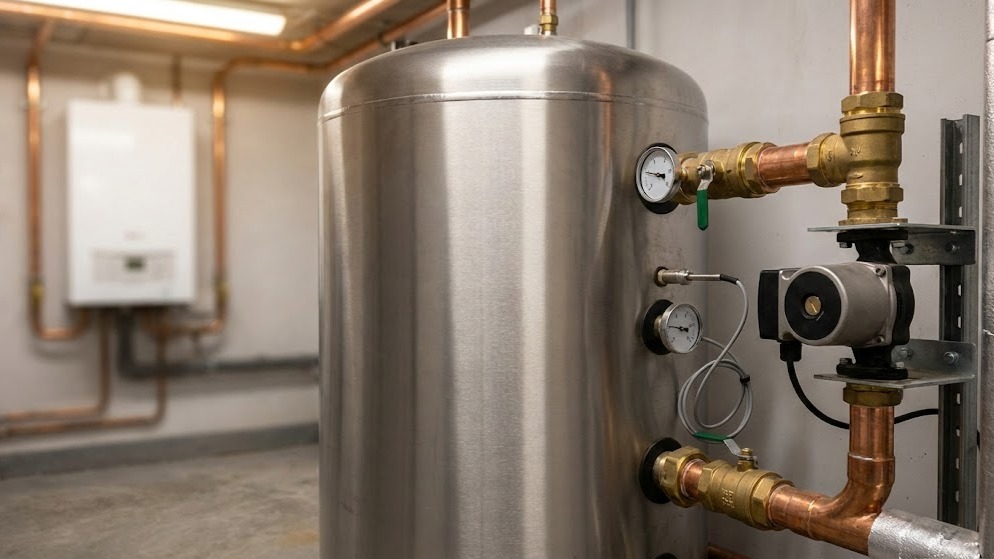
Commercial heating systems face challenges that domestic installations rarely encounter. Variable occupancy, diverse heat loads, and the need for consistent comfort across large buildings create demands that heat generators alone cannot always meet efficiently. Buffer tanks address these challenges by introducing thermal mass that smooths the interface between heat generation and heat demand, enabling systems to operate more efficiently whilst protecting expensive equipment from damaging operational patterns.
Understanding buffer tank commercial heating applications helps facilities managers and building services engineers specify appropriate solutions for their installations. These vessels serve multiple purposes beyond simple heat storage, contributing to system efficiency, equipment longevity, and operational flexibility. The investment in properly specified buffer capacity typically returns substantial value through reduced energy costs and extended equipment service life.
Understanding Buffer Tank Fundamentals
A buffer tank is an insulated vessel containing water that sits between the heat generation equipment and the heating distribution system. This seemingly simple addition transforms system behaviour by introducing thermal mass that absorbs and releases heat as conditions demand. The buffer stores excess heat when generation exceeds demand and releases stored heat when demand exceeds instantaneous generation capacity.
The fundamental purpose of buffer tank commercial heating installations is to decouple heat generation from heat demand. Without buffering, heat generators must respond instantaneously to every change in system demand, cycling on and off as loads fluctuate. With adequate buffer capacity, generators can operate in longer, more efficient cycles whilst the buffer handles short-term demand variations.
A thermal buffer vessel functions as a thermal capacitor within the heating system, analogous to electrical capacitors that smooth voltage fluctuations in electronic circuits. Just as capacitors store and release electrical charge to maintain stable voltage, buffer tanks store and release thermal energy to maintain stable temperatures despite variable loads.
The effectiveness of buffering depends on tank volume relative to system heat flows. Larger buffers provide greater smoothing but occupy more space and require larger capital investment. Optimal sizing balances buffering capability against practical and economic constraints to achieve the best overall solution for each application.
The Physics of Thermal Buffering
Understanding the thermodynamic principles governing buffer operation helps specify appropriate equipment and predict system behaviour. The physics of heat storage and transfer determine how effectively buffers perform their intended functions.
How Buffer Tanks Store and Release Heat
Water stores heat according to its specific heat capacity, approximately 4.2 kilojoules per kilogram per degree Celsius temperature rise. A one-thousand-litre thermal buffer vessel experiencing a twenty-degree temperature swing stores approximately 84 megajoules of thermal energy, equivalent to over twenty kilowatt-hours of heat that can smooth significant demand variations.
Temperature stratification within buffer tanks affects storage and retrieval efficiency. Hot water naturally rises whilst cooler water sinks, creating temperature layers that preserve the quality of stored heat. Well-designed buffers maintain stratification through appropriate connection positioning and internal baffling that minimises mixing during charging and discharging cycles.
Heat loss from buffer tanks reduces the useful energy available to meet heating demand. Quality thermal buffer vessel construction includes substantial insulation that limits standing losses to acceptable levels. Typical commercial buffers achieve heat loss rates below one degree Celsius per hour, meaning overnight temperature drops remain modest even without heat input.
The rate at which buffers can accept or deliver heat depends on connection sizing, flow rates, and temperature differentials. Undersized connections or inadequate flow restrict heat transfer, reducing effective buffer capacity regardless of vessel volume. Proper hydraulic design ensures that installed capacity can be fully utilised.
Temperature Management in Buffer Systems
Buffer tanks moderate temperature fluctuations that would otherwise affect distribution systems and building comfort. The thermal mass absorbs rapid temperature changes from heat generator cycling, delivering more stable supply temperatures to the distribution system.
Sensor positioning within buffer tanks significantly affects control system behaviour. Temperature sensors located at strategic heights detect thermal conditions at different levels, enabling sophisticated control strategies that optimise both generation efficiency and distribution temperature stability.
Quality circulation equipment from National Pumps and Boilers ensures effective heat transfer between buffers and both generation and distribution circuits. Properly specified pumps maintain the flow rates necessary for full utilisation of installed buffer capacity.
Mixing within buffers can reduce effective capacity by blending hot and cold water into intermediate temperatures less useful for either storage or distribution. Internal baffles, diffuser plates, and careful connection positioning all help maintain the stratification that preserves stored heat quality.
Why Commercial Systems Require Buffer Tanks
Commercial heating systems face operational challenges that make buffering particularly valuable. Understanding these challenges explains why buffer investment delivers returns that may not apply to simpler installations.
Managing Variable Heat Loads
Commercial buildings experience heat load variations that residential properties typically do not encounter. Occupancy patterns, solar gains, internal heat sources from equipment and lighting, and ventilation requirements all create fluctuating demands that challenge heat generation equipment.
Buffer tank commercial heating systems handle these variations by absorbing excess capacity during low-demand periods and supplementing generation during demand peaks. This load smoothing enables heat generators to operate at steady outputs rather than constantly modulating to match instantaneous demand.
Buildings with particularly variable loads benefit most from generous buffer capacity. Assembly spaces, places of worship, sports facilities, and entertainment venues all experience extreme swings between occupied and vacant conditions. Buffering enables these buildings to achieve comfortable temperatures quickly when needed without installing oversized heat generation that would prove inefficient during normal operation.
Modern commercial buildings often incorporate multiple heat sources including boilers, heat pumps, and solar thermal systems. Coordinating these diverse sources becomes simpler with buffer storage that allows each to contribute according to its optimal operating conditions rather than demanding simultaneous response to system demands.
Protecting Heat Generation Equipment
Heat generators operating without adequate buffering experience frequent cycling that accelerates wear and reduces efficiency. Each start-stop cycle stresses ignition components, exposes heat exchangers to thermal shock, and wastes fuel during warm-up phases that produce no useful output.
Modern condensing boilers and heat pumps prove particularly sensitive to cycling because their efficiency depends on sustained operation at optimal conditions. Short cycles prevent boilers reaching condensing temperatures and stop heat pumps achieving the sustained operation necessary for rated efficiency.
Manufacturers increasingly specify minimum system water content as a warranty condition. Systems failing to meet these requirements may find warranty coverage denied when premature component failure occurs. Buffer tanks provide the additional water volume necessary to satisfy manufacturer requirements and protect warranty rights.
Equipment from leading manufacturers like Remeha and Vaillant benefits from the stable operating conditions that properly sized buffer tanks provide. Protecting this investment through appropriate system design makes sound economic sense.
Buffer Tank Construction and Types
Buffer tanks for commercial heating applications differ from domestic cylinders in construction, capacity, and features. Understanding these differences helps specify appropriate equipment for each application.
Materials and Design Features
Commercial thermal buffer vessel construction typically uses mild steel with internal coating or stainless steel for corrosion resistance. Steel construction provides the strength necessary for larger vessels whilst accepting standard pipe connections and mounting arrangements.
Insulation thickness and quality directly affect standing heat losses and operational economics. Commercial buffers typically feature fifty to one hundred millimetres of polyurethane or mineral wool insulation achieving heat loss rates suitable for continuous operation. Higher insulation specifications suit applications where buffers may stand for extended periods without heat input.
Connection positioning affects stratification maintenance and hydraulic flexibility. Multiple connection bosses at different heights enable various piping configurations optimised for specific applications. Internal baffling and diffuser plates further enhance stratification by reducing mixing during flow events.
Pressure ratings must suit system operating conditions with appropriate safety margins. Standard commercial buffers typically rate for three or six bar working pressure, with higher ratings available for specific applications. Vessels must also comply with Pressure Equipment Directive requirements where applicable.
Sizing Considerations
Buffer volume calculations consider heat source capacity, minimum run times, and load characteristics. Rules of thumb suggesting specific litres per kilowatt provide starting points, but detailed analysis yields more accurate sizing for critical applications.
Multiple heat source installations require careful consideration of how each source interacts with the buffer. Backup boilers may need different buffer relationships than primary heat pumps, and solar thermal contributions add further complexity. Professional design ensures that buffer capacity serves all connected sources effectively.
Space constraints often influence buffer specification in retrofit applications. Tall, narrow vessels may fit locations where equivalent-volume short, wide tanks would not. Modular approaches using multiple smaller buffers can address particularly constrained installations.
Systems incorporating expansion vessels must account for the additional system volume that buffers introduce. Expansion provision sized for the original system may prove inadequate after buffer installation.
System Integration Requirements
Effective buffer integration requires careful attention to hydraulic design, control strategy, and commissioning procedures. Poor integration can negate the benefits that buffers should provide.
Hydraulic arrangements must enable adequate flow through buffer tanks during both charging and discharging operations. Undersized pipework or poorly positioned connections restrict flow and reduce effective buffer capacity. Primary and secondary circuit separation typically employs buffers in configurations that maintain hydraulic independence whilst enabling heat transfer.
Control strategies for buffer-equipped systems differ from conventional approaches. Temperature sensors at multiple buffer heights provide information about stored energy quantity and quality. Sophisticated controllers use this information to optimise generator operation whilst maintaining distribution temperature requirements.
Commissioning buffer systems requires verification that design flow rates are achieved and that control sequences function as intended. Thermal imaging during operation confirms that expected temperature distributions develop within the buffer. Adjustments to control parameters may be necessary to optimise performance for actual building characteristics.
Circulation pumps from manufacturers like Grundfos and Wilo provide the reliable, controllable flow that buffer systems require. Variable speed pumps prove particularly valuable for matching flow rates to varying system conditions.
Conclusion
Buffer tanks serve essential functions in commercial heating systems, providing the thermal mass necessary to decouple heat generation from heat demand. Understanding buffer tank commercial heating applications helps specify appropriate solutions that deliver efficiency gains and equipment protection throughout system service life.
The thermal buffer vessel investment typically returns substantial value through reduced energy costs, extended equipment service life, and improved building comfort. Systems designed without adequate buffering may achieve lower capital cost but incur higher operating expenses and earlier equipment replacement that exceed the avoided buffer investment.
Facilities managers and building services engineers considering buffer tank installation should seek professional design input to ensure appropriate sizing and integration. The modest additional design effort delivers systems that perform as intended and realise the full benefits that buffering can provide.
For guidance on buffer tank specification and quality heating equipment, contact the National Pumps and Boilers team for expert technical support.