

What Happens When You Change Your Pump's Speed Setting (VFD Benefits Explained)
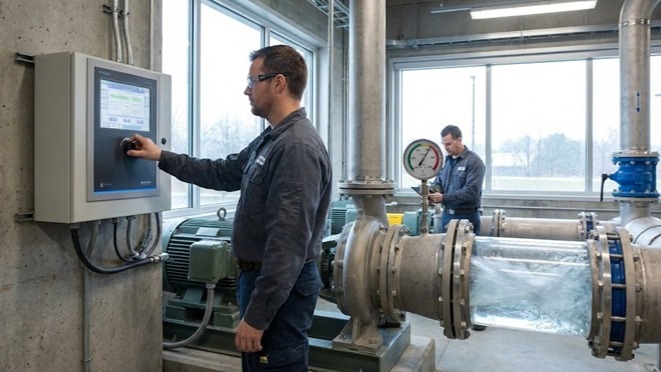
Most commercial heating systems run pumps at fixed speeds regardless of actual demand - a bit like driving a car with the accelerator permanently floored and using only the brake to control speed. Adjusting a pump's speed setting with VFD technology (variable frequency drive) changes this fundamentally, delivering precise flow control whilst slashing energy consumption by up to 70%.
The physics behind this efficiency gain isn't intuitive. When pump speed drops by just 20%, power consumption falls by nearly 50% - a relationship that transforms operational costs across commercial buildings, district heating networks, and industrial facilities. Understanding VFD pump benefits helps heating engineers specify systems that deliver substantial operational savings whilst maintaining optimal performance.
How Variable Frequency Drives Control Pump Speed
A variable frequency drive adjusts the electrical frequency supplied to a pump motor, directly controlling its rotational speed. Standard UK mains electricity operates at 50Hz, which drives a typical pump motor at maximum speed. A VFD can reduce this frequency to 10Hz or lower, slowing the pump proportionally whilst maintaining full motor control.
This differs fundamentally from older control methods like throttling valves or bypass circuits, which restrict flow whilst the pump continues running at full speed - wasting energy as heat and vibration. The VFD approach reduces the actual work performed by the motor, cutting energy consumption at source.
Modern circulators from Grundfos and Wilo integrate VFD technology directly into compact housings, eliminating the need for separate control panels in many central heating applications.
The Cube Law: Why Small Speed Reductions Deliver Massive Savings
Pump power consumption follows the affinity laws - mathematical relationships that govern how performance changes with speed. The critical relationship states that power consumption varies with the cube of speed change:
Power₂ = Power₁ × (Speed₂ ÷ Speed₁)³
Practical examples demonstrate the VFD pump benefits:
- 80% speed: Power drops to 51% (0.8³ = 0.512)
- 60% speed: Power drops to 22% (0.6³ = 0.216)
- 50% speed: Power drops to 13% (0.5³ = 0.125)
A 15kW pump running at 60% speed consumes just 3.3kW - saving 11.7kW continuously. Across 5,000 annual operating hours, this prevents 58,500kWh consumption, worth approximately £8,775 at current commercial electricity rates (£0.15/kWh).
Flow rate and head pressure also change with speed, but following different relationships. Flow varies linearly (50% speed = 50% flow), whilst head varies with the square of speed (50% speed = 25% head). Understanding these relationships ensures pump speed setting VFD adjustments maintain adequate system performance.
Real-World Performance Changes Across Speed Settings
Adjusting VFD settings produces measurable changes across multiple performance parameters. Testing a Grundfos TPE3 80-120/4 circulator demonstrates typical relationships:
100% Speed (Maximum):
- Flow rate: 18 m³/h
- Head pressure: 8 metres
- Power consumption: 1.1kW
- Motor efficiency: 85%
75% Speed:
- Flow rate: 13.5 m³/h (75% of maximum)
- Head pressure: 4.5 metres (56% of maximum)
- Power consumption: 0.46kW (42% of maximum)
- Motor efficiency: 83%
50% Speed:
- Flow rate: 9 m³/h (50% of maximum)
- Head pressure: 2 metres (25% of maximum)
- Power consumption: 0.14kW (13% of maximum)
- Motor efficiency: 78%
Efficiency decreases slightly at lower speeds because motor losses (friction, magnetic losses) represent a larger proportion of total power. However, absolute consumption falls dramatically - the 50% speed setting uses 0.96kW less than full speed, despite the 7% efficiency reduction.
How Building Heating Systems Benefit From Speed Control
Commercial heating systems rarely require maximum flow continuously. Heat demand varies with outdoor temperature, occupancy patterns, and time of day. Fixed-speed pumps must be sized for peak demand - typically cold January mornings - then run oversized for 95% of operating hours.
Variable frequency drive systems match pump output to actual demand through several control strategies:
Constant Differential Pressure Control
Constant Differential Pressure Control maintains set pressure across the system regardless of valve positions. As thermostatic radiator valves close in warm weather, the VFD reduces speed to maintain target pressure - preventing noise, wear, and energy waste from excessive flow.
Proportional Pressure Control
Proportional Pressure Control reduces target pressure as flow decreases, following the system curve more closely. When heating demand drops by 50%, the pump might target 60% of design pressure rather than 100%, delivering further energy savings whilst maintaining comfort.
Temperature Compensation
Temperature Compensation adjusts speed based on outdoor temperature. A heating system requiring 80°C flow temperature at -3°C outdoor temperature might only need 50°C at +10°C outdoor temperature, allowing significantly reduced flow rates.
National Pumps and Boilers supplies DHW pumps with integrated VFD control for both space heating and domestic hot water applications, where demand patterns create particularly strong cases for speed variation.
Sizing Considerations When Specifying VFD-Controlled Pumps
Selecting appropriate pump capacity changes when VFD control is available. Traditional fixed-speed sizing requires substantial safety factors - typically 10-20% flow margin and 15-25% head margin - to ensure adequate performance under all conditions. This oversizing guarantees coverage but wastes energy.
VFD-controlled systems permit tighter sizing because speed adjustment provides operational flexibility. A pump sized for 110% of calculated duty (rather than 120%) can increase speed slightly if actual system resistance exceeds predictions, whilst running more efficiently during normal operation.
Key Sizing Parameters
Key sizing parameters include:
Flow Rate Requirements: Calculate actual system flow using heating load, temperature differential, and fluid properties. For water-based systems: Flow (m³/h) = Heat Load (kW) ÷ (4.2 × ΔT), where ΔT represents flow/return temperature difference.
System Head Calculation: Sum static head (height differences), friction losses through pipes and components, and control valve authority. VFD systems benefit from accurate calculations because they can adjust to actual installed conditions rather than worst-case assumptions.
Control Range: Specify minimum and maximum speed settings based on turndown requirements. Most heating systems operate effectively between 30-100% speed, though some applications require different ranges.
Motor Efficiency Curve: Review manufacturer data showing efficiency across the speed range. Premium efficiency motors (IE3 or IE4 classification) maintain better performance at reduced speeds than standard motors.
Installation Requirements and Electrical Considerations
VFD-controlled pumps require specific electrical infrastructure beyond standard motor starters. The drive electronics generate harmonic currents that can interfere with other equipment unless properly managed.
Electrical Infrastructure Requirements
Electrical Supply: Most integrated VFD circulators operate from single-phase 230V supplies up to 2kW motor power. Larger pumps require three-phase 400V supplies, with VFD units rated to match motor full-load current plus 10-15% margin.
Cable Sizing: Motor cables between VFD and pump must account for harmonic currents, typically requiring 1.2× the sizing calculated for sinusoidal loads. Screened cables prevent electromagnetic interference with nearby control circuits.
Compliance and Protection
EMC Compliance: Variable frequency drives generate radio frequency emissions that must comply with BS EN 61800-3 electromagnetic compatibility standards. Category C2 classification suits most building services applications, requiring standard installation practices without additional filtering.
Control Wiring: VFD pumps accept various control signals - 0-10V analogue, 4-20mA current loop, or digital protocols like Modbus RTU or BACnet. Control cable separation from power cables prevents interference, with minimum 300mm spacing or screened cables where closer routing is unavoidable.
Protection Devices: Standard motor protection (overload, short circuit, earth fault) integrates into VFD units, but upstream isolation and emergency stop provisions remain necessary per BS 7671 wiring regulations.
Energy Monitoring and Performance Verification
Quantifying actual savings from pump speed setting VFD adjustments requires measurement of key parameters before and after implementation. Many modern circulators include integral energy monitoring, displaying cumulative consumption via digital interfaces or building management systems.
Essential Monitoring Points
Essential Monitoring Points:
Electrical Power: Measure true power (kW) rather than apparent power (kVA) to account for power factor variations. VFD systems typically maintain 0.95-0.98 power factor across the operating range.
Operating Hours by Speed: Log time spent at different speed settings to verify control strategy effectiveness. Systems spending excessive time above 80% speed may benefit from pump upsizing or system rebalancing.
Flow and Pressure: Periodic measurement confirms the system operates within design parameters. Unexpected pressure requirements might indicate blockages, air locks, or control valve issues requiring attention.
Temperature Performance: Monitor flow and return temperatures alongside space temperatures to verify heating delivery matches demand. Excessive temperature differentials or inadequate space heating indicate control problems rather than VFD limitations.
Annual energy consumption comparison against baseline (or similar fixed-speed systems) demonstrates actual savings. Commercial heating systems typically achieve 40-60% pump energy reduction, though results vary with load profiles and control strategies.
Common Issues and Troubleshooting Speed Control Problems
VFD systems occasionally develop problems affecting performance or reliability. Recognising symptoms and causes accelerates resolution:
Typical VFD System Issues
Motor Overheating: Extended operation above 80% speed in high ambient temperatures can exceed motor thermal limits. Solutions include improved ventilation, motor upsizing, or maximum speed limiting.
Cavitation Noise: Excessive speed reduction in high-temperature systems can cause localised boiling at the pump inlet. Maintaining adequate NPSH (net positive suction head) through system pressurisation units prevents this.
Control Instability: Hunting behaviour - rapid speed fluctuations - indicates incorrect control parameters. Increasing proportional gain or adding integral compensation stabilises response.
Harmonic Interference: Flickering lights or communication errors in nearby equipment suggest harmonic current problems. Solutions include line reactors, harmonic filters, or supply circuit separation.
Bearing Wear: VFD-induced bearing currents can cause premature failure in larger motors. Insulated bearings or shaft grounding brushes prevent damage in motors above 7.5kW.
Professional commissioning prevents most issues through proper parameter configuration, but understanding these patterns helps heating engineers diagnose problems efficiently.
Regulatory Compliance and ErP Directive Requirements
UK and EU regulations increasingly mandate efficient pump technologies in new installations and replacements. The ErP Directive (Energy-related Products) 2009/125/EC establishes minimum efficiency standards for standalone circulators and pumps integrated into heating products.
Energy Efficiency Index Standards
Since January 2020, most circulators under 2.5kW must achieve minimum Energy Efficiency Index (EEI) ratings:
- Standalone circulators: EEI ≤ 0.23
- Integrated heating products: EEI ≤ 0.23 for heat generators, ≤ 0.27 for other products
VFD-controlled pumps easily meet these requirements, with premium models achieving EEI values below 0.18. Fixed-speed circulators struggle to comply, effectively mandating variable frequency drive technology for most new heating system pumps.
Building Regulations Part L (Conservation of Fuel and Power) requires heating systems to incorporate efficient circulation pumps as part of overall system efficiency. Compliance calculations under the Standard Assessment Procedure (SAP) or Simplified Building Energy Model (SBEM) credit VFD pumps with reduced electrical consumption, improving overall building performance ratings.
Long-Term Reliability and Maintenance Implications
Reducing pump operating speed extends component life through multiple mechanisms. Lower rotational speeds decrease bearing loads, shaft deflection, and seal wear rates - the primary failure modes in heating circulators. These VFD pump benefits translate to reduced maintenance costs and improved system reliability.
Service Life Comparison
Expected Service Life Comparison:
Fixed-Speed Operation:
- Bearing life: 40,000-60,000 hours
- Seal life: 30,000-50,000 hours
- Typical replacement interval: 5-7 years
VFD-Controlled at 60% Average Speed:
- Bearing life: 180,000-270,000 hours (4.5× improvement)
- Seal life: 135,000-225,000 hours (4.5× improvement)
- Typical replacement interval: 12-18 years
Bearing life follows an inverse cube relationship with speed (similar to power consumption), making speed reduction particularly beneficial for longevity. A pump running at 60% average speed experiences bearing loads equivalent to just 22% of full-speed operation.
Maintenance requirements decrease proportionally. Annual inspections remain advisable, but component replacement intervals extend significantly. The higher initial cost of VFD-equipped pumps - typically 40-80% more than fixed-speed equivalents - is offset by extended service life alongside energy savings.
Retrofitting VFD Control to Existing Fixed-Speed Pumps
Many existing heating systems operate fixed-speed pumps that could benefit from variable speed control. Retrofitting involves either replacing the pump with a VFD-integrated model or adding an external VFD unit to the existing motor.
Retrofit Options
Integrated Replacement: Modern circulators with built-in VFD control offer the simplest retrofit path. Direct replacement maintains existing pipe connections whilst adding speed control and energy monitoring. This approach suits pumps under 5kW where integrated units are cost-effective.
External VFD Addition: Larger pumps (above 5kW) typically use separate VFD panels mounted near the motor. This requires electrical modifications including VFD installation, motor cable replacement with screened type, and control signal wiring. Existing motors must be VFD-compatible - most modern three-phase motors work satisfactorily, but older designs may require replacement.
Implementation Considerations
Control Integration: Retrofit VFD systems need control signals from existing building management systems, standalone pressure sensors, or temperature compensators. The control strategy significantly affects savings - simple on/off operation provides minimal benefit, whilst proper differential pressure or temperature compensation delivers full potential.
Economic Assessment: Retrofit payback periods typically range from 2-5 years depending on operating hours, electricity costs, and existing pump oversizing. Systems running continuously with substantial oversizing show fastest returns, whilst intermittent or well-sized systems may not justify retrofit costs.
Practical Applications Across Different System Types
VFD pump benefits vary across heating system configurations, with some applications showing particularly strong advantages:
System-Specific Applications
District Heating Networks: Large-scale distribution systems with diverse connected loads benefit enormously from speed control. As individual buildings modulate demand, network pumps adjust flow to maintain pressure whilst minimising distribution losses. Energy savings of 60-70% are common compared to fixed-speed operation with bypass control.
Commercial Office Buildings: Occupancy-driven heating demand creates ideal conditions for VFD control. Night setback periods, weekend shutdowns, and seasonal variations mean pumps rarely require maximum capacity. Typical savings reach 45-55% annually.
Industrial Process Heating: Variable production rates and batch processes create fluctuating heating demands. VFD pumps match flow to actual requirements rather than maintaining maximum circulation continuously. Integration with process control systems optimises both heating delivery and energy consumption.
Residential Developments: Apartment blocks and housing estates with communal heating systems show strong VFD pump benefits. Diverse occupancy patterns mean aggregate demand varies significantly, allowing substantial speed reduction during low-demand periods.
Swimming Pool Heating: Pool heating systems maintain relatively constant temperatures but with varying solar gains and usage patterns. VFD control adjusts circulation rates to match actual heating requirements, delivering 35-45% energy savings whilst maintaining water quality through adequate filtration.
Conclusion
Adjusting a pump speed setting VFD transforms heating system efficiency through the cube-law relationship between speed and power consumption. Reducing speed by just 20% cuts energy use nearly in half, whilst 50% speed operation consumes only 13% of full-power demand - savings that translate directly to reduced operating costs and carbon emissions.
The VFD pump benefits extend beyond energy reduction. Lower operating speeds decrease component wear, extend service life, and reduce maintenance requirements whilst maintaining precise flow control matched to actual demand. Modern VFD-integrated circulators deliver these advantages in compact packages that simplify both new installations and retrofit applications.
Proper implementation requires accurate system sizing, appropriate control strategies, and correct electrical installation - but the potential returns justify careful specification. Commercial heating systems typically achieve 40-60% pump energy savings with payback periods of 2-4 years, making VFD technology one of the most cost-effective efficiency measures available.
For technical guidance on selecting VFD-controlled pumps for specific applications or to discuss retrofit options for existing systems, contact us for expert advice tailored to individual project requirements.