

When to Retrofit vs Replace Your Ageing Commercial Pump
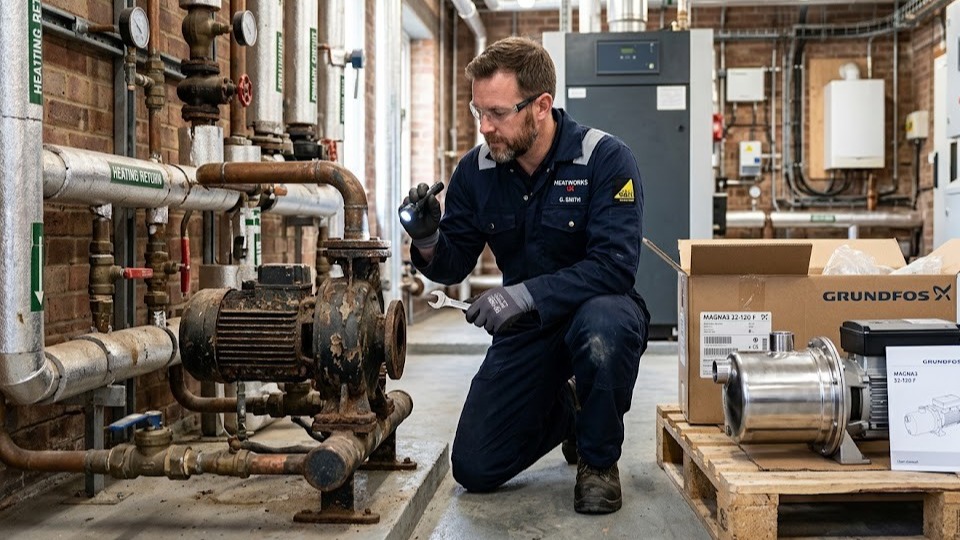
Commercial pump failure costs UK facilities an average of £8,400 per incident in emergency repairs, downtime, and energy waste. Yet facilities managers face this decision repeatedly: invest in retrofitting an ageing pump or replace it entirely?
The answer depends on six technical factors that determine whether retrofit vs replace pump delivers genuine value or merely delays an inevitable replacement. National Pumps and Boilers works with facilities teams across the UK to assess pump viability using performance data, not guesswork.
The True Cost of Delaying Pump Decisions
Ageing pumps rarely fail catastrophically without warning. Instead, they degrade gradually - consuming 20-40% more energy, requiring frequent seal replacements, and causing secondary damage to connected equipment.
A 15-year-old circulator pump in a commercial office building consumed £2,800 annually in excess electricity before replacement. The facilities team had spent £1,200 on three emergency repairs in 18 months, believing they were extending equipment life economically.
The mathematics proved otherwise. A modern Grundfos pump with ErP-compliant efficiency reduced energy consumption by 38% whilst eliminating unplanned maintenance. The payback period was 14 months.
When Retrofit Makes Technical Sense
Retrofit involves replacing worn components - seals, bearings, impellers, or motors - whilst retaining the pump body and system integration. This approach works when specific conditions exist.
Pump age under 10 years: Equipment manufactured after 2014 typically uses standardised components with good parts availability. Older pumps often require custom-machined parts that cost more than replacement equipment.
Single-component failure: If bearing noise or seal leakage represents the only defect, and the motor draws normal current, targeted component replacement extends service life economically. Multiple simultaneous failures indicate systemic wear that retrofit cannot address comprehensively.
System compatibility requirements: Some installations use pumps with unique mounting configurations, pipe connections, or control interfaces. Replacement might require expensive pipework modifications or control system updates. Retrofit preserves these integrations.
Capital budget constraints: When replacement budgets aren't available but component-level spending is approved, retrofit provides a bridge solution. However, this should never become a long-term strategy that accumulates costs exceeding replacement value.
A hospital retrofitted DHW pumps serving patient wings because replacing them required shutting down hot water to critical care areas during installation. New seals and bearings cost £840 per pump and provided three additional years of service whilst the facilities team planned a coordinated replacement during scheduled building maintenance.
When Replacement Becomes the Only Viable Option
Certain technical indicators make retrofit vs replace pump decisions economically irrational, regardless of upfront cost differences.
Energy efficiency degradation: Pumps manufactured before 2013 lack ErP-compliant motors. Running costs for these units exceed modern equivalents by 30-50%. A pump consuming £3,200 annually in electricity could drop to £1,900 with a current Wilo pump, creating £1,300 in annual savings that fund replacement within 24-36 months.
Repeated component failures: When the same pump requires repairs twice within 12 months, or different components fail in succession, the equipment has reached end-of-life. Continuing repairs rarely extends service beyond 18 additional months and accumulates costs that exceed replacement value.
Cavitation damage: If the impeller shows pitting or erosion from cavitation, the pump body likely has internal damage that component replacement cannot remedy. Cavitation indicates system design problems that new equipment with proper head pressure ratings can address.
Obsolete control compatibility: Pumps with proprietary control protocols that don't integrate with modern BMS systems create operational inefficiencies. Replacement with equipment offering Modbus, BACnet, or wireless connectivity improves system management and energy monitoring.
Shaft wear or casing corrosion: These structural failures require complete pump replacement. Attempting to machine worn shafts or patch corroded casings provides temporary fixes that fail unpredictably.
The Performance Testing Protocol
Facilities teams need objective data, not subjective assessments, to make retrofit vs replace pump decisions. This testing sequence provides quantifiable evidence.
Electrical Consumption Measurement
Use a power analyser to measure actual motor draw under operating conditions. Compare against nameplate ratings and manufacturer specifications. Current draw exceeding nameplate values by more than 8% indicates motor degradation or mechanical resistance from worn bearings.
Vibration Analysis
Handheld vibration meters detect bearing wear before audible noise develops. Readings above 7.1 mm/s RMS indicate bearing replacement urgency. Readings above 11.2 mm/s suggest shaft or coupling problems that make retrofit questionable.
Temperature Monitoring
Measure motor casing temperature and bearing housing temperature. Readings exceeding 70°C indicate friction from worn components or inadequate lubrication. Temperature differences between identical pumps in the same system reveal which units need attention.
Flow Rate Verification
Measure actual flow against design specifications using ultrasonic flow meters. Flow reductions of 15% or more indicate impeller wear, internal recirculation, or cavitation damage. Minor flow loss might justify impeller replacement; severe degradation requires complete pump replacement.
Seal Condition Assessment
Visible weeping, crystallised deposits around the seal, or moisture in the motor junction box indicate seal failure. Single seal replacement costs £180-£320 for standard pumps. If seals have been replaced previously and failed again within 24 months, shaft wear or misalignment makes further retrofit inadvisable.
Calculating Total Cost of Ownership
The pump replacement decision requires comparing the five-year total cost of ownership, not just initial expenditure.
Retrofit cost calculation: Sum component costs, labour, system downtime, and projected additional repairs within 36 months. Include ongoing excess energy consumption if motor efficiency remains below modern standards. Add the probability-weighted cost of unexpected failure.
For a commercial heating pump, this might total:
- £450 (seal and bearing kit)
- £380 (installation labour)
- £1,200 (annual excess energy × 3 years)
- £600 (estimated additional repair within 36 months)
- Total: £2,630
Replacement cost calculation: Sum equipment cost, installation labour, disposal, and any necessary system modifications. Subtract energy savings over 36 months and reduced maintenance requirements.
For the same application:
- £1,840 (replacement pump)
- £520 (installation)
- £180 (disposal)
- -£1,200 (energy savings over 36 months)
- Net cost: £1,340
In this scenario, replacement delivers £1,290 in net savings whilst providing new equipment with full warranty coverage and 12-15 years of expected service life.
System-Wide Considerations That Influence Decisions
Individual pump replacement decision factors affect connected equipment and overall system performance.
Pressure differential impact: Ageing pumps that can't maintain design pressure force other pumps to work harder, accelerating wear across the system. Replacing the weakest pump often extends the life for remaining equipment.
Control strategy compatibility: Modern pumps with variable speed drives and system communication enable sophisticated control strategies that reduce energy consumption by 30-45%. Retrofitting one pump whilst others offer advanced control creates operational inefficiencies.
Expansion vessel sizing: If expansion vessels show pressure loss or waterlogging, addressing both simultaneously during pump replacement prevents repeated system shutdowns. Coordinated replacement reduces total installation labour costs.
Valve and control integration: Pump replacement provides an opportunity to upgrade associated pump valves and controls. This system-level approach improves overall reliability rather than creating a patchwork of old and new components.
The Manufacturer Parts Availability Factor
Parts availability determines retrofit feasibility regardless of technical condition.
Pumps from major manufacturers like Grundfos, Wilo, and Lowara maintain parts availability for 10-15 years after production ends. Specialist or imported pumps may have parts availability for only 5-7 years.
When manufacturers discontinue parts support, retrofit becomes impossible regardless of pump condition. Facilities teams should verify parts availability before committing to retrofit strategies. Comprehensive parts inventory for current equipment ranges helps inform availability for older models.
Emergency Failure vs Planned Replacement
The timing of pump replacement decision significantly affects costs and outcomes.
Emergency replacement: When pumps fail unexpectedly, facilities teams face premium costs for emergency callouts (£180-£320), expedited shipping, and after-hours installation. Equipment selection becomes limited to immediately available stock rather than optimal specifications.
Planned replacement: Scheduling replacement during routine maintenance windows eliminates emergency premiums. Facilities teams can specify exact equipment requirements, compare options, and coordinate with other system work. Installation labour costs drop 30-40% compared to emergency scenarios.
A manufacturing facility implemented condition monitoring for critical pumps, replacing equipment when vibration analysis indicated bearing wear. This proactive approach eliminated three years of emergency failures that had previously cost £12,400 annually in unplanned repairs and production downtime.
The Environmental and Regulatory Context
Building Regulations Part L and the Energy Savings Opportunity Scheme (ESOS) create compliance pressures that favour replacement over retrofit.
Modern ErP-compliant pumps must meet minimum efficiency standards that older equipment cannot achieve through component replacement alone. Facilities undergoing ESOS assessments may face recommendations to replace inefficient pumps as part of energy reduction strategies.
Additionally, refrigerant regulations affect pumps in chiller systems. Equipment using obsolete refrigerants requires complete replacement to maintain compliance, making motor or seal retrofit pointless.
Building a Systematic Replacement Strategy
Rather than making isolated retrofit vs replace pump decisions, facilities teams should develop equipment lifecycle strategies.
Asset register maintenance: Document all pump installations with commissioning dates, maintenance history, and performance baselines. This data reveals patterns that inform replacement timing.
Condition monitoring programmes: Implement quarterly vibration testing, annual thermographic surveys, and continuous energy monitoring for critical pumps. Trending data predicts failures 6-12 months in advance.
Budgetary planning: Allocate capital replacement budgets based on equipment age profiles. A facility with 40 pumps averaging 12 years old should budget for 3-4 replacements annually to maintain system reliability.
Standardisation initiatives: Specify central heating equipment from limited manufacturer ranges to simplify parts inventory, improve technician familiarity, and negotiate volume pricing.
Conclusion
The retrofit vs replace pump decision hinges on quantifiable performance data, not assumptions about equipment longevity. Pumps under 10 years old with single-component failures and good energy efficiency often justify a retrofit. Equipment over 12 years old with repeated failures, poor efficiency, or obsolete controls requires replacement.
Total cost of ownership calculations over 36-60 months reveal the true economics. Modern pumps with ErP-compliant efficiency typically recover their cost premium through energy savings within 24-36 months whilst delivering improved reliability and reduced maintenance.
Facilities teams should implement condition monitoring programmes that provide objective failure prediction, enabling planned replacements during scheduled maintenance rather than emergency responses to unexpected failures.
For technical guidance on specific pump assessments or to discuss replacement options for ageing equipment, contact us for expert advice tailored to your facility's requirements.