

Why Oversized Pumps Waste Energy and Increase Operating Costs
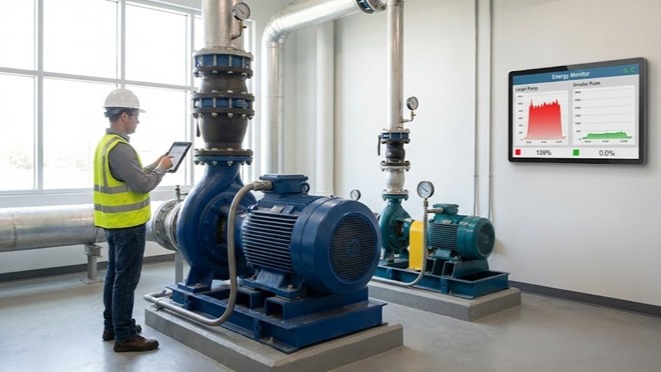
Oversized circulation pumps remain one of the most overlooked sources of energy waste in commercial HVAC and heating systems across the UK. Facilities managers and building operators often assume that installing a larger pump provides a safety margin for system performance, yet this approach typically achieves the opposite - driving up electricity consumption, accelerating component wear, and creating pump oversizing problems that compromise system reliability.
The misconception that "bigger is better" in pump selection stems from outdated design practices and a lack of understanding about how modern heating and cooling systems actually operate. When a pump delivers more flow than a system requires, the excess capacity doesn't simply sit idle - it actively works against system efficiency, generating unnecessary heat, creating pressure imbalances, and forcing control valves to throttle flow in ways that waste energy at multiple points in the distribution network.
National Pumps and Boilers encounters oversized pump installations regularly when conducting system audits for commercial clients. The energy penalties are substantial - facilities typically see electricity consumption 20-40% higher than properly sized alternatives would require, translating to thousands of pounds in unnecessary annual operating costs for medium-sized commercial buildings.
The Physics Behind Oversized Pump Energy Waste
Centrifugal pumps - the type used in virtually all commercial heating and cooling applications - consume power according to the cube law relationship between speed and power. This mathematical principle means that even modest increases in pump speed or impeller size create disproportionately large increases in energy consumption.
Understanding the Cube Law Relationship
When a pump operates beyond system requirements, several energy-wasting mechanisms activate simultaneously. The pump motor draws electrical power to generate flow and pressure that the system cannot productively use. Control valves throughout the distribution network throttle back to reduce the excessive flow, converting the surplus hydraulic energy into heat and turbulence rather than useful work. Variable speed drives, if present, must continuously reduce pump speed to match actual demand, but even with this control strategy, an oversized pump operates at a less efficient point on its performance curve compared to a correctly sized unit.
The Affinity Laws and Power Consumption
The affinity laws that govern pump performance reveal why sizing matters so critically. Flow rate changes linearly with impeller speed, pressure changes with the square of speed, and power consumption changes with the cube of speed. A pump running 20% faster than necessary doesn't just consume 20% more power - it consumes approximately 73% more power due to this cubic relationship.
Commercial heating systems using Grundfos or Wilo pumps benefit from built-in efficiency features, but these advantages disappear when the pump itself is incorrectly sized for the application. Even premium efficiency motors cannot overcome the fundamental energy penalties created by operating a pump outside its optimal performance envelope.
How Oversizing Increases Operating Costs Beyond Electricity
Direct electricity consumption represents only the most visible cost penalty from oversized pumps. The operational and maintenance consequences create additional financial burdens that accumulate over the system's lifespan.
Accelerated Component Wear
Excessive flow velocities erode pipe internals, valve seats, and heat exchanger tubes. The turbulence created by throttled control valves generates cavitation and water hammer effects that damage system components. Bearings and seals in the pump itself experience higher loads and temperatures, reducing service life and increasing maintenance frequency.
Facilities using central heating equipment with oversized circulators typically replace control valves and actuators 40-60% more frequently than systems with properly sized pumps. The cost of these premature replacements, including labour and system downtime, often exceeds the direct energy waste over a five-year period.
System Control Problems
Oversized pumps make precise temperature control nearly impossible. The excessive flow rates reduce the temperature differential between supply and return, limiting the system's ability to modulate heat delivery effectively. Control valves operate in their near-closed position most of the time, where their control characteristics are least linear and most prone to hunting and instability.
Building occupants experience temperature swings and comfort complaints that prompt facilities teams to adjust setpoints and override schedules - interventions that further increase energy consumption. The inability to maintain stable conditions in critical spaces like server rooms or laboratories can compromise operations and damage sensitive equipment.
Noise and Vibration Issues
High flow velocities through partially closed valves create noise that disturbs building occupants and suggests system problems. The characteristic whistling or rushing sounds prompt service calls and investigations that consume maintenance resources without addressing the underlying cause. Vibration from unbalanced hydraulic conditions can loosen pipe supports and create fatigue failures in piping systems.
Identifying Oversized Pumps in Existing Systems
Several diagnostic indicators reveal when a pump exceeds system requirements, even without detailed hydraulic calculations. Understanding these pump oversizing problems helps facilities managers identify inefficient installations quickly.
Control Valve Position Analysis
Control valves throughout the system operate in near-closed positions during normal operation. This throttling behaviour indicates the pump delivers more pressure than the distribution network requires. Differential pressure sensors, if installed, show readings substantially higher than design values.
Variable Speed Drive Operation Patterns
The pump operates continuously at low speeds when equipped with variable speed drives. Whilst variable speed control helps mitigate oversizing penalties, a pump that never operates above 40-50% speed suggests significant overcapacity. The motor runs hot relative to its nameplate rating, and power measurements show consumption disproportionate to the actual heating or cooling load being served.
Temperature Differential Measurements
Temperature differentials between supply and return remain consistently lower than design values. Instead of the typical 10-12°C differential in heating systems or 5-8°C in chilled water systems, oversized pumps often produce differentials of 3-5°C because excessive flow rates don't allow sufficient heat transfer time in terminal units.
System Balancing Challenges
System balancing proves difficult or impossible to maintain. When commissioning engineers attempt to balance the distribution network, they find that even with balancing valves fully open in distant circuits, nearby circuits require excessive throttling to achieve design flows. This pattern indicates the pump delivers far more pressure than the longest circuit requires.
Calculating the True Cost of Oversizing
A practical example demonstrates the financial impact. Consider a commercial office building in Birmingham with a 5.5 kW heating circulator pump oversized by approximately 50% compared to actual system requirements. The building operates heating systems 2,500 hours annually.
Direct Energy Cost Impact
The oversized pump consumes approximately 4.2 kW continuously during operation, whilst a correctly sized 3.0 kW pump would serve the same load. The excess consumption of 1.2 kW over 2,500 hours equals 3,000 kWh annually. At commercial electricity rates of £0.25 per kWh, this represents £750 in unnecessary annual costs for a single pump.
Lifetime Financial Penalties
Medium-sized commercial buildings typically operate 3-6 circulation pumps serving various zones and systems. If three pumps show similar oversizing, the annual waste exceeds £2,250. Over a typical 15-year pump service life, this single specification error costs the building owner more than £33,000 in direct electricity charges, before accounting for maintenance penalties and system performance issues.
Buildings with DHW pumps serving domestic hot water recirculation face additional costs when these units are oversized, as they typically operate continuously year-round rather than seasonally like heating circulators.
The Role of Proper System Design
Accurate pump sizing begins with correct hydraulic calculations during the design phase. Engineers must determine actual system flow requirements based on heat load calculations, not rules of thumb or safety factors applied without technical justification.
Hydraulic Calculations and System Requirements
The pump must overcome the friction losses in the longest circuit - the index run - plus any static head if the system includes elevation changes. Adding arbitrary safety factors of 20-30% "just to be safe" creates the pump oversizing problems that plague system performance. Modern calculation tools and manufacturer selection software from suppliers like Lowara provide accurate sizing when engineers input realistic system parameters.
Variable Speed Drive Considerations
Variable speed drives offer significant benefits but don't eliminate the need for proper initial sizing. A VSD allows a pump to modulate output to match varying loads, but if the pump is grossly oversized, even at minimum speed it may deliver more flow than required. The drive also introduces electrical losses that reduce overall system efficiency, particularly when forcing an oversized pump to operate continuously at very low speeds.
Targeting the Best Efficiency Point
Specifying pumps with flat efficiency curves and wide operating ranges provides flexibility without the penalties of oversizing. Premium efficiency motors and hydraulically optimised impeller designs from manufacturers like DAB maintain high efficiency across a broader performance envelope, but these features work best when the pump's capacity roughly matches system requirements.
Pump selection should target operation near the best efficiency point (BEP) at design conditions. The BEP represents the flow rate where the pump achieves maximum efficiency and minimum mechanical stress. Selecting a pump that operates 10-15% either side of BEP provides reasonable flexibility for system variations without the penalties of significant oversizing.
Control System Integration
Coordination between mechanical designers and controls engineers ensures that the pumping strategy aligns with the control scheme. Systems using differential pressure control, temperature reset, or demand-based pumping require different sizing approaches than constant-volume systems. Early integration of these considerations prevents the disconnects that often lead to oversized selections.
Retrofitting Solutions for Oversized Installations
Facilities managers discovering oversized pumps in existing systems have several remediation options depending on budget and system configuration.
Impeller Trimming
Reducing the impeller diameter provides a cost-effective solution for fixed-speed pumps. Trimming the impeller by 10-15% significantly reduces flow and pressure output whilst maintaining reasonable efficiency. This mechanical modification costs substantially less than complete pump replacement and can be performed during routine maintenance shutdowns.
The affinity laws predict performance after trimming - a 10% diameter reduction yields approximately 10% less flow, 19% less pressure, and 27% less power consumption. For moderately oversized pumps, this intervention alone can eliminate most oversized pump energy waste whilst extending component service life.
Variable Speed Drive Retrofits
Adding a VSD to an existing fixed-speed pump provides excellent energy savings if the pump isn't grossly oversized. The drive allows the pump to reduce speed during part-load conditions, which represent the majority of operating hours in most commercial buildings.
Payback periods for VSD retrofits on circulation pumps typically range from 2-4 years depending on pump size, operating hours, and degree of load variation. The investment makes economic sense for pumps above 3 kW serving systems with significant load diversity.
Complete Pump Replacement
Severely oversized pumps warrant complete replacement with correctly sized modern units. The energy savings and maintenance benefits justify the capital investment, particularly when the existing pump approaches end of service life. Replacement projects provide opportunities to specify premium efficiency motors, integrated controls, and monitoring capabilities that further improve system performance.
National Pumps and Boilers supplies replacement circulators sized specifically for existing system requirements, eliminating the guesswork that often leads to oversizing. Technical support helps facilities teams select units that match actual measured system characteristics rather than relying on potentially inaccurate original design documents.
Preventing Oversizing in New Installations
Design teams can avoid pump oversizing problems by following systematic sizing procedures and resisting the temptation to add unnecessary safety margins.
Accurate Heat Load Calculations
Accurate heat load calculations form the foundation. Using actual building characteristics, occupancy patterns, and local climate data produces realistic heating and cooling requirements. Applying diversity factors appropriate to the building type prevents oversizing the central plant based on the unlikely scenario that all zones demand peak capacity simultaneously.
Detailed Hydraulic Analysis
Hydraulic calculations must account for actual pipe sizes, fittings, valves, and terminal units in the longest circuit. Modern calculation software eliminates the tedious manual calculations that once encouraged engineers to apply large safety factors rather than perform detailed analyses. Pressure drop data from equipment manufacturers ensures accuracy for heat exchangers, coils, and other components.
The Environmental Case Against Oversizing
Beyond financial costs, oversized pumps carry environmental penalties that conflict with UK carbon reduction targets and Building Regulations Part L requirements.
Carbon Emissions Impact
The unnecessary electricity consumption contributes directly to carbon emissions. With the UK grid carbon intensity averaging approximately 0.2 kg CO₂ per kWh, the 3,000 kWh annual waste from a single oversized pump generates 600 kg of avoidable carbon emissions. Multiplied across thousands of commercial buildings, oversized pump installations represent a significant and easily addressable source of emissions.
Embodied Carbon Considerations
The accelerated component replacement cycles create additional embodied carbon impacts. Manufacturing replacement valves, actuators, and pump components requires energy and materials. The transportation, installation labour, and disposal of failed components all carry environmental costs that proper initial sizing would avoid.
Building Performance Standards
Modern building standards increasingly require energy modelling and performance verification. Oversized pumps prevent buildings from achieving their designed energy performance, creating compliance risks and reputational concerns for building owners committed to sustainability goals.
Monitoring and Verification
Implementing monitoring systems helps identify oversizing problems and verify the benefits of corrective actions. Modern building management systems can track pump power consumption, operating speeds, and runtime patterns that reveal inefficiencies.
Power Monitoring Systems
Installing permanent power metres on major pumps costs relatively little during new construction or major renovations. The data collected provides baseline measurements for energy management and helps facilities teams identify degrading performance before failures occur. Comparing actual consumption against manufacturer performance curves quickly reveals whether pumps operate within their intended range.
Pressure and Temperature Sensors
Differential pressure sensors at strategic points in the distribution network show whether the pump delivers appropriate pressure for system requirements. Consistently high differential pressure readings indicate oversizing, whilst measurements that match design calculations confirm proper selection.
Temperature sensors on supply and return lines reveal whether the system achieves design temperature differentials. Monitoring these parameters helps operators understand whether changes in pump operation improve or degrade system performance, supporting data-driven decision-making about equipment modifications.
Conclusion
Oversized pumps represent a persistent source of oversized pump energy waste and operational problems in commercial heating and cooling systems throughout the UK. The combination of excessive electricity consumption, accelerated component wear, and degraded system performance creates costs that far exceed the initial equipment savings that sometimes motivate oversizing decisions.
The physics of pump operation - particularly the cubic relationship between speed and power consumption - means that even modest overcapacity creates disproportionate energy penalties. When combined with the control problems, noise issues, and maintenance burdens that oversized pumps generate, the total cost of ownership increases substantially compared to properly sized alternatives.
Facilities managers operating existing buildings should conduct systematic reviews of pump sizing, looking for the diagnostic indicators that reveal overcapacity. Remediation options ranging from impeller trimming to complete replacement deliver measurable returns on investment through reduced energy consumption and improved system reliability. The monitoring systems that verify these improvements provide ongoing value by revealing performance degradation and supporting predictive maintenance strategies.
Design teams specifying new systems must resist the outdated practice of adding arbitrary safety factors to pump selections. Modern calculation tools and manufacturer selection software eliminate the uncertainty that once justified conservative sizing. Targeting operation near the pump's best efficiency point at design conditions provides the flexibility needed for real-world system variations without the penalties of significant oversizing.
The financial and environmental costs of oversized pump installations make proper sizing one of the most cost-effective opportunities for improving building performance. For guidance on selecting appropriately sized circulation pumps for specific applications, contact us at National Pumps and Boilers for technical support based on actual system requirements and operating conditions.