

Y-Strainers vs. Basket Strainers: Which Type Is Right for Your System?
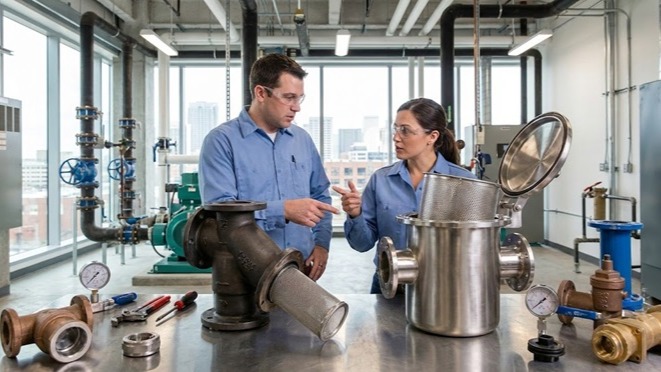
Heating and plumbing systems fail when debris enters circulation pumps, boiler heat exchangers, or control valves. A single piece of scale, weld slag, or rust can jam a pump impeller or score valve seats, causing system downtime that costs far more than the strainer that would have prevented it. The question is not whether to install a strainer but which type protects your specific system most effectively.
National Pumps and Boilers supplies both Y-strainers and basket strainers across commercial heating installations, industrial process systems, and domestic applications. Each design serves distinct purposes, and selecting the wrong type creates maintenance burdens, pressure drops, and premature equipment failure. This inline strainer comparison examines how Y-strainers and basket strainers differ in construction, performance, and application suitability to help heating engineers, contractors, and facilities managers make evidence-based equipment decisions.
How Y-Strainers and Basket Strainers Function
Both strainer types remove solid particles from fluid flow, but their mechanical designs create different operational characteristics. Understanding these fundamental differences determines which configuration suits your system requirements. This Y strainer vs basket analysis begins with operational principles.
Y-Strainer Design and Operation
Y-strainers derive their name from the angled body shape that branches away from the main flow path. The strainer element sits inside this angled pocket at approximately 45 degrees to the pipeline. As fluid enters the strainer body, it passes through a perforated screen or mesh basket that captures particles larger than the specified micron rating. Clean fluid continues downstream whilst debris accumulates in the strainer pocket.
The angled design allows gravity to assist particle settlement when installed correctly. In horizontal pipelines, the strainer pocket points downward, letting heavier particles settle away from the screen surface. This configuration reduces the frequency of screen blinding compared to inline designs where debris packs directly against the filter media.
Y-strainers typically accommodate mesh sizes from 20 mesh (850 microns) down to 100 mesh (150 microns), with perforated screens available for coarser filtration. The compact body design makes Y-strainers suitable for installations with limited space, particularly in pipework runs where vertical clearance restricts access.
Basket Strainer Design and Operation
Basket strainers use a cylindrical body with a removable perforated basket or screen element. The basket sits perpendicular to flow direction, creating a larger filtration area than Y-strainers of equivalent line size. Fluid enters the strainer body, flows through the basket walls from outside to inside, then exits through the outlet connection. Debris collects on the outer basket surface and in the basket cavity.
The larger screen area provides two advantages: greater dirt-holding capacity and lower pressure drop across the strainer. A 100mm basket strainer typically offers 3-4 times the filtration area of a 100mm Y-strainer, meaning it captures more debris before requiring cleaning and creates less resistance to flow.
Basket strainers accommodate finer filtration than Y-strainers, with mesh options down to 200 mesh (74 microns) in standard configurations. The removable basket design simplifies maintenance, particularly in applications requiring frequent cleaning. Most basket strainers include a hinged or bolted cover that provides access to the basket without removing the entire strainer body from the pipeline.
Pressure Drop Characteristics
Pressure drop directly affects pump performance, energy consumption, and system efficiency. The strainer design influences how much pressure the system loses as fluid passes through the filtration element. This inline strainer comparison factor often determines the most suitable choice.
Y-Strainer Pressure Performance
Y-strainers create higher pressure drops than basket strainers due to their smaller filtration area and the directional change fluid makes entering and exiting the strainer pocket. A clean 100mm Y-strainer with 40 mesh screen typically generates 0.3-0.5 bar pressure drop at 50 litres per second flow rate.
As debris accumulates, pressure drop increases significantly. A partially blocked Y-strainer can create 1.5-2.0 bar pressure drop, forcing central heating pumps to work harder and consume more electricity. In systems with marginal pump capacity, this additional resistance reduces flow rates throughout the system, compromising heat distribution and boiler efficiency.
The compact design that makes Y-strainers space-efficient also concentrates debris in a smaller volume, accelerating screen blinding. Systems with high debris loads require frequent Y-strainer maintenance to prevent excessive pressure drop from degrading system performance.
Basket Strainer Pressure Performance
Basket strainers generate lower initial pressure drops, typically 0.1-0.2 bar for a 100mm unit at 50 litres per second. The larger filtration area distributes flow across more screen surface, reducing velocity through each perforation and minimising turbulence.
The greater dirt-holding capacity means basket strainers maintain acceptable pressure drops longer between cleanings. A basket strainer might accumulate 2-3 kilograms of debris before reaching 0.5 bar pressure drop, whilst a Y-strainer of equivalent size reaches that threshold with less than 1 kilogram of accumulated material.
This characteristic makes basket strainers particularly valuable in commercial heating systems where pump energy represents a significant operating cost. The lower pressure drop reduces pump power consumption by 5-15% compared to Y-strainers in equivalent applications, creating measurable savings over the equipment lifespan.
Installation Requirements and Space Considerations
Physical installation constraints often determine which strainer type fits the available space and pipework configuration. The selection decision frequently depends on practical site conditions.
Y-Strainer Installation Parameters
Y-strainers require clearance below the pipeline to accommodate the angled strainer pocket and provide access for removing the screen element. A 100mm Y-strainer typically needs 300-400mm vertical clearance below the pipe centreline for screen removal and cleaning.
The compact inline body makes Y-strainers suitable for tight horizontal spaces where basket strainers will not fit. Installation in vertical pipelines requires specific consideration: the strainer pocket should point downward in vertical downflow applications, but Y-strainers perform poorly in vertical upflow installations where debris cannot settle away from the screen.
Most heating engineers install Y-strainers with the screen pocket pointing downward in horizontal runs, allowing gravity drainage during maintenance. Some applications require a drain valve on the strainer pocket to facilitate debris removal without complete disassembly.
Basket Strainer Installation Parameters
Basket strainers require significantly more space due to their larger body diameter and the clearance needed to remove the cover and basket. A 100mm basket strainer body might measure 450mm in diameter, and removing the basket requires an additional 400-500mm clearance in front of the cover.
This space requirement restricts basket strainer use in congested plant rooms or retrofit applications where pipework runs close to walls or other equipment. However, the horizontal clearance requirement often proves easier to accommodate than the vertical clearance Y-strainers demand, particularly in ceiling-mounted pipework or installations above other equipment.
Basket strainers install in any orientation without performance degradation. The large basket volume captures debris regardless of flow direction, making basket strainers equally effective in horizontal, vertical upflow, and vertical downflow applications.
Maintenance Procedures and Service Access
Maintenance frequency and complexity directly impact system reliability and labour costs over the equipment lifespan.
Y-Strainer Maintenance Process
Cleaning a Y-strainer requires isolating the strainer with upstream and downstream valves, draining the strainer pocket, removing the screen cap, extracting the screen element, cleaning debris from the screen and pocket, then reassembling and returning to service. This process typically takes 20-30 minutes for experienced heating engineers.
The small screen size limits debris capacity, requiring more frequent cleaning in systems with high particulate loads. New heating systems with weld slag, flux residue, and installation debris may require Y-strainer cleaning weekly during commissioning, then monthly during the first year as residual debris circulates through the system.
Some Y-strainers include blow-down valves that allow partial debris removal without complete disassembly. Opening the blow-down valve whilst the system operates flushes accumulated debris from the strainer pocket, though this method removes only loose particles and does not clean material packed against the screen.
Basket Strainer Maintenance Process
Basket strainers simplify maintenance through quick-opening covers that provide full basket access. After isolating and draining the strainer body, removing 4-6 cover bolts or opening a hinged cover allows the basket to be lifted out, cleaned, and reinstalled. The entire procedure takes 10-15 minutes.
The larger basket volume extends service intervals significantly. Systems requiring weekly Y-strainer cleaning might operate 6-8 weeks between basket strainer services. This reduced maintenance frequency lowers labour costs and minimises system disruptions, particularly valuable in commercial buildings where heating system shutdowns affect occupant comfort.
Many basket strainers include differential pressure gauges that monitor pressure drop across the strainer, providing objective indication of when cleaning is required rather than relying on fixed time intervals. This condition-based maintenance approach optimises service scheduling and prevents unnecessary maintenance whilst catching problems before excessive pressure drop affects system performance.
Application Suitability and Selection Criteria
Specific system characteristics determine which strainer type delivers optimal performance and lifecycle value.
When Y-Strainers Provide the Better Solution
Y-strainers suit applications where space constraints prevent basket strainer installation, particularly in compact plant rooms or retrofit installations with limited clearance. The inline body configuration fits tight horizontal spaces that cannot accommodate larger basket strainer bodies.
Smaller domestic heating systems with DHW pumps and residential boilers typically use Y-strainers because the lower debris loads do not justify the additional cost and space requirements of basket strainers. A 22mm or 28mm Y-strainer adequately protects domestic circulation pumps and provides sufficient filtration for systems with properly flushed pipework.
High-pressure applications above 25 bar often favour Y-strainers because the compact body design withstands pressure more effectively than the larger, more complex basket strainer bodies. Steam systems, high-pressure hot water systems, and industrial process applications frequently specify Y-strainers for this reason.
The lower initial cost makes Y-strainers economically appropriate for applications where the maintenance burden does not outweigh the capital savings. When installation labour, maintenance access, and energy costs are minimal considerations, Y-strainers deliver adequate protection at lower equipment cost. This comparison factor matters significantly for budget-conscious projects.
When Basket Strainers Provide the Better Solution
Commercial heating systems benefit from basket strainers due to the lower pressure drop, extended maintenance intervals, and easier servicing. A commercial building with multiple Grundfos pumps serving various heating zones achieves measurable energy savings from the reduced pressure drop basket strainers create.
Systems with high debris loads, including new installations during commissioning, systems with aging pipework generating rust and scale, or applications with poor water quality, require the greater dirt-holding capacity basket strainers provide. The larger basket volume prevents frequent maintenance interruptions whilst protecting downstream equipment more effectively.
Applications requiring fine filtration below 150 microns typically specify basket strainers because the larger screen area maintains acceptable pressure drops with finer mesh sizes. Protecting sensitive equipment like plate heat exchangers, electronic control valves, or variable-speed pump controllers often demands 100-mesh or finer filtration that only basket strainers can provide without excessive pressure drop.
Installations where maintenance access is difficult or where system downtime is particularly costly justify basket strainers despite higher initial cost. The extended service intervals and simplified maintenance procedures reduce total cost of ownership in these applications, even though capital equipment cost is higher.
Material Selection and Compatibility
Both strainer types are available in materials suitable for various system fluids and operating conditions.
Cast iron bodies with bronze screens suit standard heating applications with glycol mixtures or treated water below 110°C. These materials provide adequate corrosion resistance at moderate cost for typical commercial heating systems.
Stainless steel construction, both body and screen, is specified for systems with aggressive water chemistry, higher temperatures above 120°C, or where corrosion products must be minimised. Wilo pumps and other premium equipment often require stainless steel strainers to prevent iron oxide contamination that could damage ceramic bearings or close-tolerance components.
Carbon steel bodies with stainless steel screens offer a cost-effective compromise for many applications, providing the strength and pressure rating of carbon steel with the corrosion resistance of stainless steel where it matters most, in contact with the fluid stream.
Integration With System Protection Equipment
Strainers form part of a comprehensive system protection strategy that includes expansion vessels, air separators, and chemical treatment. The strainer type must integrate effectively with other protective equipment to ensure complete system protection. Understanding the design characteristics helps optimise this integration.
Magnetic filters complement both Y-strainers and basket strainers by capturing ferrous particles too fine for mechanical filtration. Installing a magnetic filter downstream of the primary strainer creates two-stage protection that extends pump life and maintains heat exchanger efficiency.
Differential pressure switches connected to basket strainers provide automated monitoring that alerts maintenance staff when pressure drop reaches predetermined thresholds. This automated approach prevents the excessive pressure drops that degrade pump performance and increase energy consumption.
Conclusion
Y-strainers and basket strainers both protect heating and plumbing systems from debris damage, but their design differences create distinct performance characteristics that suit different applications. Y-strainers offer compact installation, lower initial cost, and adequate protection for smaller systems with moderate debris loads and accessible maintenance. Basket strainers provide lower pressure drop, greater dirt-holding capacity, easier maintenance, and better long-term value for commercial systems where energy efficiency and extended service intervals justify higher capital cost.
System size, debris load expectations, available installation space, maintenance access, and energy costs all influence the selection decision. Domestic heating systems and space-constrained installations typically favour Y-strainers, whilst commercial buildings and high-debris applications benefit from basket strainers despite their higher initial cost and larger footprint.
Selecting the appropriate strainer type prevents pump failures, maintains system efficiency, and reduces maintenance costs over the equipment lifespan. Heating engineers and contractors should evaluate specific system requirements against each strainer type's characteristics to make informed equipment decisions that protect system integrity whilst optimising lifecycle costs.
For technical guidance on strainer selection for specific heating system applications, contact the team for expert advice tailored to your project requirements.